Recently, after the function update of the circle of friends, all people have turned on the Doutu mode. Even the elders who don't send out the circle of friends once in hundreds of years have turned on the happy picture exchange mode for the elderly, and even the excessive partners have turned on the screen swiping mode to share their love packs with everyone. So, how to use expression packs to cross the art collection? Let's talk together today.
When we talk about facial expression package, we have to mention the predecessor of facial expression package - Yan Wen. Before the official appearance of expression packs, this graphic element, which is composed of different languages and symbols, uses the most basic combination to dynamically express people's emotions, thus dominating our social media for a very long time.
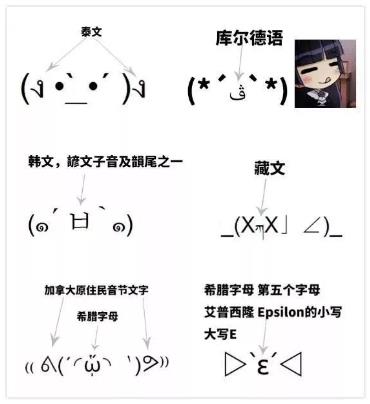
Yan characters become a collection of characters that break through national boundaries
This kind of facial expression actually first appeared in 1982, carnegie mellon university Professor Scott E Fahlman used the symbol "-" for the first time to express his happy mood in an activity of the computer society, but such a "happy unintentional act" also opened the pursuit of facial expression packs.
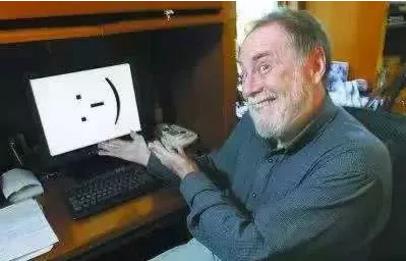
Be happy
In fact, behind these graphic elements, it is not difficult to find that the more simple expressions or element symbols, it seems that they often contain deeper meanings. These "unintentional acts" expression packs actually convey information by images through funny or emotional resonance. Then, is there a universal aesthetic significance behind these "information symbols"? Today, we will take a look at the design tips implied by these simple symbols from the perspective of design. How does Emoticon Pack cross the art collection?
How to use facial expression package to cross boundary art collection?
1. The birth of expression packs
It is undeniable that the emoticon has become an important part of modern people's social way, and it even transcends the boundaries of language. Like any graphics and words, it acts as a carrier to carry the information sent by both sides of the communication.
The first batch of universally used emoticons were designed and created by Japanese designer Ranchong Kurita in 1988. At first, he worked in a communication company. When designing smart phone programs, he saw that many guide languages and system notifications were too cumbersome, so he developed a set of language symbols to make simple information more humanized.
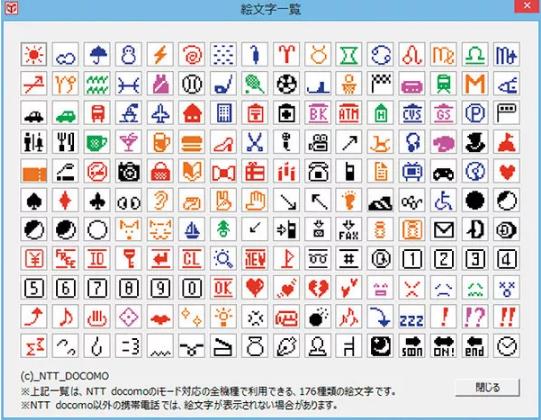
The success of standardized emoticons also made emoticons go out of Japan, with the birth of the phrase Emoji (Icon+Emotional), which became the universal symbol language in the world. However, because of cultural diversity and different user experiences, Emoji also encountered some "acclimatization" at the beginning of the communication.
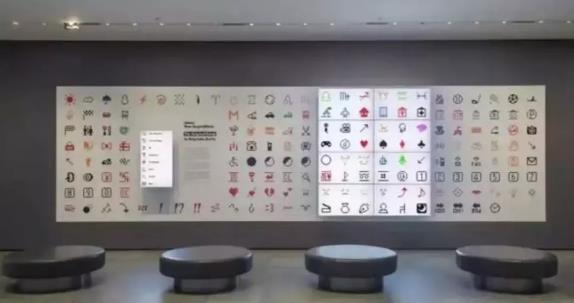
MoMA Museum collected the first set of 176 emoticons
According to the designer Ranchong Li Tian, the symbol of "poop" was added with anthropomorphic elements in the original design, which led to people mistakenly thinking that the symbol represented an Asian mascot when it was first introduced into European and American countries
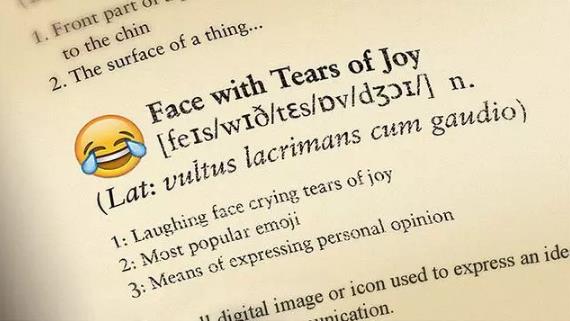
Later, with the rapid popularity of emoticons in the world, in 2015, Oxford Dictionary also named a tearful emoticon as the annual vocabulary of that year, which also made more people begin to take the meaning of emoticons seriously.
2. Development of emoticons
Nowadays, with the development of different cultural backgrounds and design means, people's diversified demands for emoticons are also increasing, and different forms have been developed, including graphic images, text combinations, sound signals, dynamic animation, and so on.
The selection range of emoticon elements is also expanding. According to statistics, the total number of Emoji in general use in the world has exceeded 2800. This year's new batch includes new professions, goods, behaviors, actions, skin colors and other categories, which are also more refined.
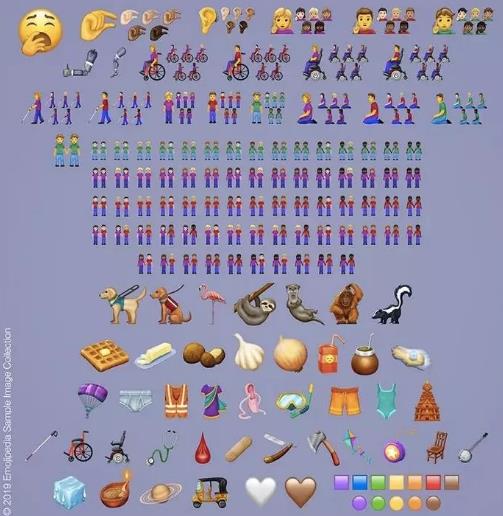
The latest addition of Emoji in 2019
All this is run by a mysterious organization, the Unicode Alliance. Unicode is a non-profit organization composed of the staff of Apple, Microsoft, Google and other technology giants. In the past, it was mainly for the purpose of unifying the coding language. Now they are also responsible for unifying "emoticons". However, the view of Unicode is that they do not produce or define Emoji. This work is popular.
This just shows the development of emoticons. Popularization and readability are the basis of communication. As an important visual language form in contemporary social media, emoticons are not only interesting, but also convey users' intentions, mentality and psychological feelings by virtue of their emotional attributes.
This nonverbal way of emotional communication not only facilitates people's effective communication, but also makes people feel the subtle emotions and different moods conveyed by the other party outside the text, further eliminating the boredom of text communication and the weakness of inaccurate attitude expression.
3. Transboundary of emoticons
With its refined connotation and simple and intuitive appearance design, emoticons have not only become a communication tool for contemporary people, but also many designers have creatively used appropriate visual language forms to cross the border in many art and business fields. Let's take a look at how emoticons cross art collections.
Animation Design
Animation designers have natural advantages in the field of expression packs with their exquisite painters, smooth special effects production and interesting character design, which also makes many animation designers' expression packs created by "doing nothing" widely praised by the market.
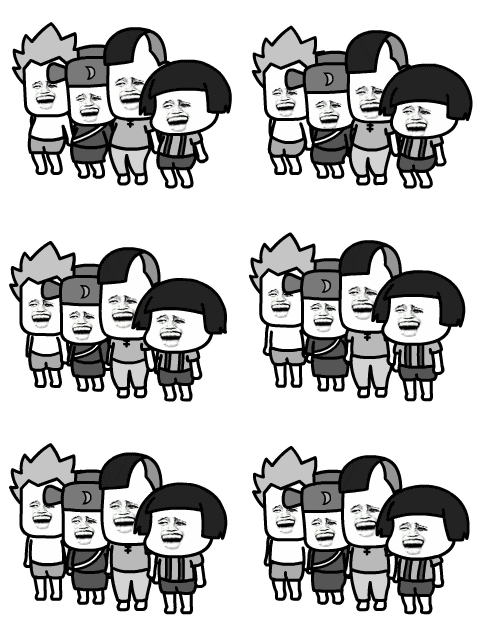
I believe that everyone should have seen or used this group of mushroom head facial expression packs. Its creative team, the main creator of Mosquito Animation, was also the creator of the domestic animation masterpiece "Joy". Behind Tie Hanhan's facial expression packs is actually the masterpiece of the animation god
In addition, Sony, a giant in the animation industry, also created an animated film "Adventures of Fantasy and Expression" with emoticons as the main characters in the last two years. The director of this animation also won the Annie Award for the best production.
The plot of this movie is similar to "Brain Secret Service", which tells an adventure of a group of emoticons wrapped in mobile phones. The emoticons live in the "Emoji Valley", and their world is connected with the world of other apps through the mobile desktop.
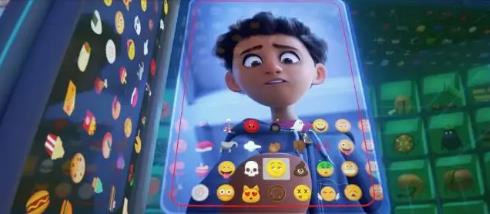
Interaction design
Interaction design usually has a target audience, but if the audience is relatively broad and there is no unified language and background culture, as the emoticon of the global common visual language, it can replace the text to play a visual guidance and convey information in the design works.
This APP is a travel tool developed by KLM (Royal Dutch Airlines) for passengers from all over the country, integrating food, drink, accommodation, transportation, navigation, comments and inquiry services (similar to our public comments).
But in this app, in order to make users of different languages and ages from all over the world more clear and understandable, designers use emoticons instead of original text descriptions to solve customer needs in an interesting and simple way.

Graphic Artist Designer
Emoticon itself is a highly concise and artistic visual design work, and it has also become the source of inspiration for many graphic designers. The poster below is designed by Melanie Duran.
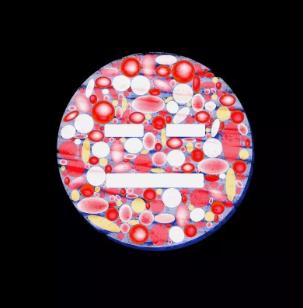
He often uses this "expressionless" expression to express his anger, so he wants to create a work to redefine its meaning. Behind this work, what he wants to show is that behind a expressionless emoticon, there is still a lot of thinking and complex emotional feelings
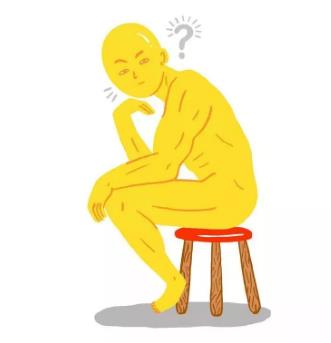
The other work is the graphic design created by the designer based on the thinking Emoji and the thinker sculpture. He combines the external images of two different design methods to create a different humor atmosphere.

Illustration works based on satellite antenna Emoji
Today, we introduced how facial expression packs can be used in cross boundary art collections. The meaning of facial expression packs is not just entertainment. With the development of social media and the proliferation of users, facial expression packs have become an important form of cultural expression. The creation of expression packs has developed from the initial simple symbol splicing, the emergence of Emoji to various customized motion pictures. Up to now, with the expression symbols in the simplest external form, they can accurately convey the characteristics of things, ensuring that the content conveyed is easy to spread at the same time; With the development of current events, it can also extend new meaning of use among different users, help the audience quickly perceive the current mood and understand the characteristics of references. These expression packs are rich in design aesthetics - readability, universality, culture, empathy and other characteristics, which are worthy of our exploration and exploration. Whether the facial expression pack is regarded as a social phenomenon or an art form, I hope today's sharing can bring some inspiration to students' creation~
More recommendations:
What are the application requirements of Sheldon College
How about the sculpture major of Rhode Island School of Design
This article belongs to the original article of Natural Light International Art Education Team. Without permission, it cannot be reproduced commercially in any form. If it is found, it must be investigated for legal responsibility.