From the perspective of art development, "academic school" is a very important keyword, which represents a profession and conforms to the traditional standards under official education and training. However, up to now, when the "academic school" is linked with the "collection of works", this style has become a derogatory term. Many students know that overseas colleges and universities pay attention to design thinking and creative diffusion, and natural light often introduces to everyone that our class mode needs to focus on brainstorming, design thinking, etc. Breaking the convention is the label of art training of works collection. So, is the collection of works "academic" really bad?
This sounds contrary to the traditional "academic style", but is it really true? Is the "academic style" really useless in the art training creation of works collection? In order to dispel students' confusion and prejudice, first of all, let's answer what is the academic school?
What is the Collegiate School of Works?
In a broad sense, "Academism" generally refers to painting with a conservative nature through strict college training, teacher and student transmission, and layer upon layer adaptation. Even those works that are lack of creativity, routine, and too realistic will be called "Academism". But to be precise, "Academism" is both a traditional way of education and an artistic style advocating humanism. The word "ACADEMIA" (college) first appeared in 1582 and was proposed by Plato, an ancient Greek philosopher. It represents a new spirit of humanism and reflects people's emphasis on classical literature, philosophy and academia at that time.
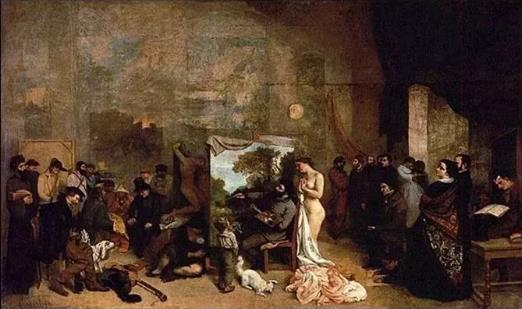
Cooper's Studio
This way of thinking was later followed by the painter Anibale Karachi, who developed a complete set of art education models, which were first applied to Bologna Academy of Fine Arts. From the art works left at that time, it can be seen that the teaching system of the Academy of Fine Arts has been formed.
During this period, the most important basic courses of painting and sculpture originated from anatomy, which attached importance to rigorous structure and realistic form. This kind of education mode prevailed in various art academies in the 18th and 19th centuries. At that time, painters who could be recognized by the society all came from this set of education mode, and gradually became the most popular art style in the early Renaissance.
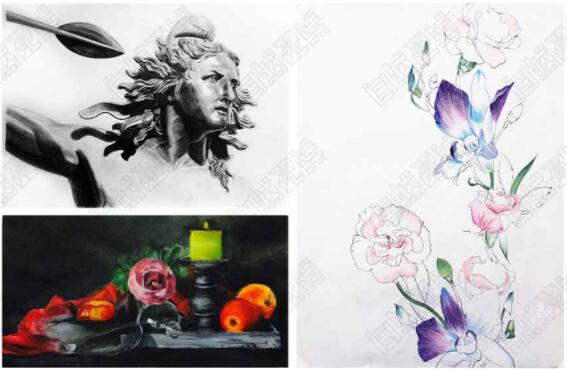
Student works collection of natural light - observational paintings
Later, impressionism, modernism and other styles gradually began to break the monopoly of "academic school" art, and the art style also officially moved towards the situation of diversity and individuality. However, it cannot be ignored that the "academic" style is a sign of the maturity of art education.
To sum up, the academic style is conceptually not equivalent to the so-called "art school style", "joint examination style", craftsmanship and other abnormal products under exam oriented education, but more a creative style that stresses rationality and commonality and attaches importance to basic skill training; Secondly, instead of rejecting the emotional role of art, academic style attaches great importance to humanism and artistic language that can be conveyed.
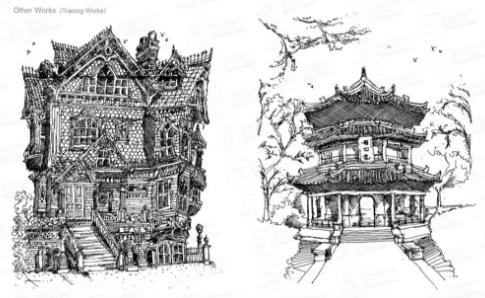
Student works collection of natural light - observational paintings
When we have a comprehensive and objective understanding of the meaning of academic style, we can go back and compare it with Collection creation We will find that many of the influences of these characteristics on students are worth learning from.
What can we learn from the academic style in the art training creation of works collection?
1. The times did not invent new creative language, but just diverged different language expressions:
Many expressions of art in the past are different from our understanding today. Some characteristics of art itself are changing, but the essence remains unchanged. Art education still retains some of the most basic skills and teaching, and the purpose of art is still to create beautiful things.
From the track of art development since the Renaissance, it is the systematic teaching of college education that has cultivated many excellent artists. These artists express the concept of the times with their skills learned, so they have left behind a batch of works with different styles that can be called classic works of the times.
For art learners at each stage, the most basic skill learning, whether from the hand painting training process of sketch, plaster image, body copy, or the design methodology of three-dimensional composition, color composition, perspective, etc., our training process has not invented a completely new language.
These are the foundation of art and the only way to learn under the proof of history, and are the key to unlimited creativity. For most people, only by meeting the basic requirements of the "academic school" can they better show creativity.
2. Art education lies in imparting skills, while art concepts need personal exploration;
Secondly, students should face up to the value of art teaching. Whether teachers or colleges, what they teach students is only "skills", which is a skill and ability to present personal views in a visual way, and is also the basis for artists to observe and solve problems.
But the most fundamental artistic concept guiding our artistic creation needs us to form gradually in the process of practice and life training. This is just like the students taught by the same teacher in the same class. Some can become creators with full personality, and some can only follow the steps and stop copying.
This is very obvious in our art education industry. Every year, "studio students" and "art school students" who have many years of painting experience in the natural light, but because of the differences in art education between China and the West, their "academic style" creation will still have some constraints and effects when facing the art training creation of the works collection.
The root cause of these problems is not their deep-rooted creative techniques, but whether they have free creative ideas. Once they correctly recognize the advantages of using divergent perspectives to analyze and solve problems, they can really grasp the advantages of painting skills.
3. "Academic style" is the basic requirement, but artistic creation must not stop here:
Picasso and Matisse, the greatest artists in the 20th century, are famous for their distinctive, bold and personalized works. However, when we look back on their artistic life, none of them has not gone through rigorous academic education. In their early works, there are also a large number of realistic works that can reflect the solid foundation.
Picasso once said, "I could paint as well as Rafael very early, but I spent my life learning to paint like a child." Realism and abstraction are not different in art creation, but in the era of valuing personalized expression, "academic" skills and styles can only be the basis for us, We should constantly explore our own style on this basis.
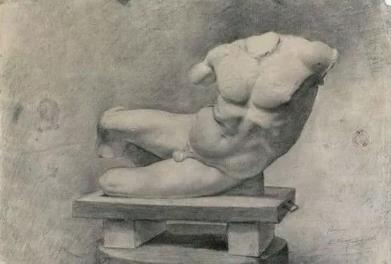
A sketch plaster work painted by Picasso when he was 13 years old
The overseas art teaching mode and discipline construction are by no means static. In recent years, we have also seen many domestic and foreign colleges and universities focus on the future, explore new fields, and think about how to solve human development and difficulties. But at the same time, their purpose for reviewing applicants has never changed, and they attach importance to students' professional ability and foresight in the industry. The two complement and promote each other in the students' learning process.
It is tempting to express freely and create individuality in the art training and creation of works, but without a solid professional foundation and correct design thinking, it is difficult to make deep and moving works of art. Systematic study of a major is the only way to enter a major. The value of "academic style" lies in that we should correctly understand that it is not just to instill skills, but to cultivate students' ability to convey ideas with visual language. When students learn to analyze and solve problems in a correct way, they can truly grasp the essence of artistic creation. Secondly, for art educators who adhere to the original intention of natural light, the "academic style" must not be an excuse for routine teaching, on the contrary, it should be the emphasis on basic aesthetics, the affirmation of strict training, and the persistence of personalized teaching!
More recommendations:
How about Manchester City University? What are the entry requirements?
RCA Royal Academy of Arts glasses design, a new major for the fashion industry
This article belongs to the original article of Natural Light International Art Education Team. Without permission, it cannot be reproduced commercially in any form. If it is found, it must be investigated for legal responsibility.