If you often read fashion magazines or pay attention to art and design, you will find that the word Capsule appears frequently, making you think you have entered the medical channel by mistake. But in fact, this "capsule" is not that "capsule", but the capsules that cross into the art/design/fashion circle.
The capsule series of the design circle, the capsule hotel with Japanese Ikebuki, is designed by the architects Makoto Tanijiri and Supply Design Firm, Book and Bed Tokyo, so that you who love books can live in the bookshelf.
The capsule sleeping cabin on the Holy Valley of Cusco, Peru, is close to the steep stone surface of the cliff, providing shelter for the brave and fearless.

Each cabin is made of aviation aluminum and polycarbonate that can resist the bad weather, so that you don't have to worry about safety while going deep into the beauty of nature.

Andy Warhol, who has a "storage addiction", put all his manuscripts, letters from home, receipts, self recommended model photos, classic commodity packaging boxes, and even cut nails into paper boxes after his death. 612 "Time Capsule" cartons of completed works were saved in the Andy Warhol Museum in Pittsburgh. Today, there is still a secretary who collates and catalogues them for further research.
In addition to Andy Warhol's time capsule, there are many time capsules buried underground by celebrities. such as University of Pennsylvania Buried in 1940 and planned to open in 2040, the time capsule contains a speech delivered by President Franklin Roosevelt at the University of Pennsylvania and some undisclosed mysterious objects!
There is also a time capsule buried in Freedom Square in Washington, D.C. in 1988 and planned to be opened in 2088. The capsule contains some personal belongings of Martin Luther King and tapes from the 1980s.
The word capsule also appears frequently in the fashion circle
Fashion circle capsule series
Capsule series Capsule origin
The origin of the word "Capsule" can be traced back to the 1970s. There was a British grocery store. Susie Fox, the owner of the grocery store, first used the word "Capsule Wardrobe". The name of the grocery store was "Wardrobe", which is the origin of "capsule series".
The reason why it is named "Capsule Wardrobe" is that this series of clothes are all based on classic styles, and today's language refers to those that are actually worn and not affected by seasonal trends
Classic, condensed, de popularized, small amount
Like capsules, concentrated essence

Capsule series Capsule rise
The term "capsule series" has been carried forward since the 1980s. Many fashion magazines have begun to quote this term and defined it as a classic product series launched by brands and composed of a number of individual products!
In 1985, Donna Karan, an American designer, launched it again and became popular
Donna Karan's "Simple 7 Pieces" includes seven interchangeable fashionable pieces for the workplace, including a tights, a skirt, a blouse, a coat, a jacket, a pair of pants and an evening dress. Since then, many brands have followed suit and launched capsule series.

Cross border cooperation of capsule series
The capsule series in the fashion news you see now may be a little different from the above-mentioned capsule series. The original capsule series is still loyal to the "classic". Now the capsule series are quite different.
You should also often see the co branding of various artists, designers and brands, and the capsule series become synonymous with cross-border cooperation. This place should be crazy Aite Uniqlo
The natural light here is a summary
The principle of "four wants and four don'ts"
Facing attractive brand co branding
*The designer's family name should not be Jin Zhu's father's
*It should be more routine than red carpet
*If you can buy them, don't rob them out of stock
*It should be priced appropriately, not overpriced
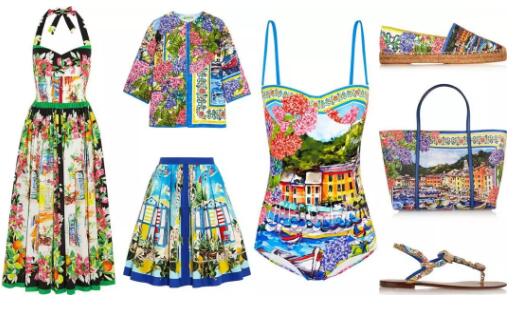
DOLCE&GABBANA
We have cooperated with e-commerce Net-A-Porter to launch a capsule series containing eight pieces
The supermodel Cara Delevingne and DKNY brand also jointly launched the capsule series design of street elements.
For example, the so-called capsule series jointly launched by supermodels and brands was earlier, and Kate Moss cooperated with TOPSHOP for more than one season.
The capsule series now looks like a big hat for a variety of co branded cooperative products, while the original meaning of "classic" and "concentrated" has become very faint.
Because now these cooperative products do not pay attention to "de trend" as before. On the contrary, co branding cooperation is more purposeful to highlight a certain style of designers, supermodels or cooperative stars.
Then why are capsule series more and more popular? What benefits can we get from capsule series? Maybe we can buy a big brand design at a low price, such as Alexander Wang at the price of H&M!
Alexander Wang x H&M Capsule Series
Designer co branded design series of H&M
It caused a long line of stores and brought fame and fortune to the brand and designers.
Consumers who spent the whole night camping at the door of H&M stores the night before the launch also became a vested interest in the capsule series.
The fashion industry believes that the cooperation between the brand and independent designers or artists can not only improve the style of the brand but also enable independent designers to enter the mass market!

These series are small in production scale and can sell well without strong publicity!
A survey shows that the brand series with personal labels are on average 10% - 15% more profitable than the full line series officially released by the brand!
Since Lafayette revitalized Chanel, fast fashion brands H&M, Diesel and Macy's are waiting to cooperate with Lafayette on "capsule series", which are brands and stores without "star designers". They need to follow the trend to earn some quick money.
Now the crossover between brands can also be called "capsule series"
For them, pushing a few pieces of cooperation products is like getting together in a fight between brothers, swallowing several "capsules" and going back to the past!
We consumers should keep in mind the principle of "four wants and four don'ts"
Rational consumption
No! As long as You are happy!
And as a designer, you
Maybe we can find some ways
Get more "secrets"
More about studying abroad in fashion design
Is fashion management, luxury management and art management indistinguishable? Comprehensively analyze for you
This article belongs to the original article of Natural Light International Art Education Team. Without permission, it cannot be reproduced commercially in any form. If it is found, it must be investigated for legal responsibility.