At the beginning, the word "craftsmanship" was mainly used to describe the art forms of painting, sculpture, seal cutting and so on in the Chinese ancient calligraphy and painting industry. In its original meaning, it is a slightly derogatory word. Craftsmanship is different from ingenuity. ingenuity refers to the exquisite emotion that the creator gives to the work. It is often used to describe the pure creative emotion of the author, who strives for perfection in his work; What is lacking in craftsmanship is actually the "heart" of the creator, which highlights the homogenization of ability and techniques, lacking novelty and originality. What should we do when art works are full of craftsmanship?
As we all know, overseas art schools emphasize students' personal awareness and unique creative style, and natural light often talks about the importance of Personal Voice. For the collection of overseas works of art, "craftsmanship" and Personal Voice are absolutely opposite. Corresponding to the collection of overseas works of art, it is actually the author's ideas, creativity, and awareness of deep excavation and expression.
We can simply understand the craftsmanship of art works as the following three meanings:
1. The sense of skill is too strong, and the work lacks "content" and "style";
2. Serious homogenization, obvious "imitation" and stacking traces;
3. The "decoration" in the works is too complicated, without priority and contrast.
Any of these three points is a deduction of absolute disadvantage for the collection of works. To avoid the collection of works being too "crafty", we should first know what causes the craftiness, and then solve it in turn.
What should we do when art works are full of craftsmanship?
The sense of skill is too strong, and the work lacks "content" and "style"; Serious homogenization, obvious "imitation" and stacking traces; The reason why these two works of art are full of craftsmanship:
I put the first two points together because they are caused by the same reason.
Thanks to the strict "art examination" system, most domestic students have solid basic skills in painting. Although they are all applied schools, compared with overseas art schools, the focus of the art examination is on the investigation of "painter" skills, and there is a relatively clear set of criteria and methods for evaluation.
First of all, domestic studios and art academies have distinct style labels. For example, "Yangmei Design Sprint Class" and "Guangmei Sprint Class" are specifically targeted at specific institutions. Yangmei pays attention to clear blocks and bright colors; Guangmei emphasizes lively colors and does not stick to the restrictions of "shape". Such a deep impression is the most direct expression. For another example, every studio has a very clear style label, "You can see that you are from xxx studio at a glance". Art examinees should also be familiar with this sentence.
The unified standard learning environment, coupled with a large number of people taking art examinations, and the fierce competitive atmosphere have created an extremely strong painting skills for domestic students, but the overly homogeneous standard requirements have also made students lose the awareness and opportunity of independent creation. The purpose of students' learning at the beginning is to "cater" to art colleges, so they will lack their own style and ideas, resulting in shortcomings in the direction of creativity and thinking.
For this kind of students, we should focus on the cultivation of ideas and personal style:
1. Brainstorm and design thinking based on the advantages of basic painting
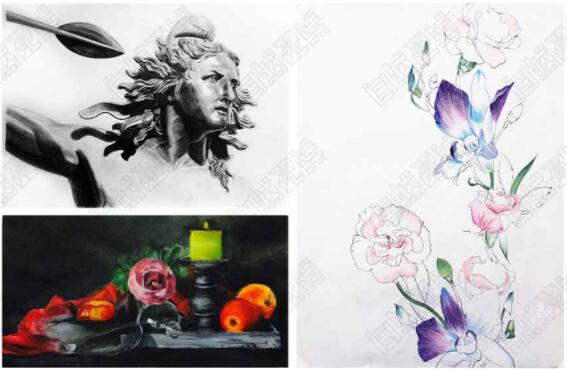
First of all, we should make it clear that craftsmanship does not mean nothing. From the perspective of painting, craftsmanship is a very solid expression of basic ability. But just as basic ability is only "foundation", painting is also only a basic way of artistic expression, just like sculpture and poetry, they can not be equated with art or design.
These "techniques" and approaches are only the media to help us express our ideas, and are the channels to realize our ideas. Therefore, there are techniques for painting expression, but there is almost no shortcut for art itself.
Students studying visual design may have done such an exercise, associating a fixed element (words, numbers, or specific things) with 10-20 at a time, and expressing these ideas separately in the form of painting, which is actually a way of thinking training.
Art itself is a unique language. When we combine the expression of works of art with different contexts, it is like "polysemy" in Chinese. The same word will express different meanings.
And painting is the most basic and easy to master art "vocabulary". Creative diffusion based on the most basic art language can help students quickly capture and express their creative intentions in a short time. Former MICA of Natural Light Overseas Alliance Maryland College of the Arts Travor, the admissions officer, once said: Compared with demonstrating the basic ability of painting, we would like to see students create different possibilities with a pen.
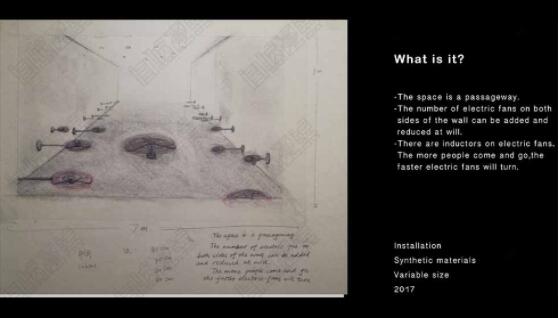
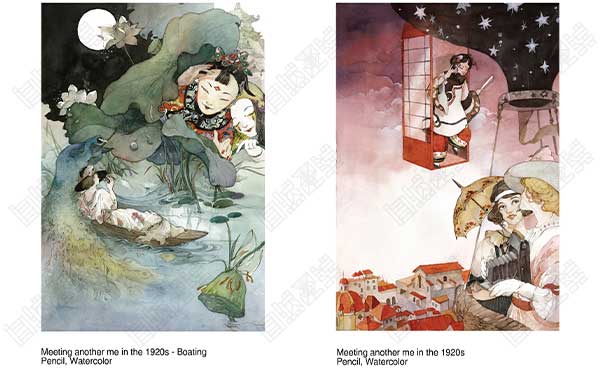
In the following case, Meiqi went to the High School Affiliated to the Academy of Fine Arts in China. The learning environment of the High School Affiliated to the Academy of Fine Arts is quite traditional. The teacher will require students to draw according to the unified standards. The teacher will decide what is right and wrong with each stroke. But in natural light, the teacher did not ask her to follow the unified standard, but gave her more advice and guidance on ideas and concepts. The teacher led her to explore the style for many times, and to create a contrast between Chinese and Western painting methods. Meiqi also extended and deepened her thinking in this process.
One project in the work collection combines the concept of traditional painting "line drawing" to create a 6-meter long scroll. Although it is the concept of line drawing, Meiqi also combines the needle pen stippling method to "dot" the picture with 0.02 needle pen.
2. Combine your own real feelings and ideas, and deeply explore the integration of emotion and works
Many students, in the long-term homogeneous learning environment, will ignore their own emotions and understanding. They have no idea or interpretation of the theme. More students are afraid that too much emotional exposure will appear too casual or alternative.
But in fact, "your idea" is exactly what overseas art schools want to see. In our past interviews with overseas alliances, the admissions officers of all schools have stressed that: schools are eager to know you through the collection of works; Know who you are and what kind of artist/designer you are; How are you different from others?
Each of us is unique, not only because of our external appearance and appearance, but also because we are individuals with independent thinking and independent expression. If even the idea of the works should be "borrowed" and "imitated" by others, what should we talk about to deepen the theme?
We should know that different growth environments, family situations, learning and life experiences will create different us and different values and life judgments from anyone. Even in the face of the same thing, different people may have roughly the same judgment, but everyone has their own understanding of the specific reasons or ideas. This is actually our most advantaged natural advantage.
All personal styles are mainly based on their own understanding of events and themes. Only by facing themselves truthfully, facing their own thoughts and feelings, and gradually investigating, deepening, exploring, and trying, can we have goals and directions.
Strong personal style cannot be cultivated through copying existing works, and simple accumulation of techniques will not impress the admissions officer, but will make your works tend to be mediocre, which will make the admissions officer lose interest in understanding you. After all, the evaluation standard of overseas art schools is not that who "painstakingly" does more.
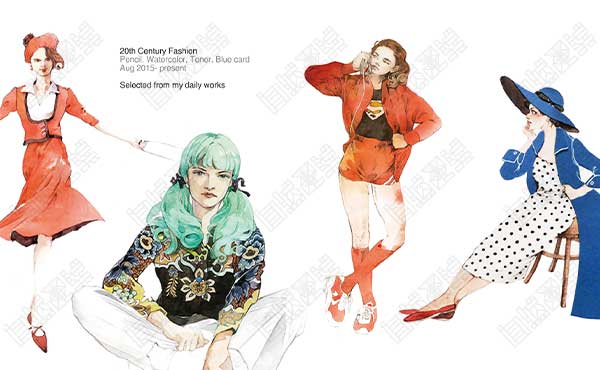
Meiqi is also the same. Because every time she painted in high school, the teacher gave her a set theme and the criteria for judging right and wrong, so she showed a high degree of self-confidence at the beginning of class in natural light. She always asked the teacher for advice, hoping that the teacher could help her to judge and make decisions.
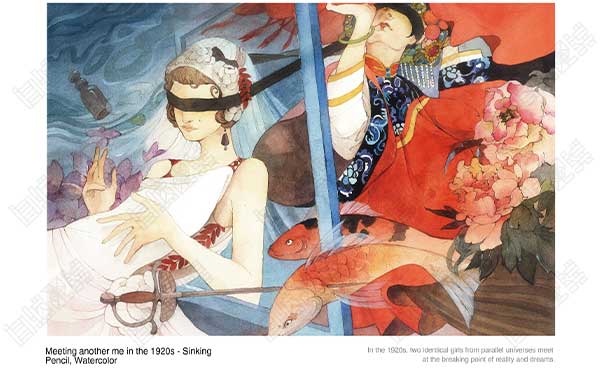
In order to help her regain confidence and establish her own style, the teacher kept communicating with her. First, she listed the things she was interested in, and then discussed and screened them in order to determine the next few major creations. It is also the previous 6m long scroll case. Meiqi hopes to express the theme of "dreams". In her opinion, dreams are abstract, so she also hopes to express dreams in an abstract way. This is why she chose the needle tube point drawing method that seems to be line drawing, but is not line drawing in reality.
3. Clarify your creative intention and theme logic
I often meet students who run off the track while doing something, and forget their own theme in the middle; Or deliberately create creativity in order to highlight creativity, no matter which of the two will only lead to "off topic" in the end.
Creativity is not "thinking leap", and unique style does not mean "abandoning logic". On the contrary, unique style and creativity need strong logic as support. Powerful logic as a guide will not hinder your ideas and limit your expression, but will more effectively and clearly help you sort out the creative direction, avoid possible errors in advance, make the best choice, and let you avoid detours.
4. In the theme of homogenization, look at the problem from another angle and try to express it in an interdisciplinary and cross media way
Many students "lose all their hair" at the stage of theme selection, partly because they have few (almost no) opportunities to choose specific directions by themselves. Most of the time, teachers give clear themes and general creative directions, and students just need to implement them, This will make it difficult for students to grasp the feasibility and selectivity of the theme in a short time.
This is the case with Meiqi, which has been mentioned before. At the beginning, it needs to be confirmed repeatedly to the teacher and dare not make a judgment on its own. Such cases are not rare.
In this process, many students, in order to express their creativity, will deliberately avoid those hot topics, such as environmental protection, ecological health, life and death discussions, and abstract topics such as "time" and "dreams".
This is indeed an effective "flattering" method, but it does not mean that the above topics are not worth digging into or discussing again. Every theme is worth trying, no matter whether someone has set foot in it before. From your own creative point of view, change the direction that others have not tried, think and express, give it a strong subjective consciousness and ideas, so that even the same theme will become different because of your influence, and become a bonus item in the collection.
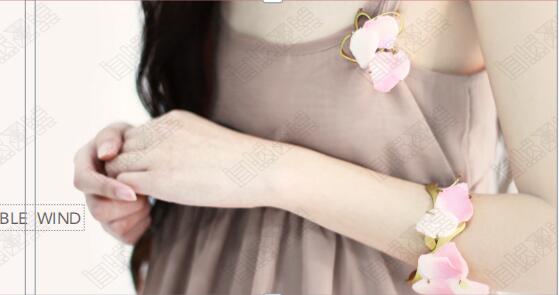
For example, in the jewelry design work collection of Yexi, one of the projects is about HIV. In this project, Yexi chose interdisciplinary combination of physics and created with the principle of light refraction.
Light passing through colored paper of different colors will show different effects. The same sentence will have different "meanings" under different light effects and angles. The final work is a rotatable brooch. Through the blue color chip above, we can see "I'm HIV positive". When the brooch rotates to the red color chip, we will see another sentence that completely changes the meaning "I'm positive". Such a "similar" theme, combined with "interesting" creativity, also enabled Yexi to win the RCA Royal College of Art Multiple school offers within.
The decoration in the works is too complicated, without priority and contrast; The reason why this artistic work gathers craftsmanship:
This problem mainly occurs in the "typesetting" link:
Different from the investigation requirements of domestic art schools, students can create on site. Overseas art schools often require students to submit more than one work when applying for a work collection, and different art schools have different requirements.
For example, if you are also applying for undergraduate education, Parsons' portfolio requires 8-12 pieces, but RISD Rhode Island School of Design Students are required to submit 12-20 copies. In such cases, many students will be limited by the number of pages.
The collection of works of overseas art schools does not have strict established scoring standards and right/wrong judgments, because it examines the comprehensive artistic quality of students in the whole creation, that is, from the first page to the last page of the collection, the content of each page should correspond to a specific "ability point", which constitutes the whole collection of your works, Can fully reflect your comprehensive strength and potential.
In particular, many art schools also emphasize the ability of students in research and sketch. Some students think that I should arrange 3-6 pages in this part? What about other contents? How on earth should I arrange the layout to better show myself to art schools? In the face of the page number requirements of different schools, how to choose becomes the difficulty.
I have seen many students throw everything in their head in order to avoid this problem, regardless of the layout of the collection and the focus of each page. I have also seen students abandon important "process presentation" in order to avoid complexity.
To solve this kind of "craftsmanship", first of all, we should make it clear that refinement of details ≠ craftsmanship, and "tough" details are craftsmanship
We have always said that one of the characteristics of craftsmanship is complexity and stacking. Correspondingly, in the composition of the collection, it is to "pick" the details, while ignoring the overall tonality and presentation of the macro dimension collection.
No matter how many works and several projects are included in the works collection, we should pay attention to the integrity. Like every work, we should have a clear and unified personal style and layout. Of course, we can refine some details after adjusting the overall layout and direction, because refining details at this time is the "optimization" of the collection of works. However, if you set the layout directly and "cut" the details, page by page, you will lose the unity of the whole set of works.

When learning painting, teachers always say: "Stand far away and look at the picture". The reason why we say this is that we should not neglect the harmony and priority of the overall picture for the sake of local delicacy. This principle can also be used in the composition of works collection.
The details of good typesetting are based on the overall unified layout. When we have a macro typesetting for the collection of works and our own style focus, we can better optimize the details and pursue the perfection of details. Only when the balance between the whole and the details is achieved, can we better understand how to choose and how to balance. The choice lies in the choice of content; The balance lies in the balance of functionality and visual experience.
Second: define the "function" and "focus" of each page of the works
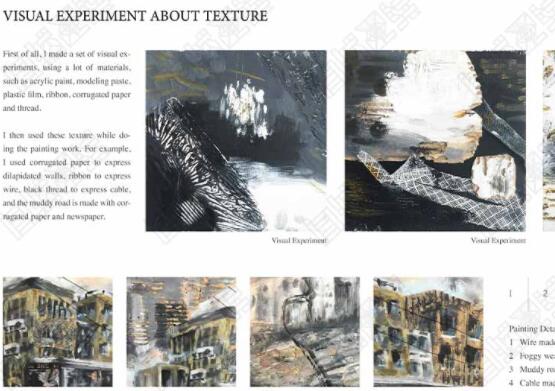
There is a limit on the number of pages in the collection of works, but when we create, we often use more than 10 pieces of sketching or research, not to mention other parts of the content. Therefore, in typesetting, we should make it clear that every project is in one direction, and every page is an opportunity to show my ability in a certain direction, so that even if each project has only 3-4 pages of layout, we can also choose to arrange different "abilities" into different projects and pages.
For example, in Project A, cross media mixed creation is the highlight of this work. First, we can define this project: mainly use it to express my mastery of creative methods and interdisciplinary practical ability, and then combine specific projects to refine the specific performance of generous and upward ability, which will be much easier and clearer. In the following projects B, C and D, the ability to show other directions can be considered. On the whole, it avoids the risk of craftsmanship.
The craftsman spirit deserves our respect, but it is too "crafty" to be feasible in the works. Overseas art schools focus on students' independent expression, creativity, and style. Although in terms of painting ability, most of the "craftsmanship" is based on solid basic skills, the collection of works is not built up with basic skills.
Artistic works are full of craftsmanship and have two main influences: creation and ideas, and typesetting. In terms of creation, first of all, we should cultivate our own creative thinking ability, take a solid foundation and innate personal background as advantages, dare to express and think, and use our unique feelings and emotions to enrich the collection of works. In the creation of work collections, clear your own ideas and themes, and never deliberately create for the sake of creativity; Secondly, logic is used to link each part of his collection of works, so as to ensure the enforceability and extension of creativity. In some hot topics of "the same kind", you should grasp the combination of your own ideas and creative expression, look at the problem from other perspectives, and try to do cross media mixed creation. Even hot topics can become your bonus items. Finally, in typesetting, it is forbidden to pile up the works at every step. First, it is necessary to clarify the overall layout and tonality of the works collection, make macro typesetting and planning, and then clarify the focus of each project, as well as the ability to show specific points on each page, so as to improve the works collection with choices and consideration.
Natural light shares more topics for you:
How to build a high-quality collection of works for landscape design majors studying abroad?
Art Design Collection for Studying Abroad _Color Contrast _Color's Influence on the Design of Collection for Studying Abroad
This article belongs to the original article of Natural Light International Art Education Team. Without permission, it cannot be reproduced commercially in any form. If it is found, it must be investigated for legal responsibility.