What if I don't like my major? What if you find yourself not suitable for your current major? Is it reliable to study abroad for art majors? Is it difficult to apply for changing majors? What is the impact of changing majors on future employment? The confused students have asked many questions about changing majors. Most colleges and universities in Britain and the United States allow students to change majors. Although changing majors can bring many advantages, such as the interesting integration of skills that non changing majors do not have in combination with multiple disciplines, and more possibilities for future employment, changing majors will also face problems such as lack of necessary professional knowledge, Have you ever wondered which discipline was the first to accept students from different professional backgrounds when they went abroad to study art? The answer is: UAL Central Saint Martin Material Future.
Today, we have the honor to interview the director of MA Material Future Department: Kieren Jones; He will discuss the mystery of MA Material Future with us.

Kieren Jones
Central Saint Martin College, London University of the Arts
Director of Future Materials Department
Kieren Jones once worked at the Royal College of Arts in product design University of Bath Pure art Brighton University He majored in 3D design and currently works in the Department of Future Materials of Central Saint Martin College, London University of the Arts. From Kieren's experience as a student, we can see that the professor himself is a model of interdisciplinary learning. His experience of changing his major many times has enabled him to obtain many innovative designs that subvert the past in this process, so that he can teach in this major that accepts different backgrounds, and cultivate many future designers with cross-border thinking.
Kieren Jones is also an award-winning designer, producer and artist. His works are in Somerset House, Barbican Centre, Internationale Architectuur Biennale Rotterdam, V&AMuseum, MOMA, British Council and other top creative institutions have also exhibited in the Gwangju Design Biennale planned by Chinese artist Ai Weiwei. His Sea Chair project was nominated as the annual design award of Design Museum and won the Sustain Award of the Royal Academy of Arts.

Kieren Jones“Chicken Project”
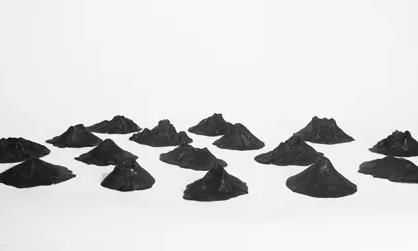
Kieren Jones
“Models of the 16 Decade Volcanoes”
Kieren is also the co-founder and creative director of FACULTY. FACULTY is an interdisciplinary studio specializing in planning, design and production, and has cooperation projects with local governments and international institutions. FACULTY is headquartered in London, and the studio will propose design schemes for buildings of various sizes according to the building environment. Through these works, Kieren's research field has also extended to industrial production and technology, and he is very willing to explore these concepts across disciplines.
Many students who are considering changing their major to study abroad in art may have worried about whether changing their major will affect their future employment, and whether they will lose their professional degree to graduates who are proficient in a certain major after entering the corresponding industry after graduation. But in fact, in terms of future employment, cross majors may bring you more possibilities. Kieren has created his own brand by combining pure art, architecture, products, 3D, etc. The accumulation of these early majors has become the foreshadowing of his current employment scope, which also reflects the necessity of MA Material Future course focusing on cultivating multidisciplinary research and comprehensive ability.
Lunyi Central Saint Martin College of Art and Design Introduction to MA Material Future:
Before this interview, Kieren Jones first introduced the specific situation of MA Material Future, a two-year master's program, which aims to explore our future lifestyle through interdisciplinary practice and expert cooperation. MA Material Future encourages students to explore the intersection of different disciplines and seek new design inspiration through the intersection of economics, technology, science and different technologies.
Does it sound like a subject about materials? If you think like this, you are totally wrong. In fact, this course is also about product design, much like MA Industrial Design we said before. MA Material Future blurs the boundaries between process, science and technology through cooperative research. The goal is to transcend the boundaries between existing disciplines and predict people's needs, aspirations and challenges for the 21st century. The MA Material Future course takes "material" as the starting point of the design process, which is literally to integrate what we can touch, feel, interact and observe, so that different materials and processes reflect the problems of people's environment.
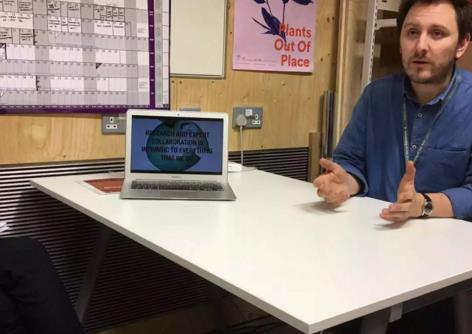
Professor Kieren Jones is showing students' homework
MA Material Future encourages multi-disciplinary design thinking. Students in this major come from different disciplines, including fashion, architecture, industry, communication, textile, digital and design. In MA Material Future, students will be exposed to new materials, processes, technologies and design methods, and take "material materials" as a platform to critically explore how we should create a sustainable future. During the study, students will cooperate with students majoring in Master of Industrial Design, Master of Ceramic Design, Master of Furniture or Jewelry Design and Master of Graphic Design.
"Just to take 2018 as an example, the students in this year came from engineering, computer science, archaeology, textile and fashion, history, architecture..." Kieren Jones said with a smile. "This is the case of last year. I won't talk about the data 20 years ago."
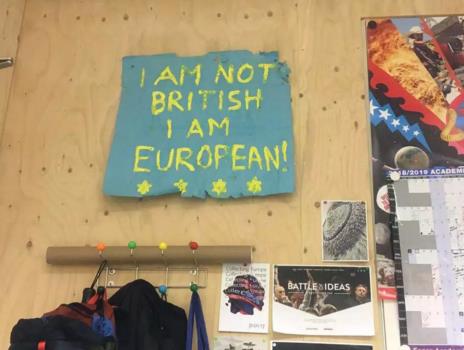
A corner of Kieren Jones' office
Kieren Jones Q&A:
How many students does MA Material Future admit each year? What is the number of applicants?
About 25 people, and the number of applicants is about 300.
Is there any difference between our course and industrial design?
Our two majors are very similar. To be honest, Nick and I have a very good relationship. Industrial design mainly emphasizes the expression of ideas through industrial design means. Our means are diverse, and we can say that our coverage is broader.
So students often apply for these two majors (MA Material Future and MA Industrial design), right?
Yes, this kind of situation is very common. Sometimes your admissions officer knows better which way you should go. I'm not the kind of person who is unhappy when students apply for two majors and throw them into the garbage can in a group; On the contrary, I will carefully analyze the students' works and the possible future development. If I think that the students are more suitable for another major than my major, I will directly recommend to another department head.
What kind of jobs are your graduates engaged in?
Many graduates have started their own studios, and some people not only work at the forefront of the creative industry, but also work in the world's leading laboratories, research centers and creative start-ups. Many people continue to study for doctorates. By the way, the ratio of our professional doctorates is the highest in the whole school.
What advantages does our major have?
We can participate in any workshop to get the knowledge you want. We are the only major in the whole school that has its own studio. For example, when you go to school, you need to work with others Art and Design Let's share the studio. (Kieren looks at me and smiles)
What kind of works collection is excellent in your eyes?
Ideas, not technology. I still remember a student who came to school at the age of 50. She had almost no design background. The collection of works submitted was also patchwork, but I was still impressed. Sometimes you can read a person's soul from the collection of works, and you can feel that she really has a strong desire to learn this field. Other students have submitted extremely beautiful collections of works, but there is no thought, no soul behind the works. Think about what you want to express, which is very important for the collection of works.
Outstanding works of students:
Thoughts on Waste Disposal: "Foreign Waste"
In the graduation work "Foreign Garbage" by Katie May Boyd, an excellent master's graduate, his "cat" has become a symbol of plastic garbage.
In history, the United Kingdom once shipped 30% of its garbage to China for treatment. This treatment method was improved only when a ban on the import of all "foreign garbage" was issued. In Katie's opinion, the traditional treatment method is very absurd, so she developed an alternative recycling method to express her objection to the traditional treatment method of plastics.
Katie said, "I spent half the time in the project developing a program that can recycle expanded polystyrene. No one in the UK has done this before. Based on this, I began to design products that can be made of this material, turning garbage disposal into a more daily and practical thing. I believe that human beings need to solve the negative impact of their own consumption behavior, more analysis of the commodities we use daily, and do a good job in classification. "

Ethical and moral impact of "humanized" equipment
"Hey, Google, what's your dream?"
"I've always wanted to sing a duet with Stevie Wonder..."
With more and more artificial intelligence (AI) entering the society, our concept of "human" has been challenged unprecedentedly. Recently, the emergence of new personal intelligent assistants (PIAs), such as Google Home, Amazon's sub Alexa, Apple's Siri and other intelligent mainstays, has further exacerbated this phenomenon, and consumers can regard them as human goods or friends. Among all these machines, the most critical humanized expression factor is voice interface, which can be said to be one of the most convincing technologies to make machines more like human beings.
Davide, a master's degree graduate of St. Martin, tried to realize an impossible "wish": let the artificial intelligence device cooperate with Stevie Wonder to complete the duet. With the help of experts, musicians and fans in relevant fields, Davide developed Gogo and helped Gogo complete its "dream".
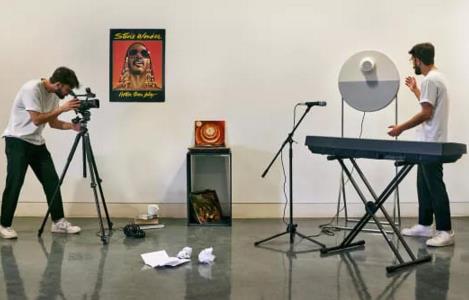
Davide's design is ironic in nature. He tries to study and express the ethical and moral impact of this "humanized" device (artificial intelligence) around the world.
The above is what Mr. Gao brought to you at the Central Saint Martin School of Art and Design about MA Material Future's conversion to professional art study abroad. From the dialogue between the educational philosophy of this course and the professors, we can find that more and more foreign colleges and universities are integrating interdisciplinary ideas into their education, and students are no longer learning a single subject, Instead, it focuses on various fields, takes "art+design+technology" as the basis, comprehensively cultivates interdisciplinary awareness of problems, boundary recognition, and domain interaction, and integrates and innovates more works that adapt to the current society.
Natural light shares more topics for you:
Art Study Abroad Across Disciplines | Natural Light Art Education Across Disciplines Jumps out of the Art Study Abroad Collections Homogenization
This article belongs to the original article of Natural Light International Art Education Team. Without permission, it cannot be reproduced commercially in any form. If it is found, it must be investigated for legal responsibility.