Central Saint Martin College of Art and Design is one of the four major fashion design colleges in the world. As a famous school rich in fashion designers, it is famous in the international fashion industry. Most graduates of fashion design are employed by many international fashion brands, Every year, the graduate work conference at London Fashion Week has become the focus of many international fashion brands and international fashion media to pay attention to and explore new designers. CSM Saint Martin is not only good at clothing, but also has other majors such as fashion, textiles, art, media production, graphic design, drama, performance, 3D design, interdisciplinary art and design. No matter what kind of art major you choose to study, the college will have an excellent learning environment to support your creation. Today, we would like to introduce Saint Martin's new and unknown specialty: creative industries and applications.
MA APPLIED IMAGINATION IN CREATIVE INDUSTRIES (Master of Creative Industries and Applications), as a new and unexpected major, has begun to flourish in recent years. The total number of students this year is 50 (60 students in total plus 10 students at part time). Among them, the number of students from China has grown from the initial single digit to 14 this year, which also reflects the increasingly diversified choice of art education in China.
However, as one of the few majors in Saint Martin that "accept students from different professional backgrounds" to apply for. What knowledge is it talking about? The application requirement says that a 500 word "study plan" needs to be submitted. Can this "study plan" set the world in one fell swoop? Many people think that this major is similar to fashion management. Are these two majors really the same thing? How much knowledge about management is told in MA APPLIED IMAGINATION IN CREATIVE INDUSTRIES? What questions will this major ask about interviews?
With these questions, we are honored to meet Central St Martins Professor Richie Manu hopes to get the answer from his mouth. Richie Manu is an award-winning UAL excellent lecturer, designer and creative mentor in 2017, as well as the author of the best-selling book You: Rebuilding the Brand, and a TED speaker. In addition to MA APPLIED IMAGINATION IN CREATIVE INDUSTRIES as senior lecturer and course instructor in St. Martin, London, he is also responsible for relevant design and creative projects in Britain and Europe. At present, Richie Manu is also the tutor of MA Fashion Entrepreneurship and Innovation at London Fashion College.

Professor Richie Manu (the picture is from the official website of the UAL)

Professor Richie Manu's graduation exhibition in 2018, the picture is from the official website of UAL
Tutor interview:
Q: Could you briefly introduce our course structure?
A: This is a one-year full-time or two-year (part time) multidisciplinary master's program. Our focus is to help students apply their ideas to the real world. We encourage students to find "gaps" in life (i.e. problems in life). This course enrolls students from different educational and professional backgrounds, and we believe that this integration of different backgrounds can stimulate special creative inspiration.
At the primary and intermediate stages, we mainly study how to put your ideas into practice, think about and analyze how to deeply practice the project, and learn the relevant skills required during this period. An important word here is called "interventions". In this process, students record and reflect on the evidence obtained by "interventions" to confirm their ideas. Our expectation for students is that they can test their ideas in real life and contact and cooperate with relevant partners. Finally, we will leave the theme of the graduation design project to students - the curriculum team will help students in their research process.
Q: So our professional keyword is "creativity", right?
A: Yes, "creativity". Let me give you an example. One of our group assignments was called "time machine". The topic was time machine. Our goal was to stimulate everyone's creativity, how to conduct research under such a crazy topic, how to plan projects, and how to bring your creativity into play. Creativity, ideas, research, and how to turn your ideas into real business projects or even how to start your own company.
The application of creativity can be advertising, animation or fashion. However, fashion is only a part of creativity, which is too small.
Q: Is a 500 word study plan important? Is it more important than personal statement?
A: Equally important, we look at it together with your study plan in combination with your personal statement. The personal statement tells your own story, and you are telling us who you are. The learning plan refers to what you hope to learn here, your own plans and expectations for us.
Q: So, the learning plan does not need to be a creative and mature business plan, right?
A: No, because many of my students have no learning experience of artistic creativity. They have studied finance, media and drama. I just want to see a real plan for their future learning. This is just a plan. Your future study is likely to be very different from the plan you handed in. It's normal to be different. It doesn't matter.
Q: Can I believe that our profession has little to do with fashion management?
A: I have no idea what the fashion management major will talk about. I am not a teacher in this field.
Q: How do you evaluate the feasibility of a business plan?
A: I might say that in a mature business society, the services you provide must also be provided by someone. What's your difference? For example, if you want to provide language tutoring courses for Chinese students in the UK, then I would say that we also have such academic support in St. Martin. Why choose you?
Q: What directions do you usually ask questions about the interview?
A: This will still integrate your personal statement and learning plan, and may be discussed according to your learning plan. The personal statement is about your own experience. If we find any topic of interest in the personal statement, we will also pay attention to it.
Analysis of graduation works:
Next, let's analyze the work of a student who just graduated this year, which may give a more powerful answer to the specific connotation of this major: how can the values of skateboard subculture empower young refugees while improving the awareness of community integration needs?
Student Federico Casu's project "Skateboarding Road" hopes to use skateboarding and the values embodied in its culture - inclusiveness, community and authenticity - as an authorization tool. Here, Casu tells us more about his work, highlighting key aspects and the inspiration behind his project.
Research topic: How can the values of skateboard subculture empower young refugees while raising awareness of integration needs in the community?
I have always been keen on skateboarding, and started skateboarding when I was ten years old. The purpose of my research on skating lanes is to find a subversive way to cultivate inclusive behavior in today's society. It focuses on analyzing the skateboard community, its set of values and its social role, and turns it into a communication and authorization tool for vulnerable youth. Studies have shown how discrimination and exclusion affect young refugees psychologically. Although more than 160000 British charities have made efforts to change the status quo, they still cannot get the reports, attention and political assistance they need (Slack, 2016; Bulman, 2018). The project aims to help young refugees raise their awareness. I hope to find a new and more effective way to realize this wish by studying sliding.
London is one of the largest skateboarding cities in the world. There are countless skateboarding grounds and skateboarding parks everywhere beside the Thames River. As part of my research, I participated in many skateboarding activities, which made me discover a new world: skateboarders, skateboarders and other non-governmental organizations around the world can see that they use skateboards to help educate young people in countries torn apart by war, political oppression and religious extremism. In addition, it also includes many brands I met, which convey inclusive and free values through their products. Through these research experiences, I found my inspiration, which also further deepened my ideas.
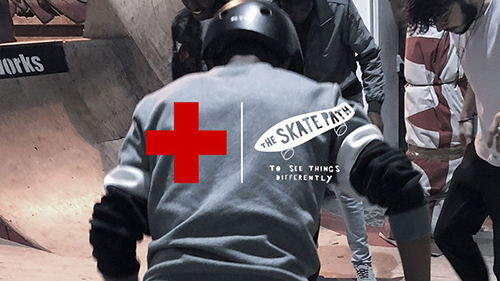
In the process of developing the skating track, I found that people were very interested in what I did, and they also wanted to participate in it. Earlier this year, I was Leeds University I had a skateboard lesson, which had a great impact on me. Then on October 2, I went to an indoor skateboard field in Leeds, where I met a group of young refugees who received help from the Red Cross. I still remember that it was a windy day. After I got in touch with some associations, brands and other stakeholders, I could give everyone free access and provide everyone with a board and a helmet. The purpose of this activity is to test and observe the spontaneous interaction and reaction between young refugees and local people, and to observe the extent to which skateboarding can cultivate unpredictable and inclusive behaviors. As a result, I only saw a group of young people having a good time. I didn't feel that I saw refugees anymore. They were just children enjoying the moment. I was no longer a teacher at that moment. I was just a person in the group. This activity made me understand the possibility of skateboarding in different environments.
(Works collection data comes from the official website of the UAL)
Reference for other graduation works:
1.How can art be a catalyst in highlighting societal problems and making people think about them?
How art becomes a catalyst to highlight social problems and make people think about them
2.How can we protect our personal information in this society of electronic surveillance?
How can we protect our personal information in this electronic regulatory society?
3.How can we identity and address the increasingly disaffected attitude towards the way we engage with the social media?
How can we identify and resolve our growing dissatisfaction with the way we interact with social media?
Application requirements:
Course structure:
From January 7 to 8 (the specific time depends on the year), the Master of Creative Industries and Applications has 180 credits, including three units.
Unit 1 (60 credits) Full time 15 weeks
7 January 2019 to 15 March 2019
Unit 2 (60 credits) Full time 15 weeks
15 April 2019 to 21 June 2019
Unit 3 (60 credits) Full time 15 weeks
23 September 2019 to 6 December 2019
You must pass all three units to get MA, but the final score of MA comes from the score of the third unit.
Application conditions:
1. Background: Honorary degree or equivalent experience or 3 years of relevant professional experience
2. Personal information (this category can be sorted into CV), including legal full name, date of birth, nationality and address; Current English level; Details of current and/or previous education and qualifications; Employment history;
3. Personal statement, tell the reason why you apply for this major
4. Learning plan 500 words
5. IELTS: 6.5
Screening criteria:
The school will select applicants according to the following criteria:
Your bachelor's degree or equivalent skill certificate (educational background);
Personal statement and learning plan;
Self motivated and ambitious;
Be ready to participate in collaboration and reflective practice, as well as research on external society;
Willing to contact students with various cultural, educational and professional backgrounds.
(The last three items can be reflected in personal statements)
Tuition: £ 19350 (2018/19)
The above is the first-hand information that Mr. Gao of Natural Light brings to the forefront. The future development prospect of APPLIED IMAGINATION IN CREATIVE INDUSTRIES is also very broad, which can be used in fine arts, performing arts, curation, advertising, marketing, business, management, and even emerging science and technology fields.
This major needs creative, purposeful and talented students. If you like to work with others to complete a project, and if you like to challenge new things to find new ideas, you may want to learn more about APPLIED IMAGINATION IN CREATIVE INDUSTRIES, a new and unexpected major.
Natural light shares more topics for you:
Central Saint Martin Product Design Program Director's personal account: CSM product design application/portfolio/courses/employment prospects
Short term fashion course in St. Martin, England, to visit the most interesting fashion major with natural light
This article belongs to the original article of Natural Light International Art Education Team. Without permission, it cannot be reproduced commercially in any form. If it is found, it must be investigated for legal responsibility.