Today, Natural Light introduces a student who applied for studying in interactive art, and won seven offers from three majors in Britain and the United States in her collection of works. Her "hard core" engineering course changed from zero to major, and she chose the wrong application intention by hand sliding, but she gained double offers of ethics, including the Grand Slam achievements of Pratt, ACCD, SVA, SAIC, and SFAI top British and American universities, 7 offers cover 3 different professional fields!
In her collection of interactive art works, she is full of the most rational thinking under delicate emotions. She uses interactive space to explore the relationship between AI and people in the future, conducts human behavior experiments in the way of games, and defends the right of wildlife survival with codes She is the object of our interview today, Mr. Jun. Where does her unique view of art come from? How did she take risks on her way to apply for studying in interactive art?
Jun applied for studying in interactive art, and won 7 offers from 3 majors in the United Kingdom and the United States:
Q1: Why did you change your major to apply for studying in interactive art? How did you learn about this major?
Because my undergraduate major is information security, which is affiliated to the School of Computer Science in our school, I first started to contact the field of interaction by doing UI design for APP. At that time, I found that my interest in art and design exceeded my interest in my original major. In the summer vacation of my sophomore year, I decided to change my major and apply for studying in interactive art. After I really entered this field, I found that this field was totally different from what I had expected before, just doing interface design for APP. It was more comprehensive and involved more fields. So I came to the natural light to seek more professional and systematic learning methods. After communicating with professional teachers, I also learned that interaction can also be divided into two major directions: interaction design (UI design, user experience design...) and interaction art (installation art, new media art...). Compared with each other, I think interaction art is more suitable for my personality and way of thinking, so I decided to choose to learn interactive art.
Q2: Is there any influence or help in your application for interactive art works collection and master's degree with such a hard core "code farming" background as your undergraduate?
Um I think the biggest advantage of the computer background in creating a portfolio is that it has a certain programming foundation. When learning a new programming language (such as Processing) or a technology with programming ideas, it is easier to learn.
In addition, I have difficulty with design thinking, production process and projects involving vision. In these aspects, I really want to thank the professional teachers of natural light for their help.
Not only help in professional courses, but also help me analyze the interactive professional courses and enrollment priorities of different colleges and universities when I choose colleges and universities, so that I can select portfolio projects in a targeted way, find the starting point that best suits my advantages, and help me build a very important self-confidence in the early stage.
Secondly, engineering students generally have strong practical ability. It is also important that they find problems and solve them without fear of frustration. Many people believe that the advantage of interdisciplinary portfolio creation is the ability to put forward ideas from different perspectives. I don't agree with that. The ability to think across borders depends on everyone's accumulation. This advantage can be acquired by everyone through accumulation and training, and has nothing to do with whether they are interdisciplinary or professional.
Q3: There are several items in the interactive art collection. What are the contents of these items?
There are four projects in my collection of works. The first is an immersive interaction space, which is called Cube_1. Cube_1 is the first work of the Cube series (planned). Cube aims to explore the relationship between AI and people in the future. Cube_1 shows the first step of AI and people communication, and figures out the number of people.
The second project is a behavioral experiment conducted in the way of game. The game is conducted in an interactive space. The inspiration of this project comes from Skinner's pigeon experiment and the psychological suggestion skills of mind magician Darren Brown. It wants to study human superstition behavior.
The other two items in the collection are Creative Coding Practice, which is a collection of small works written at ordinary times, and the UI design of a taste museum APP.
Q4: You got the offer of Lunyi game design and interaction at the same time. It's said that this is actually an "accident". Can you share it briefly?
This process was indeed an "accident". The two majors that Lunyi enrolled were Games Design and Creative Computing. At first, I wanted to apply for Creative Computing, but I was very tired when filling in the application form. I had just taken a long flight, so I clicked the wrong TAT when choosing my major
After submitting the application, I found this error. Then I immediately told my professional teacher that he had learned about game design at the moment, and found that many aspects overlap with interaction design, and the curriculum is very interesting, so I didn't have to withdraw my application.
Later, London University of the Arts Game design was the first major to send me an interview invitation. An interview was held on the evening of the New Year's Day. The interview lasted for 40 minutes. The dean was very interested in the behavior experiment project in my work collection, that is, the second project in my work collection. It was a surprise that he directly sent an offer on the spot.
Q5: What is the biggest problem encountered in the production of interactive art works? How to solve it?
The biggest problem is the construction and exhibition of the works, which is a process of transforming all the ideas and drawings into reality. I may have many ideas in my mind and have drawn many sketches, but I have little experience in making them into practical things.
Two of my projects are immersive interactive experience spaces. I have encountered some difficulties in exhibition arrangement and construction, and I felt great pressure at that time because of the time limit of renting the venue. I am a very independent person, and I prefer to solve problems alone rather than seeking help.
The teacher gave me very important help when I was "desperate". In the early communication process, the teacher knew that I was a very passive person, so she always asked me what I needed help. For example, during the exhibition arrangement, I was very inexperienced, and she helped me to complete many things that needed to coordinate human and material resources.
Now I understand that seeking help from an experienced person can find a suitable solution very quickly, and I also find that the energy saved and detours taken less are really unnecessary.
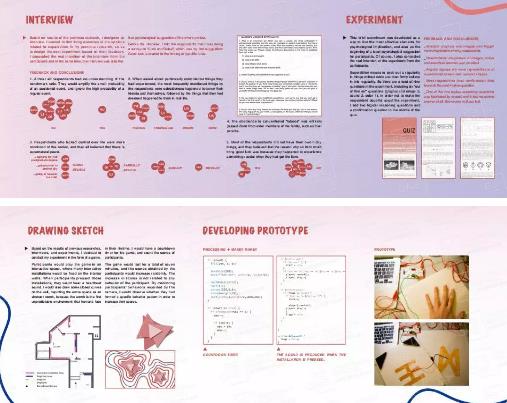
Works collection project of Jun
Q6: What do you think the teacher can help you most in learning natural light?
I think the teacher of natural light helped me to clarify the direction at key nodes.
When I first started to change my major to learn something about interaction, I was confused. I didn't know anything about this major. Later, this state would appear at the beginning of each learning stage, but the teacher of natural light would help me remove the fog in front of me at this node, figure out the ways ahead, and then let me make my own choices.
Q7: It's said that you have obtained interviews in almost all schools. The Spring Festival is spent in interviews. Do you have any simple experience to share?
My experience is relatively simple, that is, I should do as much work collection research as possible. First, conduct research on the school to understand the school and the major, including the teachers of the next academic year, the research direction of full-time professors, curriculum, the proportion of students, and the employment situation of past students.
The second is to research the interview situation of the school. There are many experiences on Douban, Zhihu, Yimu Sanfen and Gradsafe. If you dig, you can dig out a lot of information, such as the form of the interview. In some schools, the main part of the interview is through voice, and only open the video to greet each other at the beginning and end, In this form of interview, you can prepare a draft according to your experience in advance and answer it fluently.
The above is the interview content about Jun's application for studying in interactive art. With his exquisite expression and unique ideas, Jun won seven offers from three majors in the United Kingdom and the United States. The offer received by Jun includes three professional tendencies, SVA New York Institute of Visual Arts The offer of computer art is animation oriented. In addition, Lunyi has a game design. Other majors are interactive oriented. Although Jun thinks this is an "accident", it may also be a "surprise" that can be replicated for students.
"Interdisciplinary thinking" is the key point we can learn from. Interdisciplinary is not only the teaching concept advocated by natural light, but also the education system that many art colleges have been implementing. We need to learn to open our own knowledge system in a multi-dimensional way, whether you are interdisciplinary or not, whether you have a design foundation, integrate your knowledge system in science, technology, art, humanities, history and other aspects, and break through restrictions, Bring you more development directions!
Natural light shares more topics for you:
Classifying Interactive Design Collections for Studying Abroad
What does the admissions officer like to see in the interactive design works
This article belongs to the original article of Natural Light International Art Education Team. Without permission, it cannot be reproduced commercially in any form. If it is found, it must be investigated for legal responsibility.