Many students who choose to apply for art study in the UK, the target schools in the first tier are always Huangyi and Lunyi, and the second tier are comprehensive universities with strong art majors such as Kingston, Kingssmith and Edinburgh. The Glasgow School of Arts GSA is usually not the first choice for students, and even some students will regard it as a guaranteed college. Is GSA of Glasgow Academy of Arts really not good enough? Today, let's take a look at GSA's position in the UK art schools with its strong professional field, the design innovation major of Glasgow Academy of Arts?
How about the design innovation major of Glasgow Academy of Arts?
CITIZENSHIP/Design Innovation: Citizens
This series of courses are all 1-year master courses. Citizenship/Citizenship Gu Mingsiyi is particularly close to people. The curriculum plan requires students to go beyond their existing professional knowledge and professional cognition and think about how to apply design practice more widely to the life of the society and residents.
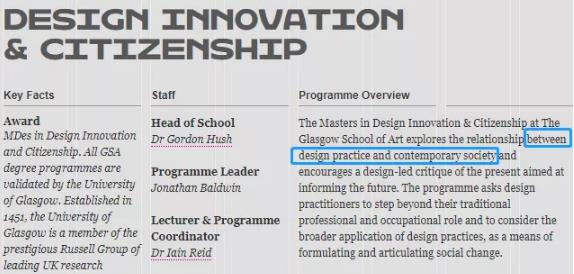
Glasgow School of Art GSA believes that designers are citizens first and need to have reflective ability and crisis awareness. Therefore, the most important purpose of the curriculum plan is to train students to master the knowledge of the mainstream interaction design field of interface design, service and interaction experience, and also to have the methods and theoretical research that challenge the current design practice.
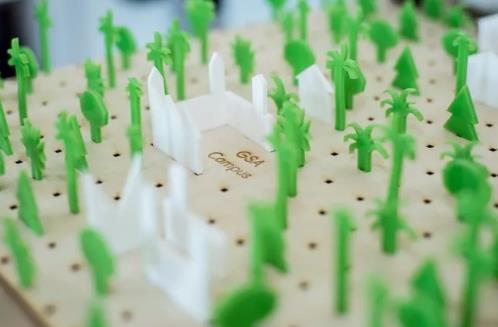
Creative Student Works of Glasgow Academy of Arts
Students will develop innovative design participation forms, adhere to the people-oriented design principles, and use the design language and practice to develop innovative solutions for complex political, economic and social problems.
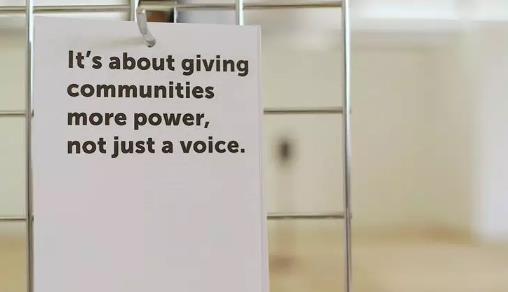
Creative Student Works of Glasgow Academy of Arts
The Glasgow Academy of Arts Design Innovation Program will focus on these specific areas:
1. Interaction between state organs and large private enterprises;
2. Emerging problems in society. Such as challenges caused by new science and technology, economic structure or resource problems;
3. Expand the cognitive framework of students' design practice;
4. Understand the friendly interaction between regional culture and local residents.
Design activities to be carried out in the course:
1. Making the service system corresponding to the contemporary society;
2. Solve the hazards caused by the progress of science and technology;
3. Generate new strategies and tools to promote economic, social and ecological transformation;
4. Strategies and activities related to political and social action, including social change issues such as government policies, health, social welfare and living environment.
COLLABORATIVE CREATIVITY/Design innovation: collaborative creativity
GSA believes that the nature and purpose of design practice are constantly changing. Design discipline is not only a direction focusing on creativity or production, but also includes more links such as materials, industry and sales.
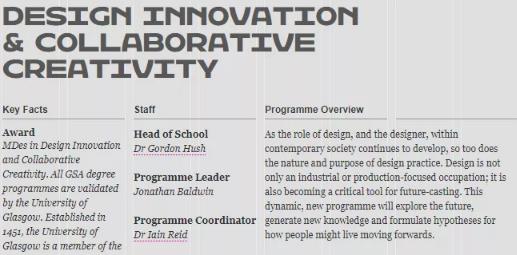
The direction of COLLABORATIVE CREATIVITY/collaborative creativity is to train students to explore the future, integrate new knowledge in more fields, and put forward assumptions and theoretical basis for people to move forward.
There are three key points in the whole course plan:
1. Future oriented design scheme
In order to effectively design and create, it is essential to adhere to the people-centered view. So no matter whether the designed product is service, experience or decorative function, designers need to understand what the foothold of design is? What are the needs of the audience? And why this design pattern?
It is the basic task of designers to dare to ask questions to themselves. Throughout the course, students will develop professional skills from which to accumulate and derive their own design language, and master the ability to create value and meaning with partners.
2. Learning through practical projects
The establishment of big data and emerging technologies in today's society have a huge impact on human life. GSA has carried out many cooperation projects with Toshiba, the Scottish government, the Bank of England, Alzheimer's disease in Scotland and many other organizations to provide students with real practical opportunities.
Most of these projects focus on social projects with the theme of solving vulnerable groups and improving the reality of the homeless, hoping that students can grasp the importance of collaboration ability and participation in the real world.
3. International perspective
It is also important for students majoring in design innovation to cultivate an international perspective. This course is jointly carried out by GSA, Huangyi (Copenhagen Campus) and KISD (Cologne).
The three universities jointly solve design problems by sharing teachers and methodologies, which are more determined by natural factors such as culture and environment, helping students to explore more complex problems in the fields of art, service and interaction.
ENVIRONMENTAL DESIGN
The course of environmental design is carried out in the campus of Glasgow University, sharing resources with the architecture major of Georgia University. This course plan focuses on the guiding role of designers in the environment.
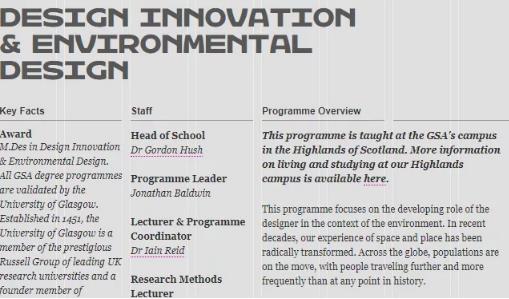
With the change and progress of society, the relationship between human living community and natural environment is being redefined, which also provides a series of possibilities and challenges for future designers. This course trains students to explore and communicate with the world by developing new forms of environmental interaction through the latest digital technology.
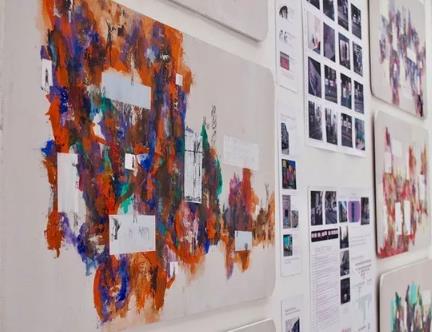
GSA environmental design direction student works
Teachers of this discipline come from many fields such as architecture, visual communication, product design, human heritage research and human geography. Through their guidance, students are encouraged to master interdisciplinary knowledge and explore their own design methods in the direction of sustainable development and architectural interaction.
The courses are mainly in the form of multidisciplinary collaboration groups carried out in the open studio space, in addition to regular theoretical courses and seminars. The key area of learning lies in the application of participatory environmental design and people-oriented research methods in the real world.
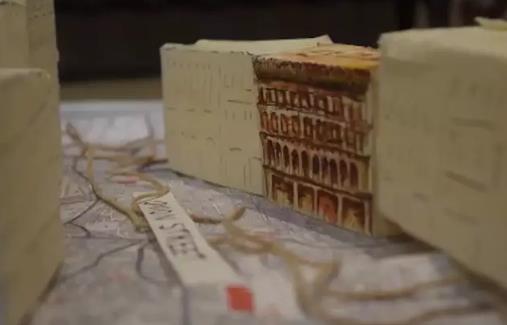
GSA environmental design direction student works
Graduates of the program will be able to conduct business across multiple disciplines, including UX design, urban planning, architecture, engineering planning, etc. Through the plan's emphasis on innovation ability and exploration of future architectural schemes, graduates will have professional reserves to make significant and lasting contributions to the field of environmental design.
SERVICE DESIGN
Service design is based on the concepts and methods of interaction design, user centered design, innovation management and other disciplines, and trains a new generation of designers to apply these disciplines' methods and processes to service design.
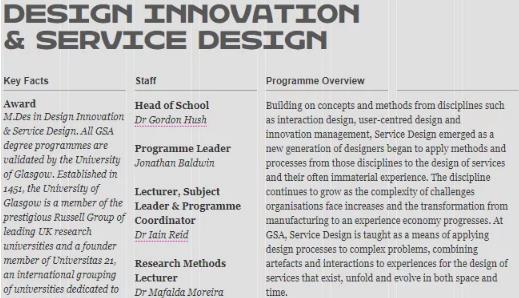
With the transition from manufacturing to experience economy, interaction designers will face more complex challenges. At GSA Service Design Study Abroad Students will be taught how to combine product and interaction, as well as personal experience, to present design works in the form of space and time.
In the future development, service will be an essential design focus. The focus of students' consideration is "people": what do people want? How? Why? By constantly thinking about this issue, we can interact with the world around us in an individual and cooperative way.
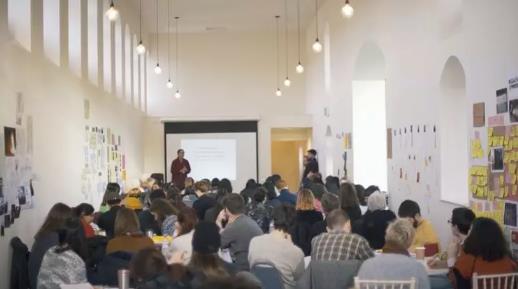
GSA Service Design Student Winter Course
In the whole possible plan, students will find the social value of service design and its importance to economic development. The role of service design is to solve problems in the service field by taking human experience and desire as the core of the design process.
GSA has carried out in-depth cooperation with the Scottish government, major British enterprises and private organizations to provide students with different forms of practical opportunities. So that students can promote the design process in the design and delivery stages after mastering the concept of service experience.
Because this subject is a new design direction, in general, the curriculum form is mainly theoretical courses, and a new design method is established. Students with various academic backgrounds are also encouraged to apply.
RANSFORMATION DESIGN/Design innovation: transformation design
This course plan is also a cooperation project with Huangyi and KISD (Cologne), which will be carried out in the headquarters of Glasgow University. The world we live in and the problems we face are becoming more and more complex. The practice of transformational design as a profession and a form of exploring the world and creating knowledge must respond to this.
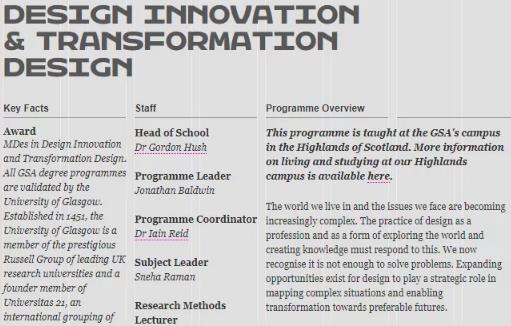
The transformational design discipline will involve more complex social or system problems, focusing on providing changed design methods. The school will help students understand the complexity of the world and participate in the design process with stakeholders.
The course direction will cover many fields, including visual image, narration, aesthetic thinking, interactive design, etc., and provide more students in the form of elective courses to help students develop personalized strategies and master various design means to trigger the change process.
Through learning this plan, students will experience collaborative work and integration with the commercial society, and prepare for new design careers in the future. The college will also conduct research and teaching through projects combining strategic thinking with hands-on exploration.
The curriculum forms are concentrated in studios, and GSA has also launched a variety of public institutions. Through these resources, students explore new design forms related to society, technological innovation and policy making.
The school will also ensure that graduates of this major will have the ability to express their personal views in the field of management, and have the opportunity to define a new role of designers in a complex social, economic and political context.
The series of courses of design innovation of Glasgow Academy of Arts has always focused on the people-oriented center, combining technology, interaction, product and other skills to build five new design discipline systems, and cultivate students' ability to solve complex social problems in the future.
More recommendations:
One year study abroad fees of New York Institute of Interior Design in 2020
This article belongs to the original article of Natural Light International Art Education Team. Without permission, it cannot be reproduced commercially in any form. If it is found, it must be investigated for legal responsibility.