Last year, UAL London University of the Arts launched CCI. At present, UAL has seven colleges. We have talked about CCI several times. The establishment of CCI is a breakthrough for UAL. At present, its professional courses mainly rely on LCC. It is not difficult to understand that LCC has always been the most interactive and innovative college in the UAL, and it is understandable that the newly opened college relies on LCC's advantageous resources in the early stage. But, you know what? LCF, UCL and Loughborough have opened new specialties? Medical+interactive innovation? LCF London Fashion Academy has released such a PDF file: LCF, UCL and Loughborough collaboration on a new Masters in Design for Disability and Innovation。
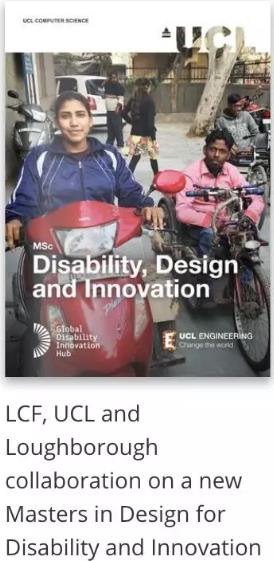
Screenshot from LCF ISSUU homepage
LCF, UCL and Loughborough have opened new majors? And look at the name of the specialty, "Disability" and "Innovation", a specialty full of sense of science and engineering, "medical"+"interactive innovation", will it give birth to an interactive specialty for the medical field?
Interaction Design of Loughborough University Majors have always been preferred by many students when they applied to British schools. For example, this year many of our students have received Loughborough's offers for interaction majors. UCL's HCI/human-computer interaction focuses on psychological research. It is not surprising that UCL's HCI/human-computer interaction appears here. But LCF? To be honest, I was surprised to see LCF in this combination.

Screenshot from LCF ISSUU homepage PDF document page
But on second thought, is it because I have misconceptions or stereotypes about LCF that I am surprised? What the practitioners in the art study abroad industry fear most is that "the information is not updated in time". They are afraid that they will stagnate and will not be able to provide students with the most accurate and timely information about art study abroad. Open the manual and the home page of UCL Masters in Design for Disability and innovation immediately to have a look.
LCF×UCL×Loughborough DDI
On the LCF ISSUU homepage, this PDF has only 4 pages, except the cover and back cover, and only 2 pages of professional content. This paper gives a brief introduction to this new major. The description in the text mainly includes the definition of the major, academic highlights, credit distribution, course structure and application details.
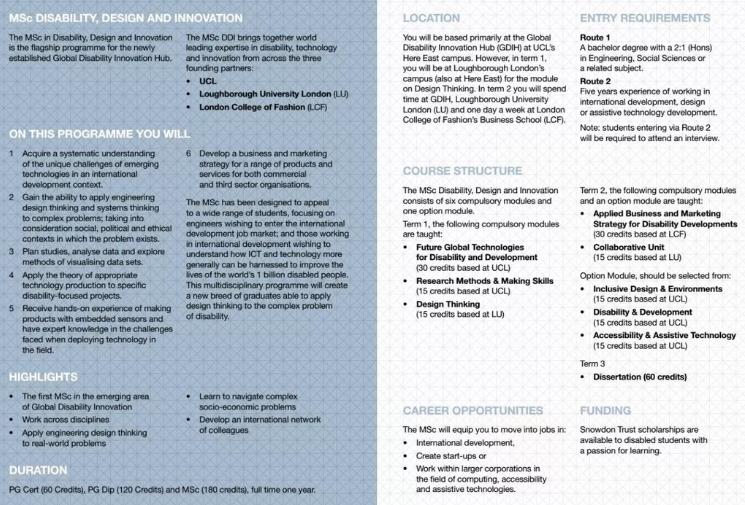
Screenshot from LCF ISSUU homepage PDF document page
In order to obtain more professional information, we'd better go to the school's official website and have a look! Although this major is jointly opened by three schools, it is located under UCL Computer Science and is dominated by UCL. It is a one-year master's degree program awarded to MSc.
In the professional description, I saw a very interesting professional definition "Flagship program" - a banner specialty.
In fact, the combination project of interaction and medical treatment is not rare. Last year, when Natural Light signed the licensing ceremony with MIT Media Lab, we communicated with professors from Media Lab. At that time, the teacher of MIT Media Lab introduced that MIT had a project combining design and medical treatment, inviting students of art textile specialty to cooperate, and used the element of "clothing fabric" to use special textile fabrics for surgical hemostasis. This interesting and interdisciplinary project is also the reason why natural light and MIT Media Lab will choose each other.
For another example, in the application for art study abroad, many students will take this theme as their own portfolio project. Like Tianze, a student of Natural Light 2019, who was injured as a child, he was impressed by his experience of rehabilitation training. He put this experience into his collection of works and designed a set of products that can be used for relaxation and rehabilitation training.
Speaking of this big one small two examples, you should also think that the integration of design with medical field is not a goal to be achieved, but a trend promoted by the current world development and a real existence that can be achieved. However, although we can find many such interdisciplinary "precedents", I'm afraid that DDI is the only one that combines art and medical treatment and offers a separate specialty besides art therapy.
In the above paragraph, in addition to the flag program, there is also a key point, which is "Global Disability Innovation Hub/GDI Hub" - the global innovation center for the disabled. On the official website of LCF, we can see its introduction:
GDI Hub Collective Aim:To make a positive difference to the lives of disabled people. The purpose of GDI is to bring a positive social impact on the lives of the disabled.
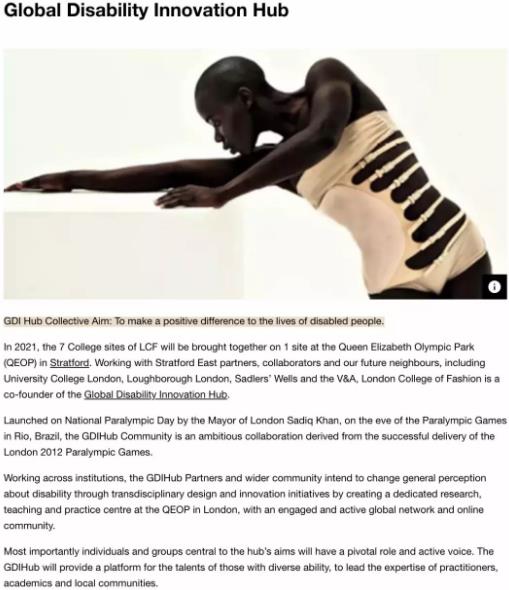
Screenshot from LCF official website Global Disability Innovation Hub
We can see that GDI Hub has been proposed and launched during the London Paralympic Games in 2012. Besides the LCF University College London Besides UCL and Loughborough University, there are also V&A and Sadlers' Wells.
As a complete global medical project, the whole GDI Hub includes the following directions:
Assistive Technology/Research on assistive technology for the disabled
Disability Inclusive International Development
Inclusive Design, Arts and Culture
Accessibility of the Built Environment
Disability Sport
Corporate Social Responsibility
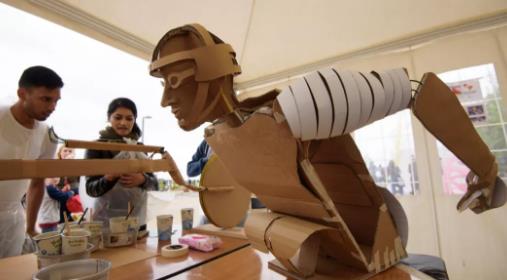
The picture is from the official website of Global Disability Innovation Hub
In general, this project, in addition to the usual social care for the disabled, has also added a lot of research investment in the combination of technology and innovation fields, such as building space, environmental facilities, sports projects, etc. The professional DDI we are talking about today is also a part of these "investment projects".
Open module course
In the professional information provided by UCL, the following sentence is the focus I draw for you: This multidisciplinary program will create a new breed of programs can to apply design thinking to the complex problem of disability/ The purpose of this major for students is to "apply design thinking to the real treatment environment for the disabled".
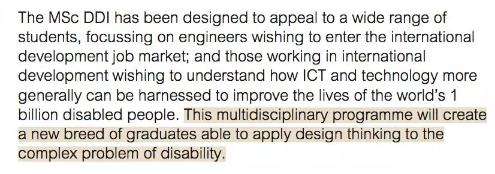
Screenshot from DDI Viewbook
Secondly, in addition to applying design thinking in the treatment environment at home and abroad, it also emphasizes a high degree of "inclusiveness" and "openness", so that students can be more open and inclusive to learn theory and practice.
As for the specific learning methods, we basically rely on the well-known overseas teaching models - group projects, individual making, lessons and seminars/group projects, personal research, lectures, seminars, etc.
As for the specific course division, the requirement of the whole profession for students is to complete 180 credits. However, unlike the common professional courses in the past, these 180 credits are divided by "Module".
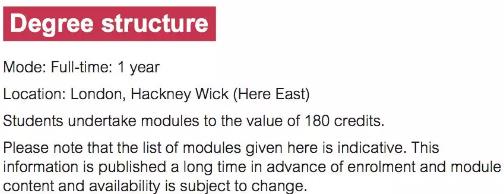
Screenshot from UCL official website
When we look up information on the Internet, learn about schools, and see the courses of a specific major, most of them are "one course at a time", such as graphic design courses, we may learn about book binding, advertising design, font design, packaging design, and so on. In short, it is in terms of "courses" and "projects"; If the time span is longer, it may be in terms of "units", "years", "parts", etc. It is rare to divide courses and credits by module.
What is "module"? To put it simply, we divide the courses we will encounter during our professional study into different modules. Compared with detailed specific courses, module More "mixed" interdisciplinary nature, because students will not learn from a single dimension in a single curriculum, but will integrate various disciplines and conduct comprehensive learning and exploration. All disciplines are intertwined, and they are not parallel to each other, but cross each other. For example, DDI courses are divided into three modules:
COMPUTORY MODULES/Compulsory
OPTIONAL MODULES
DISERTATION/REPORT/Graduation Thesis/Report
The courses under each module have also become "piece by piece". For example, we can take the COMPUTORY MODULE as an example. These courses are not searchable on UCL's official website or Loughborough's official website:

Screenshot from UCL official website
Not only can't search, but just look at the names of these courses. Maybe we can't guess what they will learn. Like the specific professional courses we have seen in the past, we can probably guess what they will learn by their names. But look at these courses:
Future Global Technologies for Disability and Development
Design Thinking
Research Methods&Making Skills
Applied Business and Marketing strategy for Disability Development
Collaborative Project
Rather than saying that they are professional courses, I think it is better to call them "the building of a thinking system around a major and the mastery of professional skills". These courses may not be conducted under a complete and vertical curriculum, but they are complementary and cross cutting, To form a complete learning system.
Entry Requirements
Having said so much about the establishment of majors and courses, there must be some special requirements when applying for such a special major:
The first is the professional background. Although there are no rigid restrictions on the major, there are also certain requirements, especially "engineering". If you are not an engineering major, the first thing you need to do to apply for this major is to take a certain amount of engineering courses and credits before formally applying for MA.
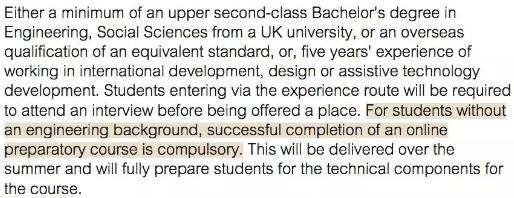
Screenshot from UCL official website
In fact, you can also see from my previous interpretation that this major is not purely based on research or academic discussion based on theory, but requires every student to make concrete achievements. Think about it this way. It is a very typical design innovation major.
The second is language. The language of UCL is divided into Standard, Good and Advanced grades. Different grades correspond to different scores. For example, the "Good Level" that DDI needs to reach refers to IELTS 7.0, and each grade must reach 6.5; TOEFL 100, of which reading and writing reach 24/30, listening and speaking reach 20/30.

Screenshot from UCL official website
Above is my sharing and interpretation of this new major today. Finally, Yu Bochen still wants to "nag" with everyone.
Innovation
First of all, we can see that both LCF and UCL have given a lot of "limited descriptions" for this major, such as "flag", "outset", "multidisciplinarity", "future", and so on. These words have a common feature, that is, they all have the meaning of "innovation". They integrate design into other disciplines and use innovative thinking to solve some specific globalization problems.
In the daily teaching of students, natural light has always emphasized such a combination. Like the case of Tianze, which I briefly shared with you today, this is just one of many cases created by students of natural light. In the daily teaching, we will encourage students to think and integrate in multiple dimensions.
Interdisciplinary
Secondly, we are most familiar with "interdisciplinary", but this time, DDI has extended "interdisciplinary" to a more concrete dimension. According to the department, DDI should be regarded as a "new direction" among the design innovation majors. In the past, when we said design innovation majors, we roughly referred to industrial design, product design, and interaction design, which are all interdisciplinary in nature. What about DDI? It is to bring this "interdisciplinary" nature into play in a specific field - medical treatment+design+engineering.
As for this kind of specific "interdisciplinary" specialty, it is the same as the "CSM MA Biodesign" mentioned briefly at the beginning. Biodesign is to put design into the field of biological research, and DDI is to combine design with the medical treatment of the disabled.
MODULE
The embodiment of this "interdisciplinary" in the concrete dimension is also reflected in the curriculum in the form of module. I am particularly glad to see this word in such a new and leading professional course today. Not only because "interdisciplinary" is the concept of natural light throughout teaching, but also because our curriculum has always emphasized the concept of module.
It is an extension of a specific curriculum form of "interdisciplinary" nature, which "blocks" the professional knowledge and skills of the discipline, cross studies each other, complements the differences between different disciplines, and gradually builds a comprehensive system of theory+practice+skills+thinking starting from basic courses.
For example, in the specific portfolio course, we will not overemphasize the concept of "pages" and "projects" of the portfolio, but let students be in a spherical thinking system, and each part of the skill display and creative expression is a piece of puzzle on the sphere. Even if it is specific to each page, we also hope that each page of the portfolio is complete and can show a certain ability of students.
For students, what they need to do is not to fill in the content of a page in the work collection, but to splice together puzzles containing different contents to build a complete professional ability system, so as to show different abilities through different "modules".
A student often asked me why my classmates would add an "unfinished project" in their portfolio, such as a small research on Design Thinking and a small experiment on Mindstorms. In fact, these are not unfinished projects, because they may not even be "projects". They are part of your ability puzzle.
In this form of course, module plays the role of "spherical puzzle", which is mapped to the students. If you are preparing your work collection now, you can try to think about your project theme from other dimensions, "disassemble" your own ideas with the concept of module, and improve your work collection with the idea of full dimensions. If you want to know more, please come to Natural Light for free consultation.
Natural light shares more topics for you:
What can I learn from studying English and American interactive design? Innovation and ease of use of interaction mode?
UAL CCI, the 7th school of London University of the Arts, is a big IP in the field of innovative design
This article belongs to the original article of Natural Light International Art Education Team. Without permission, it cannot be reproduced commercially in any form. If it is found, it must be investigated for legal responsibility.