After more than a year of polishing, CCI Innovation College of London University of the Arts has gradually matured in terms of curriculum and training direction. At first, the college was just established, and CCI campuses were tentatively located in Camberwel College. Except for two degrees in Creative Computing (BSc, MSc), most of the other majors were shared with LCC, and even the curriculum content and teachers were almost "copied".
CCI Innovation Institute, the future global digital industry talent training
Now, belonging to UAL Creative Computing Institute CCI The independent major of MSc Data Science and AI for the Creative Industries/data science and AI for the Creative Industries/artificial intelligence creative industries has finally been opened, which truly reflects the talent training direction of the college for the "future global digital industry" has gradually become clear. At present, in addition to the core field of Creative Computing, three professional degree courses have been added, MA Internet Equality/Internet Equality. The combination of computer science and art, as the general trend of development in the field of art design, what inspiration will CCI's new major bring to us? Today we will introduce these specialties in detail!
Creative Computing
undergraduate
BSc Creative Computing
graduate student
MSc Creative Computing
MRes Creative Computing
Creative Computing Institute Diploma
Graduate Diploma Creative Computing
The major in Creative Computing is the one set up by CCI Innovation College at the beginning of its establishment. At present, a major has been set up at the undergraduate stage. Postgraduates are divided into four different courses according to MSc (Master of Science)/Master of Science and MRes (Master of Research)/academic research masters, as well as preparatory and academic masters.
Creative Computing, as the "original choice" of the same name of CCI, also focuses on the five key contents of CCI - creativity and machine learning, human-computer interaction, big data, social platform and digital citizenship, computing environment, visualization and sensing, creative coding and software development of digital creative industries.
According to different degrees, the curriculum is slightly different. Next, we will take BSc Creative Computing for undergraduate students and Msc Creative Computing for graduate students as examples to introduce:
BSc Creative Computing
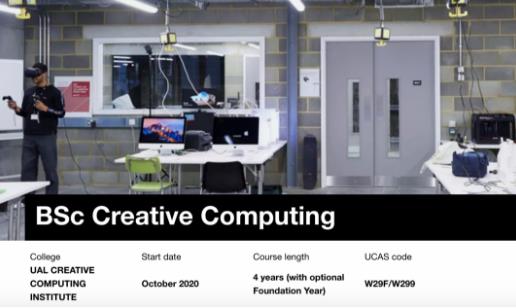
As a new major, UAL conducts interdisciplinary exploratory research at the intersection of creativity and computer technology. This four-year undergraduate course also includes preparatory studies to help students supplement more basic knowledge in cross cutting fields and conduct exploratory research.
During the learning process, students will learn different skills of coding, building applications, making digital experiences, exploring intelligence and other cutting-edge creative industries. Students will comprehensively deal with the future global digital industry, and will be able to become the most competitive new design talents in the digital and development industry.
Year Zero: This year is equivalent to the preparatory course of this major. Students will build a basic understanding of creative computing, including basic knowledge of creative practice and digital production.
Year One: Students will begin to expand their computing skills by learning coding courses, including building data, numbers and programs to help students better carry out creative production and computing practices such as sound, image and experience.
Year Two: With the deepening of students' understanding of computers, students in the second year will gradually begin to design experimental human-computer interaction and explore the digital production of social platforms.
Year Three: In the first semester of the second to third year, students can choose whether to enter the industry for internship; There are also opportunities to cooperate with universities or research institutions in different countries through real practical projects.
Year Three+Year Four: In the last year, students will use the machine intelligence framework to develop creative project work and complete and develop a self dominated graduation project.
In the laboratory based curriculum, students will carry out a series of practice and creative exercises in the form of individual or group. At the same time, the college will also arrange a series of workshops and seminars based on studios to provide students with different dimensions of support and guidance.
MSc Creative Computing
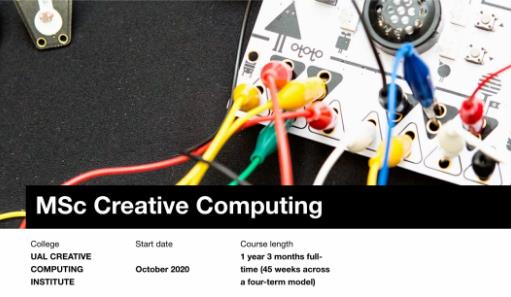
Compared with undergraduate courses, graduate courses are more in-depth and systematic. During the 15 month course, students will learn more deeply in creative practice, programming, computer conceptual thinking and critical thinking.
At the same time, students will explore higher level creative computing fields (such as visual interaction, physical computing and machine intelligence) to accumulate cutting-edge expertise. Through participating in many creative practice projects, students can get a full understanding of the role and opportunities of technology in creating the future in creative practice, creative industry or digital technology, and realize the ultimate aspirations of personal career development in the future.
In the four semester curriculum, students' freedom is also very high. In addition to the series of coding courses that each student must learn, including advanced coding skills such as Python and JavaScript, as well as the learning of development frameworks such as Open Frame works and Unity.
In addition, students can freely choose corresponding studio courses and academic seminar courses according to their professional orientation and research direction.
Because this discipline belongs to a new interdisciplinary field, CCI Innovation College requires applicants to have a disciplinary background in the computer field or interactive design and other creative arts majors, as well as corresponding requirements for internship experience and personal background. Interactive study in the UK Students can come to understand.
Data science and artificial intelligence creative industry
MSc Data Science and AI for the Creative Industries
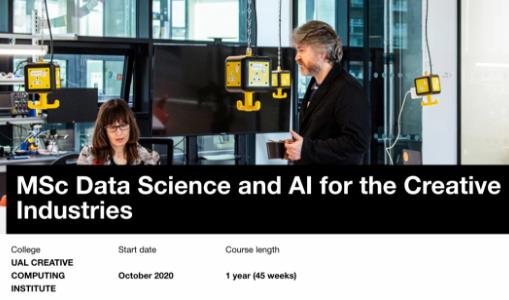
CCI Innovation College has shouldered the social mission entrusted by the UAL since its establishment, including three points:
a. Digital inclusion: ensure that the opportunities provided by innovative technologies can cover the whole society.
b. Technological diversity: to ensure the technological social order we are creating, and to address the existing values and norms in a wide range of social fields.
c. Digital industry: ensure that the infrastructure created can be used by the broad class of society.
With such a mission, this new discipline - MSc Data Science and AI for the Creative Industries/data science and AI creative industries also came into being.
This major is also an MSc Master of Science degree, which requires students to master the data science and AI design skills of creative industries, and provides opportunities for undergraduate graduates majoring in arts and humanities to reposition their learning to the STEM application discipline in creative industries. (STEM science, technology, engineering, mathematics)
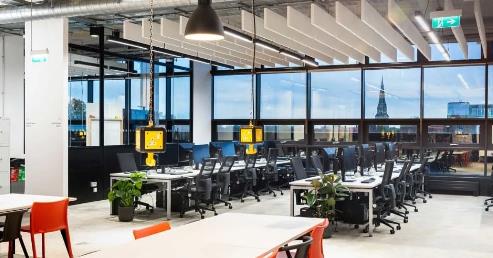
CCI Innovation College Student Studio Source: CCI official website
The one-year course provides students with computer science skills, data science training and AI functional design methods across multiple fields. The three core features of this discipline also include: sophisticated research knowledge based teaching, interactive design of computer technology, and high-quality creative environment.
The course is divided into 7 units according to different learning objectives and courses:
Unit 1-STEM for Creatives
This unit provides the undergraduate graduates majoring in arts and humanities with a "Transformational Thinking Training Camp" for STEM learning, including mathematics, physics and computer courses that lay the foundation for designing data research methods.
Unit 2-Natural Language Processing(NLP)for the Creative Industries
This unit is mainly a practical course, which teaches students to master the development of key coding skills and natural language processing (NLP) to support creative industries, and introduces the concept of applied computer science.
Students will use coding languages such as Python and JavaScript to develop code analysis, software generation, chat robots, etc., for the news industry and data centric marketing industry, and study product design methods in the fields of customer insight and service system improvement.
Unit 3-Introduction to Data Science
This unit is mainly composed of seminars and programming courses. It teaches students to build data, analyze data, and explore big data methods for analysis, including skills such as topic modeling.
Unit 4-Artificial Intelligence for Media
This practice unit introduces students to practical AI tools, such as Tensorflow and PYTorch, so as to conduct research on processing classification, style conversion, image and video generation. Students in this unit also have the opportunity to establish direct cooperation with senior researchers in this field and Google's design team.
Unit 5-Data Science in the Creative Industries
This unit will carry out cooperative teaching with the current industry partners of UAL, including the following fields: a. Data science methods for product development; b. Method design for marketing activity research, customer research, media analysis and generation application.
Unit 6-Personalisation and Machine Learning
This practice unit aims to expand students' machine learning experience, including the construction and testing of audience analysis tools. The study of application computing software based on Python and JavaScript helps students to build a test system for statistical analysis of audience preferences.
Unit 7-Thesis Project
The last unit requires students to complete an 8000-10000 word paper report to record the complete process of technical methods, development, evaluation and design of personal design projects.
CCI Innovation College, a new major, also welcomes students with different academic backgrounds and work experience to apply. UAL also provides special technical resources for everyone to participate in the seminar and curriculum plan of the whole Lunyi Institute, and has more opportunities to interact with researchers, teachers and students of other colleges.
Internet equality
MA Internet Equalities
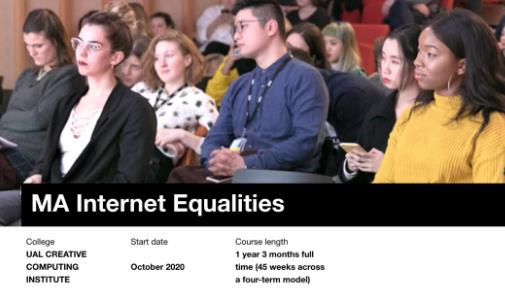
This new major has been officially enrolled since October this year, so the curriculum has not been finalized yet, and may be slightly adjusted later. However, we can clearly see the "wild heart" of this short and powerful major for the future from the professional introduction page on the official website.
It was written in the introduction that MA Internet Equality will explore how to organize, embed and continue human rights relations in Internet technology, and how to redefine equality through criticism, innovation and the practice of activists.
CCI Innovation Institute believes that more and more Internet based products, services and platforms have become hubs for social issues such as racism, gender oppression and economic exclusion. With the development of the art industry, we should also have greater social responsibility. Colleges and universities will train technical professionals who are critical and creative of human rights, inclusiveness and moral design, and contribute strength from the art field to promote social equality and non discrimination.
The college also clearly stated that the core of the course is to oppose all social systems based on race, class, gender, gender identity, sexual orientation, age, belief and ability. Provide students from different academic backgrounds and experiences with technical skills to understand and implement technology development to achieve equality.
Students will explore a series of methods in the 15 month course, including participatory design, feminist human-computer interaction, digital ethnography and public service design. In addition, the school will also organize scholars and creative practitioners of the contemporary affirmative movement to directly teach students how to deal with the social oppression structure in the framework of critical racial technology research, digital feminism, queer theory and post colonial science and technology research.
This course emphasizes more on summarizing the whole course direction with the definition of social organization, and all teachers and students will solve problems together with a cooperative, open, inclusive and diversified attitude.
All courses are divided into 4 units in total. The college will provide students with practice projects in different directions for students to choose independently. It requires students to cooperate with each other and gather their own views to achieve the common goal. At the same time, it respects everyone's individual differences and different life experiences. All projects have no standard answers.
The courses are mainly in the form of seminars and various social practice projects and intervention activities, which will provide reference for the theories and methods taught, and provide students with job opportunities to enter the technology and creative industries, or enter higher academic fields to engage in research.
More recommendations about Lunyi CCI Innovation Institute:
LCF/UCL/Loughborough opened a new specialty? Medical+interactive innovation?
This article belongs to the original article of Natural Light International Art Education Team. Without permission, it cannot be reproduced commercially in any form. If it is found, it must be investigated for legal responsibility.