The "Giant Stone Robot" workshop, together with him from MIT, will build a 3 ton hard core robot without electrical structure! The interdisciplinary practice project integrates multiple disciplines such as industrial design, architecture, landscape, and installation, and has more rigorous data analysis and cultural discussion to bring different content to your portfolio! Take the most original "building" as the starting point, use the most rational parameters and modeling to guide the direction of the design scheme, and finally complete an incredible "boulder robot" 。
Whenever we mention the "megalithic culture", we often think of "miracle", "amazing" and "mystery", which are very attractive words. The mysterious power of the ancient megalithic era has survived for the contemporary, not only culture, but also these amazing wonders.
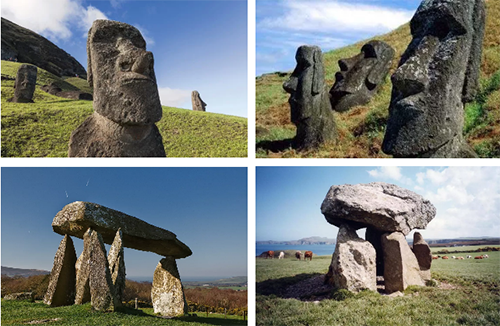
Image from Google "Megalith"
The conjecture about these giant stones, like the time, has never stopped. For example, in MIT SA+P, which ranks the first in the architectural profession in the world, the architect Kaining Peng and his team have been committed to studying the related topics of giant stone culture and architecture.
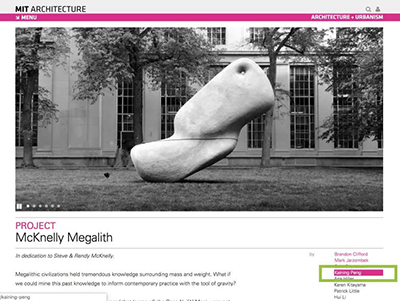
The screenshot is from the MIT official website, Kaining Peng and his team's project
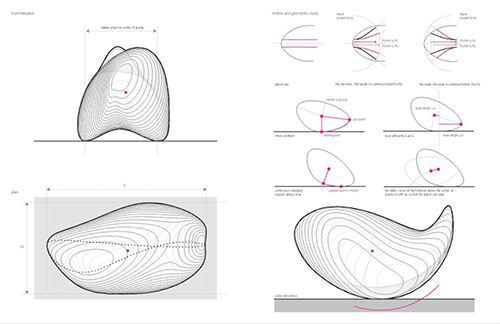
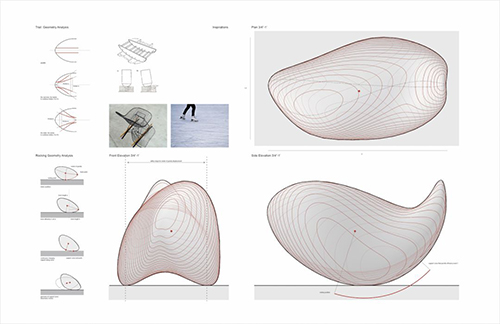
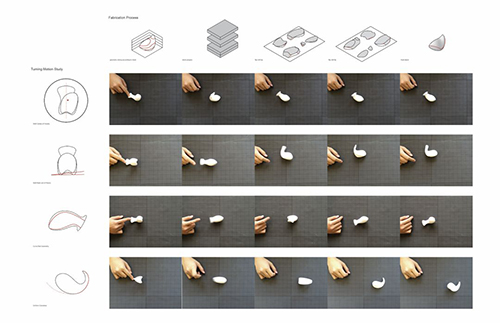
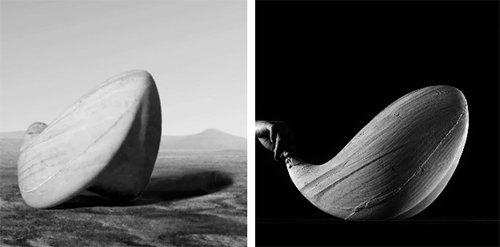
Since the "megalith culture" has become a worldwide research topic, there has never stopped the discussion about its "weight" and "quality". In this project, Kaining Peng and his team partners took the "boulder culture" as the starting point of the project, inspired by the way of rolling stone transportation in the quarry, carried out relevant design exploration in a form of pure physics combined with architectural composition, found the balance point of the boulder with highly meticulous data, and designed the 2000 pound boulder device in combination with the traction of the rope, Let these huge stones weighing several tons "walk" independently, simulating and restoring the "boulder culture".
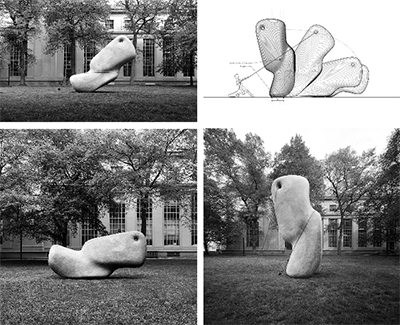
Drawing from
In addition to this project about "boulder culture", Kaining Peng has also completed a series of wonderful projects, from MIT to the domestic architectural field, and worked in Zhixiang Architecture, NADAAA, SOM and other architectural design firms.
This time, natural light and he who participated in the MIT megalithic project invite you to build a "megalithic robot", use reason and curiosity to cooperate with the concept of technology and high-precision, give a new meaning to the ancient "legend", and explore the mysterious building power behind the miracle.
Interdisciplinary Practice Project "Giant Stone Robot" Workshop
Natural light × Peng Kaining
He graduated from MIT Master of Architecture Design, who was educated by two MIT department heads, has served in many famous architectural design firms, and has two years of experience in architectural design tutoring abroad. He is familiar with MIT SA+P teaching philosophy and architectural design thinking. From overseas education to teaching to people, he is a practitioner of breakthrough architectural concepts and an architectural designer with a high sense of responsibility.
Teacher Kaining Peng
Overseas in-service architect, Bachelor of Architecture Design and Finance, University of Toronto, Master of Architecture Design, MIT, with rich practical experience, studied under the two MIT department heads, Nader Tehrani and Mr. Zhang Yonghe have worked in many famous architectural design firms at home and abroad (Zhixiang Architecture, NADAAA, SOM, etc.), served as assistant teachers in MIT's core studio, participated in the Shenzhen Architecture Biennale, and had two years of experience in architectural design tutoring abroad. Many students were enrolled in famous schools (GSD, MIT, COLUMBIA, CORNELL, UCLA They are good at helping students combine concepts with practice, deepen plans, express space, structure and atmosphere.
In 9 days, we will provide 100000+project funds. Building materials will link with modern machines to create a huge interactive device weighing up to 3 tons. We will complete the construction of a giant interactive device, and transform ancient techniques and "architectural" wonders with new modern technology and creativity.
Project background:
Humans once had a high level of megalithic construction. The design concept and construction process of these megalithic structures are often closely combined with customs, rituals and beliefs. Unfortunately, as time goes by, these knowledge and technologies are gradually forgotten, and modern people often show amazement and incomprehension when facing these wonders.
This is actually because people have been accustomed to the rational and functional thinking mode, and the continuous maturity of complex curve surface modeling tools and computing technology has provided a series of design possibilities closer to the original, instinct, and nature. This interdisciplinary landing practice project, "Giant Stone Robot" Workshop, is intended to jump out of the inherent industrial and functional design framework, use the latest electronic tools to rediscover the design of the ancients, and expand the boundaries of contemporary design and construction.
Project highlights:
Implementation and construction of interdisciplinary practice projects
This is a rare opportunity to complete an interdisciplinary practice project combining architecture, industry and installation with architectural designer Kaining Peng. With the most original "building" as the starting point, use the most rational parameters and modeling to guide the direction of the design scheme, and finally complete an incredible "boulder robot".
Non traditional robot construction
In the past, most of the robots we know were completed by sophisticated science and technology, equipped with the latest electronic systems, and even presented in the form of black technology. But this time, we subvert the concept of traditional robots, use architectural design awareness, combined with physical and parametric support, and use modest human power to create giant rock miracles.
Real experience of high pay and high return
The interdisciplinary practice project involves the use of industrial grade high-density polyethylene foam, fiber reinforced concrete, polyamide powder, PVC and other materials; 3D printer, CNC (multi axis numerical control machine tool) multiple equipment support; More than that, Rhino, Tspline, Grasshopper, KANGAROO, ADOBE CC software can be mastered at one time. The final product of this project will be landed in Daxing Qingyun Art Park as an interactive architectural device. The giant stone robot weighs 2-3 tons, and the project cost is estimated to be more than 100000 yuan (the natural light will provide the cost of consumables and venues throughout the whole process, excluding student meals, accommodation).
Immersion overseas team cooperation project
Team work is the most important project practice mode in overseas teaching. This 9-day project practice+course will enable students to feel the power of team work under the leadership of professional tutors and architects. From the brainstorming guided by the initial concept, to the "boulder robot" finally landed in the project, and from the drawing to the reality, every step has condensed the cooperation of the team.
Opportunities to improve the background of high competitive advantage
In the art study abroad, overseas art schools attach great importance to the display of students' comprehensive artistic literacy and various abilities. In addition to the collection of works and application documents, strong interdisciplinary practice project background is also a plus for students' art study abroad. This project practice is based on a new architectural concept, and students' cooperation and participation is not only a comprehensive cultivation of professional ability, but also a unique and highly competitive background improvement opportunity.
Achievements of interdisciplinary practice projects:
1. An interdisciplinary practice project that can be included in the collection of works applied for art study abroad
Integrating multiple disciplines such as industrial design, architecture, landscape, installation, and more rigorous data analysis and cultural discussion, it will bring different content to your portfolio.
2. One time harvest of multiple software and creative skills
Learn 3D modeling, graphic production, and 3D printing to comprehensively improve various abilities. From modeling to parametric programming, not only design, but also develop hard core skills.
3. Scientific prudence and meticulousness match the tension and scale of architecture
Participate with students from all majors, jump out of the limitations of personal projects, feel team cooperation, and sign the name of Jushi Robot after the landing of interdisciplinary projects.
4. One project, multiple gains
Considerable and perceptible real skill mastery and comprehensive ability cultivation, overseas classroom experience under the guidance of team cooperation mode, and the most competitive Improvement of overseas study background Bonus items.
Interdisciplinary practice project arrangement:
Day 1:
10:00-12:00, January 23
Course Introduction
Concept brainstorming
13:00-15:00
Concept and modeling guidance of software teaching (Rhino, Tspline)
Day 2:
10:00-12:00, January 24
Concept report
Mutual evaluation and discussion
13:00-15:00
Software teaching (Rhino, Tspline, 3D Print)
From concept to prototype
Design promotion guidance
Day 3:
10:00-12:00, January 25
Prototype deepening guidance&software teaching (3D Print)
13:00-15:00
3D printing practical operation experience (teaching in firewood department)
Submit the first set of 3D printing prototypes and start printing
Day 4:
10:00-12:00, January 26
Visit CNC factory
13:00-15:00
Device assembly
Day 5:
10:00-12:00, January 27
Device assembly
13:00-15:00
3D printing prototype report and test
Design deepening guidance
Day 6:
10:00-12:00, January 28
Software teaching (PS, AI, VRAY)
Report image and text production
13:00-15:00
Report image and text production
Day 7:
10:00-12:00, January 29
Personal PROTOTYPE achievement report
13:00-15:00
Plant concrete spraying
Day 8&Day 9:
January 30-31
Project completion&rest
Establishment ceremony
Interdisciplinary Practice Project Course Time: January 20 to January 29, 2020 (9 days)
Number of people: 15
Price: 11900 yuan (20% off for natural light internal students)
More about MIT cooperation projects:
How high are the requirements for studying at MIT? What application materials are required?
This article belongs to the original article of Natural Light International Art Education Team. Without permission, it cannot be reproduced commercially in any form. If it is found, it must be investigated for legal responsibility.