This is an article Interview with the Admissions Officer of Maryland Academy of Arts As we all know, just a few days ago, Natural Light came on board as an official certification partner MICA Maryland Academy of Arts College Official Website Natural light and MICA together presented the Chinese version of Portfolio Days for this application season. We also invited Sarah Titford, the admissions officer, to give an exclusive interview. Sarah not only introduced MICA's new art center Center for Creative Citizenship/CCC To connect students and local citizens to create art together. Taking MICA as an example, it also explains the First Year Study in detail, which brings Personal Voice 。
Whether it is the intention behind the establishment of CCC, the curriculum of First Year Study, or the core Personal Voice of the overseas study portfolio, not only MICA Maryland College of Arts In fact, it is "universal" in overseas art schools. Now, we will start an exclusive interview with the admissions officer of the Maryland Academy of Arts!
Center for Creative Citizenship
Sarah: "MICA has many unique courses, and we should especially emphasize that we have opened a new office this year:" Center for Creative Citizenship "(Public Creative Center). We encourage students to interact and cooperate with local citizens and social groups, and carry out project cooperation with different local schools, organizations and companies. These collaborative projects can create business plans for graduates. "
MICA is located in the midtown cultural area of Baltimore, the largest city in Maryland, the United States. It has a strong artistic atmosphere and rich cultural resources. As one of the oldest art schools in the United States, MICA naturally shoulders some heavier cultural responsibilities.
According to the interview with the admissions officer of the Maryland Academy of Arts, MICA's new Center for Creative Citizenship (CCC for short) is such a cultural and artistic medium that connects college students with local citizens. CCC has cooperated with many public non-profit organizations and all private educational institutions in Baltimore to carry out this long-term project.
When it comes to the word "Citizenship", people may think of "citizens" and "citizens". What's the connection between it and art? This is actually what distinguishes MICA from other art schools. MICA, as a representative art school in Maryland, not only focuses on the development of students, but also on whether students can create works with practical significance as local citizens.
Learning and creating together with a wider range of people is a new form of cognition for students majoring in art and design, which enables students to have more social awareness and carry out really useful design with a high sense of responsibility in the social environment.

Image from MICA official website
In fact, it is not just MICA. Many overseas art schools are very encouraging students to cooperate with classmates in other professional fields. They attach importance to students' practical ability, and more importance to students' ability to create in real real environments. Therefore, many off campus cooperation is essential for students.
For example, the double degree major GID of RCA and IC covers a wide range of disciplines and is committed to paying attention to the dynamics of globalization. Its research fields include market, economy, enterprise, culture, medical health, etc. It can meet various needs in a globalized environment by solving problems for enterprises in various fields.
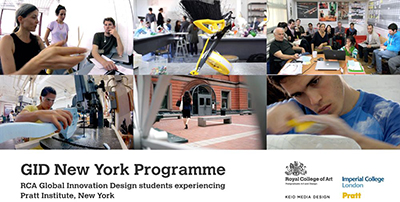
Screenshot from RCA official website
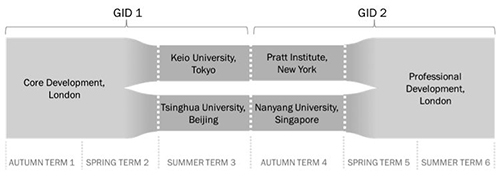
Like other majors, students can choose one of the two research directions provided by the university according to their own conditions in the second academic year (three or four semesters), but these two directions are very different, because... they are two research directions with completely different routes, and students should choose to go to the cooperative organization of the university for the next stage of learning.
The two directions are London Tokyo New York and London Beijing Singapore. Students can study in Keio, Pratt, Tsinghua University, Nanyang Technology and other schools.
Screenshot from RCA official website
Secondly, whether it is the professional theoretical knowledge learned during class or the school projects completed with classmates, every step of accumulation is to start work smoothly after graduation and become a real designer. Therefore, it is also very valuable for students to get practical opportunities in relevant directions during their study.
Under such a combination, MICA provides students with a complex but real environment as a practical medium, so that students can truly feel the society and environment in different cultural atmosphere, and stimulate students' creative thinking and diverse creative ability in the actual environment.
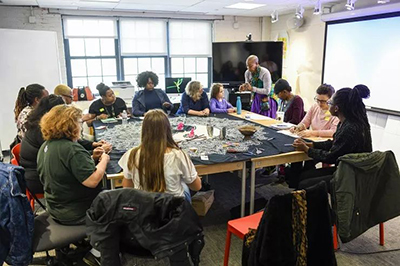
CCC Studio, pictures from MICA official website
First Year Study
Sarah: "At MICA, students apply for the major they want to study, but until the end of the first year, students will officially determine their college major. The first year is mainly for students to explore and try different professional fields. Teachers will carry out teaching in different forms to help students develop their own ideas. After the first year, students can begin to determine their own majors. "
Many students will encounter a variety of basic courses when they first enter the university. These basic courses may be boring and may cost you a lot of time and energy. They may even be the knowledge that students have acquired before preparing their applications. But why set up these basic courses?
Unlike what we call basic courses in China, which tend to grasp skills and theoretical knowledge, the content of basic courses in overseas art colleges is more inclined to shape and cultivate students' awareness. In these courses, teachers will not assign students with specific subject assignments. What students need to do is to constantly explore and find their real interests in the exploration.
In these courses, students gain not only basic skills and theoretical knowledge, but also cognition and understanding of comprehensive aesthetics and design thinking. In the first year of study, students will comprehensively learn basic knowledge in the form of interdisciplinary art study abroad, which will be carried out through Forum courses and courses based on 2D, 3D and 4D media.
Not only MICA, but also this basic understanding of comprehensive aesthetics is a key point in any art school. For example, in RISD, the learning focus of freshmen is also a basic course, which is completed through three aspects: Design, Drawing and Spatial Dynamics.
In this regard, the same is true of British colleges and universities, which attach great importance to students' foundation, but also to their personal development. For example, UAL-LCF/London Fashion College, although courses in the first year are centered around majors, they are also more inclined to basic courses, aiming to inspire students' creative concept development.
It is not difficult to find that, compared with giving students some existing concepts or definitions directly, overseas art schools prefer to let students explore by themselves through practice. In combination with a wide range of cultural and disciplinary backgrounds, students will have a comprehensive and stylized understanding of design through their own research.
Under the framework of these disciplines, students will gain more academic backgrounds as accumulation. At the same time, combining these courses, students will also gain the ability and awareness of independence and deep expression, and think creatively and analytically. The first year of basic courses can help students master basic aesthetic knowledge, have higher visual aesthetic awareness than ordinary people, and have basic visual art application/creation ability.
The lack of basic cognition will lead to a gap in students' creation and learning. Especially in overseas art colleges, the teaching mode is biased towards projects and studios. Students need to have the ability of independent creation and practice, as well as independent thinking design thinking and creative logic, and in the process of continuous research and exploration, Further cultivate deeper critical thinking, independent creation awareness, and the establishment of personal style. These are all based on the preliminary basic courses.
Interview with the Admissions Officer of Maryland Academy of Arts: Personal Voice
Sarah:“ In the preparation stage of the portfolio, MICA pays more attention to active students with diverse skills. We are also looking for students who are interested in many different fields and pay attention to unique ideas, which we call 'Personal Voice'. "
In the Portfolio Days segment of this exclusive interview with the admissions officer of the Maryland Academy of Arts, Sarah also brought a lot of suggestions for the collection of works. All the suggestions are centered around the core "Personal Voice". The collection of works is easy to create, but the collection of works with unique personality and strong personal style is not easy.
For most students, the collection of overseas art works submitted at the time of application is a medium to introduce and recommend yourself to the school. The ordinary collection of works, although not particularly "risky", but also because of the ordinary, the collection lost its characteristics. A collection without highlights will not have a competitive advantage in the application.
Colleges need to know you through your portfolio, and you need to prove yourself with your portfolio. The single project theme and unilateral ability show only one aspect of ability, and the work gathering is very thin. However, project works with strong theme guidance and multi-dimensional ability display can help the collection of works become fuller.
Any professional work collection of studying abroad can be considered to be integrated into other majors Interdisciplinary art study abroad The multi-dimensional attempt and show. Natural light has always encouraged students to try and create in other disciplines.
The creation of the collection of works for studying abroad needs to be organized and primary and secondary. It is not just the accumulation of works that can enrich the content of the collection. Only by taking the theme of the work and the creator himself as the main line, and combining their own advantages, can the collection of works focus more on personal voice.
This time, Sarah not only brought the exclusive Portfolio Days, but also shared a lot of internal information. The newly opened CCC/Public Creative Center connects students with social citizens in the general environment, enabling students to effectively discuss the realization and development of design in the social environment; The arrangement and offering of the First Year course enable students to have a solid foundation of comprehensive aesthetics and design thinking, and also cultivate the sense of independence of independent creation, as well as the ability to combine critical thinking with in-depth expression; The high integration of Personal Voice and interdisciplinary in the application portfolio will ensure the "thickness" and depth of the works while improving the texture of the portfolio, and increase the possibility of success for your application. Also want to know more about the content of the exclusive interview of the admissions officer of the Maryland Academy of Arts. You can get it free of charge by private mail and natural light!
Natural light shares topics with you:
Art study abroad application 64 seasonal study abroad application suggestions from natural light professional instructors
This article belongs to the original article of Natural Light International Art Education Team. Without permission, it cannot be reproduced commercially in any form. If it is found, it must be investigated for legal responsibility.