For students going abroad, Chinatown is a special term. When students are wandering around the world and cannot go home for the holidays, Chinatown has become the common spiritual home of all overseas Chinese. Just as foreigners think that China is like Chinatown, the oriental literature and art in the eyes of foreigners must also be different from our common sense, which can be proved by the Chinese style in the eyes of foreign designers. What does Chinese art, or "mysterious" oriental art, look like in the eyes of foreigners? How should we show and export the unique aesthetic concepts in our culture to foreigners? Today, based on the topic of "Oriental Art" created by western artists, we will take outstanding western artists as examples to see how oriental art is interpreted under the premise of different cultural foundations. Now let's bring you a dry treasure trove of Chinese style works collection, hoping it can help you create your works collection.
Chinese Style Works Collection
Pablo Picasso
(Pablo Picasso)
When our modern impression of Chinese art still lingered on the stylized labels of the so-called ancient style, fine brushwork, and court patterns, a large number of western artists in the early 20th century began to jump out of the category of "shape" and begin to understand Chinese style from the perspective of "appearance", of which Picasso, the master of modern art, is the most familiar.
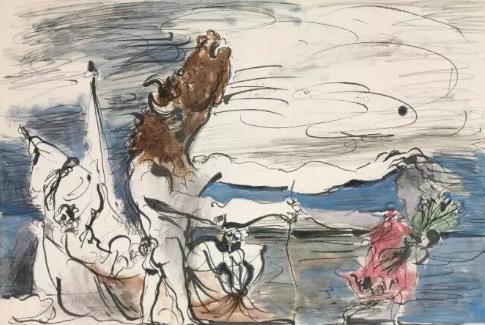
Minotaure aveugle conduit par une petite Pablo Picasso(1881-1973)
The picture "The Little Girl Riding the Bullhead Monster" above is the embodiment of Picasso's excellent ink painting skills. Picasso has a long history with China. Unlike Matisse's passive influence from childhood, Picasso is more adult, and even actively learns and understands after becoming famous.
One of the most famous is the correspondence between him and Guo Moruo, as well as an anecdote about Zhang Daqian's visit to him in France. It is said that when Zhang Daqian visited Picasso, Picasso showed him hundreds of his own ink paintings copied by Qi Baishi. This is also the origin of Qi Baishi's title of "Oriental Picasso".
The authenticity of this period of history has been difficult to identify under the ear of the post population, but the influence of Picasso's Chinese painting techniques is real.
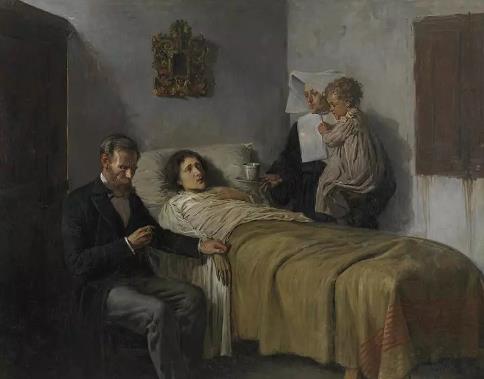
Science and Charity
Pablo Picasso 1897
The biggest difference between western paintings and traditional Chinese paintings is focus perspective and scattered perspective. Picasso's early painting is shown above, which is an obvious work of focus perspective. The composition focus of the whole painting is focused on the woman on the bed, and it is impossible to interpret the painting from other perspectives.
Traditional Chinese painting is the opposite——
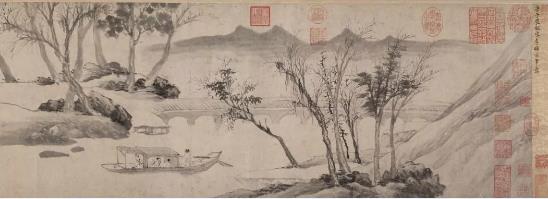
Farewell to the Rainbow Tang Yin
The painting of Tang Bohu is a typical scatterdot perspective. Contrary to the focus perspective, this painting can be seen from different perspectives. This also benefits from the carrier of Chinese traditional painting scroll.
BBC analysis believes that Picasso's artistic style in his later years and even the inspiration for creating cubism were all influenced by traditional Chinese painting techniques.

JUAN LES PINS
Pablo Picasso 1924
The above picture shows the landscape painting "JUAN LES PINS" created by Picasso in his middle age based on the French town of Riviera. Although the style is quite different from that of traditional Chinese painting, the composition of plants and lakes in the picture, the towers set off each other, the scenery placement is difficult to distinguish between primary and secondary, and the beauty can be seen no matter from which angle of view. Is it true that the more you look at it, the more you feel it is the same as the above picture "Farewell to the Rainbow" Is there something similar?
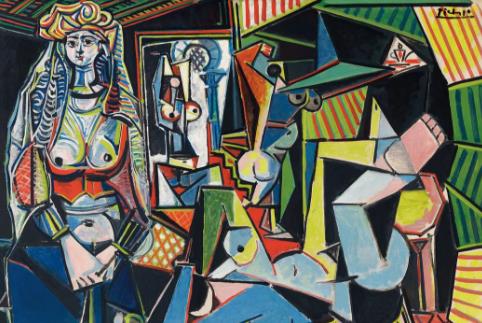
Les Femmes d'Alger Version'O'
Pablo Picasso 1955
In fact, the two paintings, JUAN LES PINS and Les Femmes d'Alger Version 'O', in terms of the composition level and the treatment of the relationship between them and the scenery, can really see the application of scattered perspective and the impact of Chinese painting on Picasso. Les Femmes d'Alger Version 'O' is also recognized as a representative work of Picasso's artistic style transformation.
He finally broke away from the traditional western painting style's excessive demand for a single perspective, or broke the limitations of the so-called "west" or "east", and really let all the artistic techniques be used by him. And it is not just the scattered perspective. The technique of turning pen to front in Chinese traditional art is more common in Picasso's late works.
Drawing lines with different thickness and strength from different angles of the brush tip is also one of the major techniques of Chinese calligraphy and traditional Chinese painting, called "Turn the Brush Frontier". Although Zhang Daqian said that "copying hundreds of Qi Baishi paintings", it is suspected that there is an exaggerated element. However, Picasso, as a foreigner with no Chinese cultural foundation, his understanding of Chinese art can be detailed to the level of the use of brush strokes, but it must not be achieved by a day or a moment of interest.
Although in his later years, Picasso's painting style tends to be simple, simple and self entertaining, his love for ink painting has surpassed all other painting media, and his application is becoming more and more skillful and flexible.
After watching the evolution of Picasso's artistic style throughout his life, people can't help sighing. It turns out that Chinese art has always been narrowed in the public's aesthetic sense. The Chinese style is really more than just the pattern and visual presentation in the bright place. All the aesthetic, composition, visual effects and even painting techniques in Chinese art can be regarded as a kind of Chinese style.
Another modern western pop artist also added a commendable touch to the Chinese culture in the western art history.
David Hockney
(David Hockney)

David Hockney's exhibition "Big Water Flower"
David Hockney, who has just finished his solo exhibition in China, is also a Western artist who is deeply influenced by Chinese art, although he seems to have nothing to do with Chinese style. As a pop artist as famous as Andy Warhol, how does Hockney combine his personal style with Chinese art?
In David Hockney's solo exhibition "Big Water Flower" at Mumu Art Museum, he mentioned the influence of Chinese "scroll painting" on his works.
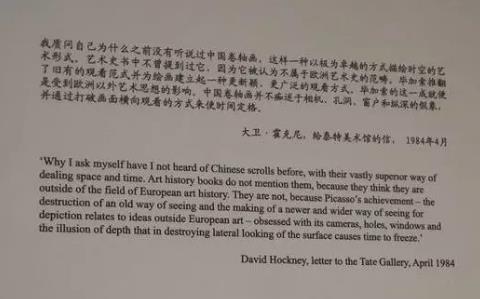
David Hockney's exhibition "Big Water Flower"
The answer to Hockney's Chinese style is hidden in the "changing scenery". The changing scene first originated from the writing technique of ancient travel notes, which means that the perspective moves with people's walking and constantly presents new scenery to readers. The difference from ordinary travel notes lies in that changing the scene takes people's vision as the central narrative, while ordinary travel notes take scenery as the central narrative.

Suzhou Gardens
This technique is also used in the modeling design of garden landscape, which is a very important part of Suzhou garden art. For example, the rock landscape in the above figure, framed by the portal, presents a different style with the movement of the visitors' perspective. The ancients paid attention to painting in gardens and gardens in paintings, so they often projected the aesthetic of art into the construction of gardens.
This painting is dominated by the path. When the audience's eyes move with the path in the painting, the scenery presented will change accordingly. Is there anything more vivid than this?
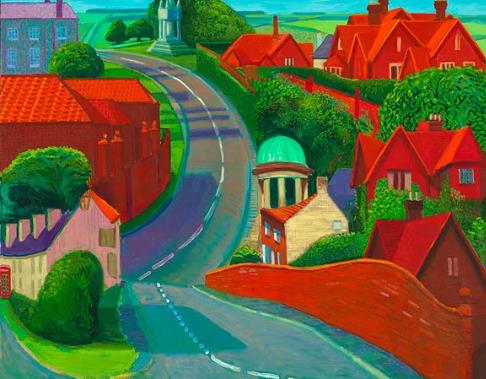
The Road to York through Sledmere,David Hockney 1997
There are many similar paintings of Hockney, but is that all? As a "China hand" who wrote a whole book of "China Diary" for the trip to China, and even directed the documentary "One Day Tour of the Grand Canal with the Chinese Emperor, or the surface is illusion and the depth is also the same" according to the "Kangxi Southern Tour", Hockney gave us more than that.
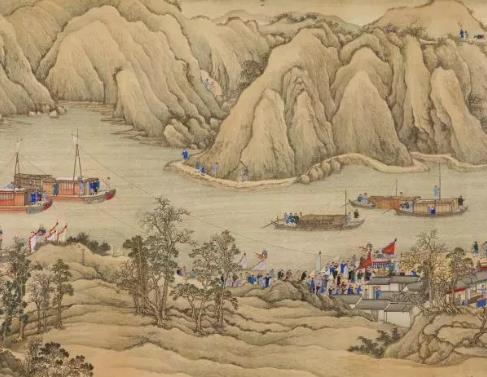
The Painting of Kangxi's Southern Tour (part)
In the film One Day Tour of the Grand Canal with the Chinese Emperor, or the surface is an illusion and the depth is also the same, Hockney's painting, as an example, tells in detail how he "swims in the vast and subtle Chinese scroll painting", as well as the way he feels that Chinese painting depicts time and space with dynamic hands.

Hotel Acatlán:Second day
David Hockney
So looking at Hockney's works, although they have bright colors and visual conflicts, they have a dynamic impression of heaven and earth in traditional Chinese painting in terms of size and expression.
Hockney's understanding of "changing scenery by changing steps" is not only in the size and connotation of the painting, but also in the visual presentation and composition, trying to simulate the vision of the garden window frame.
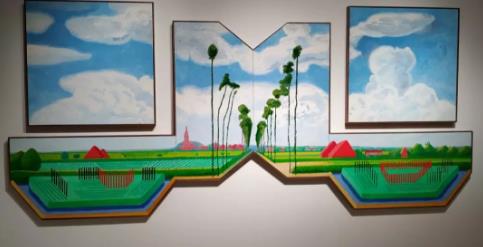
David Hockney's exhibition "Big Water Flower"
The meaning of the frame design of this painting is even better than the painting itself. Hockney went against the way of Suzhou gardens. Suzhou gardens are framed landscapes into paintings, while Hockney turned paintings into landscapes. He divided the static painting through the window pane, giving the painting a sense of spatial hierarchy and dynamic effect.
David Hockney's understanding of Chinese art has not only remained in simple research and learning, but also is more valuable because he can draw inferences from other cases through practice to create new art forms. In the fertile land of traditional Chinese art, he planted his own flowers and fruits.
I believe that students must have been advised by friends or teachers to choose carefully when preparing the collection of Chinese style works. I must have heard friends studying abroad talk about the differences between Chinese and Western cultures and the professor's confusion about oriental thinking.
Indeed, the difference of rooted culture is an insurmountable mountain between us and the admissions officer. However, in the face of the profound traditional Chinese aesthetics, it is really difficult for us who study art to turn a blind eye to it and not make use of it. It is believed that every Chinese art student hopes to let foreign professors see the true beauty of Chinese culture, rather than those rigid labels of backwardness, mystery, and decay.
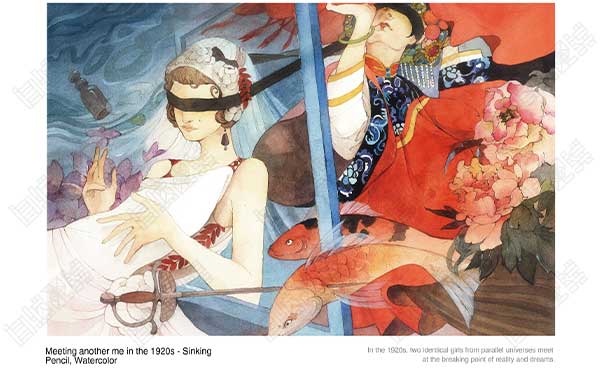
Natural Light Meiqi's Chinese Style Works Collection
First of all, if we want foreign teachers to tear down the label of national style, we need to break our superficial understanding of Chinese art. The three artists cited today are the best examples. As Westerners, what form and what kind of Chinese art can they accept is really worth thinking about.
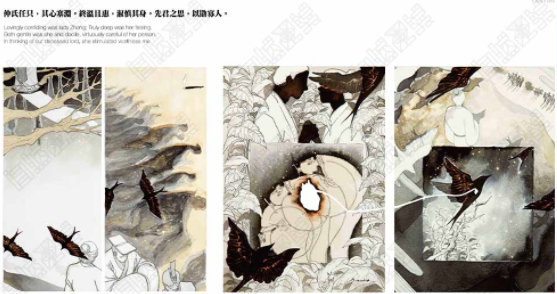
Natural Light Shiyu's Chinese Style Works Collection
Although Matisse seems to only use elements of China, or oriental culture, he makes the seemingly concrete and immutable oriental totem used for his style. In which, combined with the brushwork and color of his Fauvism, he collided with a strange beauty.
Compared with Matisse's shape selection, Picasso is more interested in learning skills. Whether it is the use of ink, the composition of scatter perspective, or the change of pen style, it is a great addition to his new style.
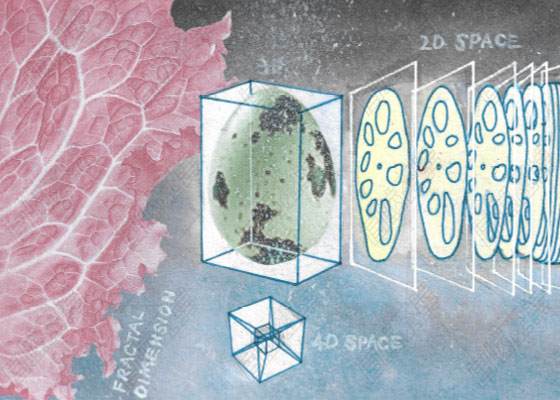
Natural Light Qingwen's Chinese Style Works Collection
Hockney, on the other hand, has the advantages of Matisse and Picasso, and even does not stay in the form or manner of Chinese style, but has created a new situation dedicated to pop art.
So when students are preparing a collection of Chinese style works, there are far more Chinese art styles to choose from than the so-called formal patterns, folk customs, metaphors, etc. The aesthetic characteristics, painting techniques and even the artistic conception of composition over thousands of years in Chinese history can collide with various branches of art, resulting in wonderful chemical reactions. This choice not only does not confuse the admissions officers, but also can skillfully make use of the advantages of Chinese culture to make them see a bright future. Isn't this much better than simply using the superficial Chinese style?
More recommendations:
Is the academic degree of art study abroad a piece of waste paper?
New York Institute of Interior Design Portfolio Requirements
How about the design innovation major of Glasgow Academy of Arts?
This article belongs to the original article of Natural Light International Art Education Team. Without permission, it cannot be reproduced commercially in any form. If it is found, it must be investigated for legal responsibility.