Previously, Natural Light shared the latest collection requirements released by RCA Huangyi this year. The content of the collection was significantly simplified. In addition, it was necessary to upload a two minute video about their own creation process. These nearly "harsh" requirements really made many students panic. The biggest difficulty and innovation is the collection of the creation process. In the past, most students used to record the creation process in the form of sketchbook, and in many cases, colleges and universities did not explicitly require the submission of work collection sketchbook, so we only need to select some key turning points to include in the work collection as part of research. However, through Huang Yi's requirements for updating the collection of works this time, we also gradually found that colleges and universities attach importance to the creation process, which is an important reference basis for investigating the applicant's creative thinking, critical thinking and even the authenticity of the works. In fact, not only do colleges and universities pay more attention to it, but also sketchbook can play a very important role in promoting the creation of our collection of works. It is an indispensable part of the collection of works. So today, let's talk about what decisive role and impact can sketchbook play in the application for art study abroad?
1. Definition of Sketchbook
Sketchbook, as we used to understand, is nothing more than a sketch book and inspiration book, which can be used for people to draw pictures and collate the collected materials into a book.
But the sketchbook prepared for the collection of works is not just these second-hand inspiration materials. A complete sketchbook needs to include the inspiration source of the works, research data, mind map, sketch, preliminary design scheme, material test, production process, etc., which is equivalent to the detailed process of completely transforming second-hand materials into first-hand materials.
In the whole collection process, students need to record the extension and divergence of the initial inspiration in full detail, and calculate the next stages and steps according to the rigorous design logic. Only such a collection of works, sketchbook, can fully demonstrate our clear design process and overall thinking to the admissions officer.
2. Clear sorting and extension of inspiration
"How to find inspiration and how to screen inspiration" is a very frequent problem we usually encounter in our work, and the collection sketchbook is the best way to solve the inspiration problem.
The first is to collect inspiration. Collection is not only to take a picture and save a picture, but also to record our senses, emotions and thoughts as detailed as possible. The process of hand painting is the best transformation process. For this, we can refer to the definition of "observational painting".
Because for everyone, when we observe a thing that triggers inspiration, we quickly record it in the form of skech. The brain has automatically added our feelings and emotions to the inspiration. Of course, to assist the development of ideas, we can also simply and clearly cooperate with words to completely record the process of divergence.
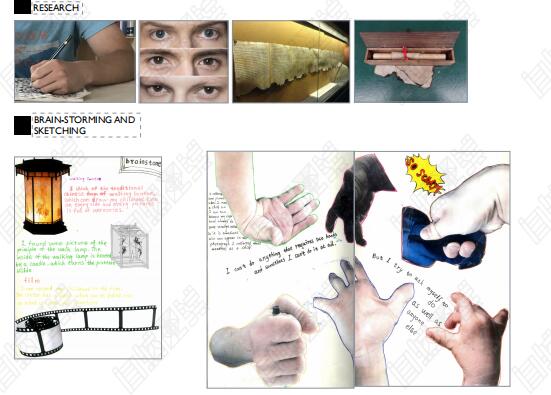
On this basis, we will continue to collect materials related to this inspiration. With the increase of materials, our ideas will be further promoted. Later, we will coordinate with the mind map to clearly sort out and extend the inspiration and ideas.
This step is particularly critical for rigorous disciplines such as industry and architecture. The complete evolution process will directly affect the rationality and completion of the final design results. Because many students receiving art education in China have no habit of recording, they often go to finish the design drawings first and then go back to the analysis process, which is easy to lead to inconsistent results.
Sunmeng, a natural light student, majored in architecture as an undergraduate, had prepared a complete collection of works early, but after our professional teacher's assessment, there was a serious disconnect between the design concept and the design results. In response to this problem, the professional teacher put forward a "strict" requirement, She needs to complete no less than 20 different sketch maps for each set of works.
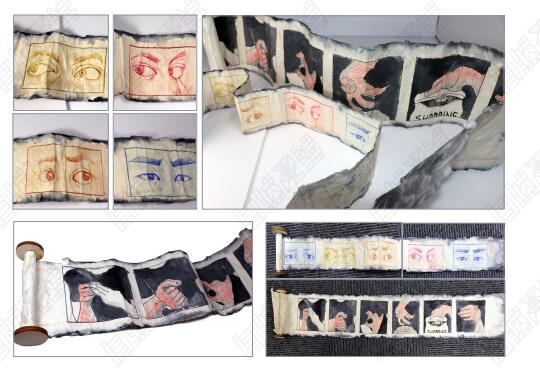
Sunmeng had some complaints at first. She thought that so much research and analysis could not be used in the collection of works. But later, she was very grateful to the professional teacher who proposed this task, because in the follow-up process, she constantly felt that a good early analysis had a strong positive impact on the later design deepening, It has also greatly improved the quality of her entire work.
3. Overall design logic of planning
Generally speaking, in the composition of the collection of works, the sketch part is placed at the front, which is equivalent to a rough introduction, showing us the most central parts from the collection of inspiration, scheme planning, color matching, material selection, etc., so that the admissions officer can have a clear concept of the theme and positioning of our works.
According to the review process of the admissions officer, the first impression is very important, which can determine whether the admissions officer is willing to further understand the content of the student's work. Therefore, when preparing sketchbook, we must clarify our design intent to reflect the process of how our ideas develop and gradually improve.
As we said at the beginning, the collection sketchbook contains a variety of contents. In addition to the inspiration record, we also need to consider specific design schemes, such as what technology, materials, colors, etc. are used, and make full use of our own experimental and exploratory nature. In the later production process, we can also refer to this part for the exploration and transformation of materials, It's both trial and error and finding the best solution.
Admission Royal College of Art Biwei, a student of fashion design, has a collection of works with the theme of [In Soft]. When it comes to softness, people may think of different things - shapes, colors or touch. The soft understanding and imagination of different people is the inspiration source of Biwei's students for this project.

In fact, things that make people feel soft and calm can be seen everywhere in life, most of which are curved. Biwei hopes to explore whether soft things will affect people's emotions through a set of works without straight lines and right angles.
In the whole collection of Biwei's works, the design of ready-made clothes is relatively small, but a large number of materials collected from her sketchbook are displayed. For the extension of the theme of "softness" and the experiment of materials, the final presentation is a very infectious clothing work.

4. Demonstrate comprehensive design capability and potential
In addition, the collection sketchbook usually contains a lot of information, and because our recording process is usually random and mainly hand drawn, the requirements for typesetting are relatively high.
How to let the admissions officer quickly and clearly understand the design process, and cooperate with the style and creativity of the overall collection of works, needs our careful design. In terms of typesetting, in order to highlight aesthetics, my suggestion is to set up a main line of design process, select key elements according to each step, try to focus on pictures, and try to simplify the text.
Secondly, we also need to pay special attention to the placement of elements in various positions, visual balance, and the comprehensive richness of elements. Moreover, sketchbook is also a good part to reflect our style and potential. We don't need to use hand painting or pictures, but also try to use diversified expressions with our works.
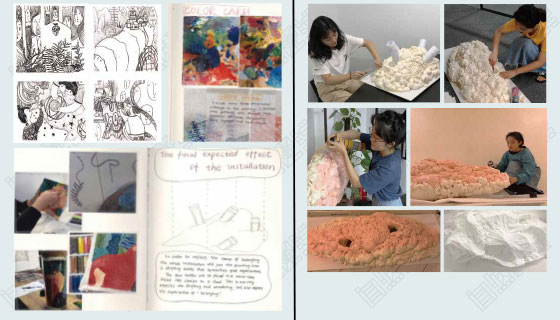
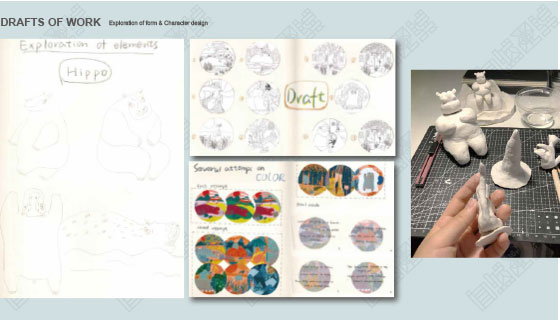
Illustration Design Study Abroad Yiran's collection of works includes 6 works in total. The collection retains the traces of handwork from typesetting, sketching to the creation process, which is very personal and presents the entire design process.
And in her collection of works, sketchbook, combining the characteristics of each work, uses appropriate comprehensive materials such as handmade fabric atlas, pottery device, paper box, etc., which transcends the 2D expression mode, endows the works with more vitality, and also allows viewers to experience a strong visual impact.
Not only Huangyi, but also foreign art schools attach great importance to the investigation, and the applicant's creative process and design ideas can be centrally displayed in the collection of works sketchbook. We should also make it clear that inspiration, creativity, and design schemes are not the result of a sudden inspiration, but should be calculated step by step through careful design thinking, We should take the process of creation seriously, show our attention to details as much as possible, and show our dedication to the creation of works, and these accumulated achievements will also become a huge driving force for our learning process in the future!
This article belongs to the original article of Natural Light International Art Education Team. Without permission, it cannot be reproduced commercially in any form. If it is found, it must be investigated for legal responsibility.