Many art colleges and universities have new majors specialized in interdisciplinary research for fashion design department, but these hidden dark horses are often delayed in naming due to such reasons as "strange looking" and "untouched". For example, CSM's MA Material Futures is one of them. It seems to have nothing to do with fashion, but it is a key course of CSM's jewelry, textile and material research projects. What are the similarities and differences between the future materials of CSM and the fashion material majors such as Material&Jewellery and Textile that are generally recognized?
What is the difference between CSM's future materials and fashion materials?
CSM - Jewelry, Textile and Materials Research Project
CSM Jewellery, Textiles and Materials Programme. Before introducing the graduate courses of Materials Futures, we would like to talk briefly with the students about the Jewellery, Textiles and Materials Programme of Central Saint Martin. This is an interdisciplinary material research project based on the major of Fashion Design Department.

Jewellery, Textiles and Materials Project Video Introduction
On the home page of the project on the official website, we can see the original intention of CSM to set up this project and its four professional courses for detailed degrees - "create things through materials" in the video introduction of Caroline Broadhead, the former director. It seems that this sentence is a bit general. Caroline further introduced the core values of the whole project in the video. The college hopes to expand the experimental research on materials in the whole design field through the jewelry materials and textile materials in fashion design.
It has to be said that the Jewellery, Textiles and Materials project of Central Saint Martin is really very smart. It has chosen materials refined into clothing design as the starting point, and then expanded to interdisciplinary experimental research on design materials in macro concepts. (Understand Saint Martin College of Fashion Design )
The four degree courses included in the project mentioned in the introduction video are the BA courses of Textile Design and Jewellery Design, and the MA courses of Biosign and our hero Material Futures today.
Here is the connection between the past and the future mentioned by Caroline in the introduction video. Textile and Jewellery can be regarded as the relatively basic courses that pave the way for the research of two MA courses, especially the experimental Material Futures; But it can also be seen as an independent fashion material research course.
It is also worth mentioning that under the Jewellery, Textiles and Materials project, there is a Swarovski CONSCIOUS Design Hub (Swarovski Conscious Design Research Room) which is officially cooperated with Swarovski.

Home page of Swarovski Concious Design Hub
The purpose of the research room is to further deepen research and discussion on the sustainable development of materials in design. Although the partner Swarovski is an internationally renowned jewelry brand, the research field of this institute does not stop at jewelry, or fashion design itself.
In the official definition of Conscious Design given by the university, the conscious century is actually a sustainable design research with a conscious environmental protection support attitude.
In addition to jewelry and fashion, the whole project also covers architecture and all design related fields. Since 2015, Swarovski, as a partner, has cumulatively donated more than six million gemstones to the Jewellery, Textiles and Materials Project of Central Saint Martin to study the sustainable design of new material concepts.
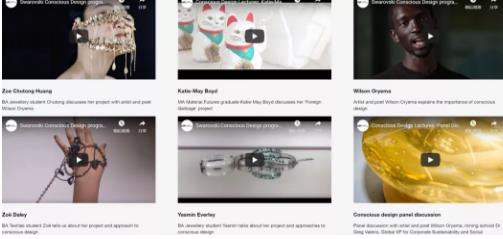
Swarovski Concious Design Hub Research Results Example
From this cooperative research room, we can actually see that the research purpose and direction of this major project set up by Central Saint Martin are more or less related to the recycling of materials and sustainable development.
CSM Jewelry Design
BA (Hons) Jewellery Design, the Swarovski CONSCIOUS Design Hub we just mentioned, actually at the beginning of its establishment, it did not cooperate with the entire Jewellery, Textiles and Materials project, but with the Jewellery Design BA under the project alone. Later, it was further expanded to support the material research of the whole project.
Next, let's take a detailed look at how the undergraduate course of Jewellery Design under the Central Saint Martin's Jewellery, Textiles and Materials project operates.

Introduction to CSM Jewellery Design BA
Although it is a BA course, CSM's Jewellery Design still has its advanced creativity and unique charm. The jewelry designers of Vanke Yabao, Cartier, LV and many other world-class fashion brands have graduated from this undergraduate course.
Like the overall research style of the Jewellery, Textiles and Materials project, the Jewellery Design course highly emphasizes and encourages students to innovate in materials and subvert previous jewelry concepts in research.
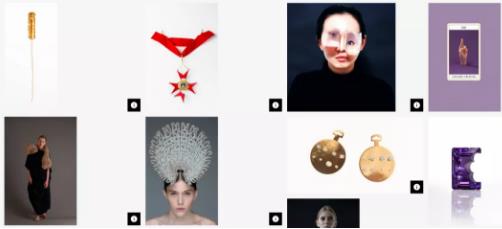
CSM Jewellery Design BA Student Works Exhibition
At the same time, there are also a large number of research opportunities for practical cooperation with well-known international enterprises, which are highlighted by the college. In addition to old friend Swarovski, there are also jewelry design companies such as Cartier and LV, as well as cross-border material cooperation in metal fields such as Wire Workers.

CSM Jewellery Design BA Curriculum
Further refining into the curriculum, we can see that Jewellery Design has high requirements for students' innovation in materials and great "ambition".
In the course overview, in addition to the basic requirements for jewelry materials and shape design, the college also stressed that students are expected to deeply think about the impact of jewelry materials and related manufacturing processes on society, environment and economy. This also corresponds to the research objectives of the Jewellery, Textiles and Materials project we analyzed earlier.
The college divides the course of Jewellery Design into three stages. The first stage is a relatively basic introduction to jewelry design. It is worth mentioning that when entering the second stage, the college's requirements for students began to rise sharply, the proportion of critical research courses increased, and the emphasis began to be placed on interdisciplinary innovative research in addition to jewelry design; The third stage is to implement the specific project output of students.
The three stages are linked to each other, forming a basic and innovative Jewellery Design BA course under the project of Jewellery, Textiles and Materials.
CSM Textile Design
Let's take a look at another BA course - Textile Design under the project which is parallel to Jewellery Design. The two courses seem to be juxtaposed, and there are only differences between jewelry and textile in the name, but in fact, there are still great differences in the style of detailed curriculum.
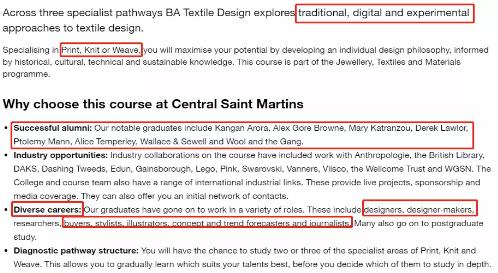
Introduction to CSM Textile Design BA
Textile Design, like Jewellery, has cultivated a large number of excellent designers in the fashion industry and design field. In the professional introduction, Textile Design clearly divides the research of the entire undergraduate teaching course into three ways to explore the three presentation ways of textile fabrics, namely, the traditional way, the digital way and the experimental way.
Traditional and digital approaches are physical research differences, while experimental approaches are more inclined to abstract innovation and academic experimental spirit in the field.
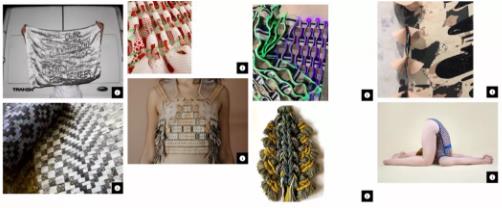
CSM Textile Design BA Student Works Exhibition
It is also worth noting that the employment directions of graduates majoring in Textile Design listed on the official website involve almost all professions in the field of art and design, even journalists. It can also be seen that this is an interdisciplinary practical course with a wide range of practical abilities.
In fact, it is still a lack of persuasiveness to say that how to practice the interdisciplinary nature of specific courses, and whether it can guarantee the practical value in real society while taking into account the experimental nature, depends on the specific curriculum.
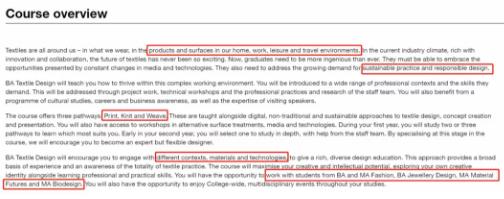
CSM Textile Design BA Curriculum
In the overview of curriculum, the college explained the possibility of such a wide range of employment channels for graduates mentioned above, emphasizing that in the current society, fabric materials cover almost all aspects of human life. What students need to master is not only in the field of traditional fashion clothing.
When it comes to the deconstruction of textile specialty, colleges and universities divide it into three ways: printing, knitting and knitting. In the first year of enrollment, students can widely understand 2-3 ways, and after the second year, they need to select a detailed research direction with the help of teachers.
Textile Design also emphasizes that students in this major are encouraged to cooperate with students in other three Jewellery, Textiles and Materials programs, and will even provide interdisciplinary cooperation in Central Saint Martin and even the whole UAL campus.
CSM Future Materials
Next is our focus today - Material Futures!
In accordance with international practice, let's first take a look at the curriculum. Colleges and universities define Material Futures as the collision of science, technology and design, and use the phrase "we not only envision a bright future, but also are committed to changing it" to summarize the concept of the entire profession.
I never expected that Material Futures, a seemingly "straight" and incompetent major, would still be a romantic idealist advocate.
Further refining to the highlights of the course, we can see that the four highlights almost cover all the research directions of the Jewellery, Textiles and Materials project summarized in the previous article.
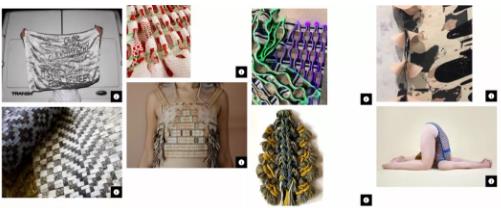
CSM MA Material Futures Student Works Exhibition
1. Future oriented design direction;
2. Focus on the sustainability of materials;
3. Interdisciplinary cooperation within the art industry;
4. Cross field cooperation outside the art industry.
Four discipline highlights are also the research direction of the whole project of Jewellery, Textiles and Materials.
No wonder Caroline Broadhead, the former director of the project, attached great importance to the course Material Futures in the project introduction video.
Faced with such a new concept art design course based on the future, students are often most worried about its foothold. Because for the design field, it is easy to have grand concepts and ambitions, but it is not easy to find the specific practice of research.
How does Central Saint Martin deal with the relationship between practicality and experimentation in the discipline of Material Futures?
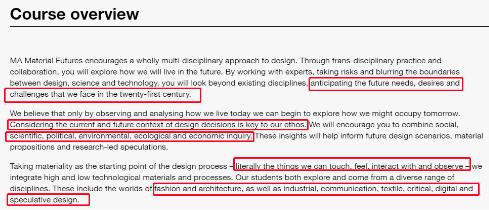
CSM MA Material Futures Curriculum
In the course overview, colleges and universities directly and positively explained the definition of the future. The university said that what the Material Futures major really wants to teach students is the ability to analyze and predict the future development trend of materials according to the current actual situation.
This is bound to require students to go beyond the scope of existing disciplines, blur the barriers between disciplines, and truly study how materials are used in the design field from the root.

CSM MA Material Futures Research Story
However, colleges and universities also said that research on the future does not mean that they do not attach importance to the present, nor does it mean that the teaching style of the major is not rigorous. The teaching system in the whole learning process of Material Futures will be based on the current research.
Just based on the current situation, we will carry out macro and dialectical thinking and research on the subject of materials horizontally across the fields of fashion, architecture, design, industry, communication, and digital, and vertically extend almost all human perception capabilities such as touch, feeling, interaction, and observation.
The curriculum detailed to each stage also closely revolves around the multi-directional and interdisciplinary research and exploration of the theme of materials. Central Saint Martin has made adequate preparations for this new futuristic course, from project endorsement to BA basic research.
In previous articles, we interviewed Material Future, the dean of the Department of Material Futures. From his perspective, he also gave us an interpretation of the new major Material Future, as well as requirements and suggestions for applicants. ( Which discipline is the first student to accept interdisciplinary background when studying abroad in art ?)
The concept of Material Futures seems strange, but it is actually related to all aspects of all design fields dominated by fashion design department. The fashion design department is unique because Central Saint Martin has chosen jewelry and textile as the entry point for future material research.
More recommendations for St. Martin's interdisciplinary courses:
A new interdisciplinary research major at St Martin's College, London, integrating multiple fields
This article belongs to the original article of Natural Light International Art Education Team. Without permission, it cannot be reproduced commercially in any form. If it is found, it must be investigated for legal responsibility.