We all know that CSM Central Saint Martin School of Art and Design has a strong fashion major, so many people ignore that CSM is not only a fashion school, but also a very comprehensive art school. In the past two years, the CSM of St. Martin's College in London has been practicing "interdisciplinary". At the same time, it has really become more and more valuable. Biology, engineering, science... there is almost nothing St. Martin can't do. In April this year, Natural Light UK Campus had an exclusive conversation with Nancy, the head of CSM's newly opened major, Biodesign. Nancy, as the head of the major, "revealed" to us the planning and development of CSM in the direction of "scientific research" in recent years, and further explained it by simply distinguishing Biodesign from material futures of similar majors. Today, natural light will talk to you about the new interdisciplinary research major at St. Martin's College, London.
As the popularity of SDI in the newly opened college of UAL continues to rise, until recently, the number of students who come to learn about these "new" majors in natural light is still increasing, and it is no exaggeration to say that it has also brought about considerable impact on the art study industry. It can be seen that people have paid attention to this new type of interdisciplinary majors in the past two years, So today we will make a more in-depth horizontal comparison with CSM Central St Martins The three most "scientific research" majors: MA Art and Science, MA Material Futures, MA Biodesign. Look at how St. Martin's College London managed the "scientific research" industry, except in the fashion industry!
MA Art and Science
Interdisciplinary
New approaches
Creative insight
Critical investment
It seems that art and science are two completely unrelated majors, but in fact, art has begun to "accompany" science from a very early age, such as the earliest scientific atlas, plant atlas, human anatomy, etc., which are the combination of science and art.
With the common development of art and science, we are now beginning to be in a completely "interdisciplinary" environment. The boundaries between disciplines, whether art or science, are becoming more compatible. In this process, art and science also have a common character - both need creative awareness and insight.
This also makes the two disciplines have the same goal - challenge some views or ideas in the current world, and better solve various problems around us through innovation, so as to help human beings live in a more optimized world atmosphere.
Therefore, the purpose of this major is to let students explore the creative relationship between art and science. Through the creation of art and science, we can better solve the relationship and problems between human activities, living environment and natural things.
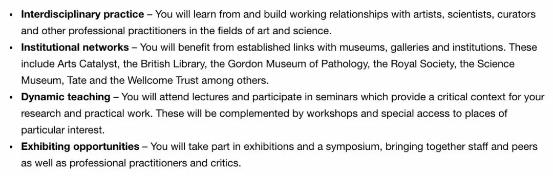
It can also be seen from the name of the major that this is an art major related to science. The educational system is two-year, belonging to CSM Art Program. In the professional positioning part, CSM London Saint Martin College gave four keywords:
Interdisciplinary Practice
Institutional Networks
Dynamic Teaching
Exhibiting Opportunities/Exhibition Opportunities
Let's take a look at them:
Interdisciplinary Practice
First of all, interdisciplinary, which is needless to say. The reason why CSM St. Martin's College London can become a unique presence in the field of fashion, to a large extent, is related to its own advocacy of boldness, independence and interdisciplinary. For example, students majoring in fashion will use some brand new fabrics in their creation, and combine unique creation concepts to carry out cross-border design.
This is also applicable to Art and Science majors. For example, students will not only cooperate with students majoring in art and design, but also with scientists, biologists, curators and other professionals from other backgrounds in their daily study.
Institutional networks
If the UAL itself has brought CSM a good background and academic resources, then maintaining long-term cooperation with art institutions, art foundations, museums, galleries, brand companies, etc. in the industry is a more unique background advantage for CSM. Art institutions such as the British Museum, the Royal Society of Art and Tate are long-term partners of Art and Design.
Dynamic Teaching/Dynamic Teaching&Exhibiting Opportunities/Exhibition Opportunities
Like other professional courses of CSM, Art and Science majors learn in a very open and diversified environment.
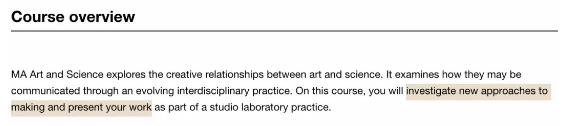
Compared with the "image" relationship between traditional art and science, this major emphasizes students' independent creation of new materials, new ways of creation, etc. through science.
As mentioned in the Course Overview: "invest new approaches to making and present your work"
Secondly, for students of this major, another characteristic is very important, that is, the ability and awareness of questioning. If you want to find out, you must first be able to question. Another key word given by the new interdisciplinary research major at St. Martin's College in London is critical investment.
In the course setting part, since the first semester of Art and Science, students will continue to practice what they have learned with projects.
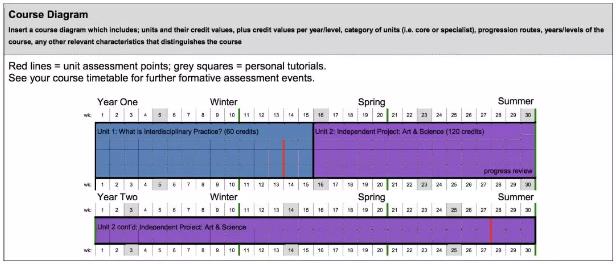
The course of Unit 1 is 60 credits in total and 15 weeks in total. The students will begin to study in an interdisciplinary environment from the beginning. Synthesize the development process of historical theory, use the practice of projects as a unit to better understand different research methods and create new methods.
At Unit 2, the student union began to complete their own independent creation, which accounted for 120 credits. The only thing students need to do in the past half a year is to choose their own tutors, and under the guidance of the tutors, independently complete larger projects and write academic papers. That is to say, even if you are an art student, you need to go out early and return late to do experiments, research, seminars, etc., just like a science student.
The course of Unit 3 seems easy, but it is actually the most challenging for students - because students need to complete their own graduation projects. In addition to preparing works, students should also consider the layout of the final exhibition of works in combination with exhibition planning (this is the Exhibition Opportunities/exhibition opportunities mentioned in the professional positioning section).
MA Material Futures
Future facing
Sustainability
Multi disciplinary
In a word, Material Futures combines material design and industrial design with innovative concepts. It focuses on the properties and characteristics of textiles/fabrics, as well as the design language represented by each new material. This major is divided into Jewellery, Textiles and Materials Program.
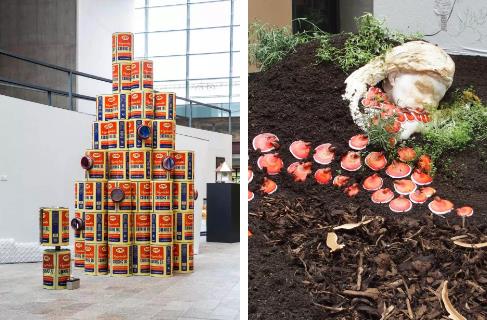
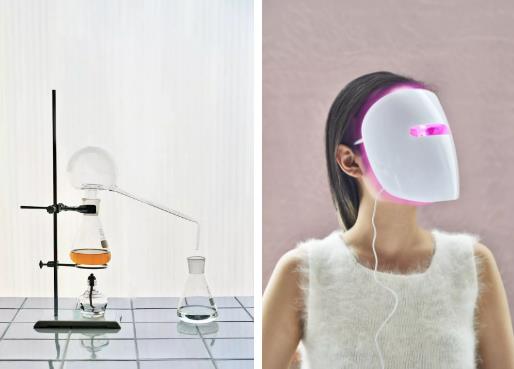
Before the official introduction, let's take a look at the project of the students majoring in Material Futures. It's not difficult to find that although the major belongs to Jewellery, Textiles and Materials Programme, However, it is different from traditional fabrics, metalworking materials and other professions. It is more innovative and has a sense of "black technology", such as nanomaterials, electrode tube materials, optoelectronics, sound, and so on. It can even be said that it is not only the products or materials we currently know, in a broad sense, but also more diversified exploration and attempts.
It is even no exaggeration to say that these topics are about the research and thinking of everything in our life and even in the world. The student union will solve medical and health, economy, ecological balance, natural environment, climate, social culture and other problems through these topics.
In the part of professional introduction, CSM of St. Martin's College in London pointed out its professional orientation:
Material Futures is where science, technology and design college.
We don't only image a better future, but aim to actively change it today.
This idea can almost be said to be very grand. In order to achieve this goal, CSM also disclosed three key information in the application reasons:
Future facing design approach
Embedded focus on sustainability
Multi disciplinary
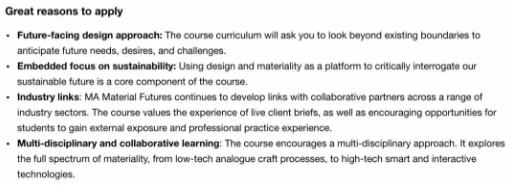
First of all, the new interdisciplinary research major at St. Martin's College in London has very high requirements for students. It should be able to break through the current state and transcend the existing boundaries.
In fact, it can also be seen that Material Futures is really FUTURE and forward-looking. We all know that in the early society of mankind, everything was completed by hand. At the beginning of the industrial revolution, machines began to replace manual labor. In the field of contemporary art, new professions such as new media art and interactive innovative design came into being, accompanied by digital manufacturing and digital media becoming the mainstream.
What Material Future wants to do is to further promote the current state, and at the same time, go back and think about the possibility of new development of traditional materials.
Secondly, Embedded focus on sustainability/sustainability.
Last week, the newly opened school SDI Social Design Institute of UAL mentioned that one of the main development directions is "sustainable fashion/sustainable fashion design", which is a certain overlap with material features. The sustainability proposed by Material Features is mainly in the direction of materials and design, while Sustainable Fashion refers to the whole fashion field.
"Sustainability", as the most frequently mentioned term in recent years, is an inevitable trend of future development, not only in the field of art design or science, but also in many disciplines.
Finally, multi discipline, namely "interdisciplinary", is the primary development trend among disciplines. Students majoring in Material Futures are encouraged to study in a completely interdisciplinary atmosphere.
The reason why the school does this is to enable students to go beyond the existing discipline orientation to "predict" the future needs and challenges we will face in the twenty-first century. In other words, students need forward-looking ideas to "predict" a series of problems that may occur in the future world in advance.
In specific project practice, CSM of St. Martin's College London said: "We believe that only by observing and analyzing how we live today we can begin to explore how we might occupy tomorrow." Future clues.
Therefore, the school particularly encourages students to combine social science, politics, environment, ecology, economy, architecture, industry, communication, textile, programming, digital technology and other disciplines to spread. (This is actually another manifestation of mixed multi discipline/interdisciplinary)
The curriculum is also divided into three units.
Unit 1 is summarized as Material Experimentation/material test stage. Therefore, students in this stage of the course will conduct a lot of material experiments to obtain new ideas, new methods, and find new design problems. That is to say, students need to rebuild a perfect cognitive system and creative way system first, and then gradually go deep into specific projects to implement these "methodologies" and ideas.
Here, the school mentioned: forget your previous disciplines and methodologies, and to experience and be ambitious.
Unit 2 is the advanced stage of Unit 1. Students will start a deeper and more formal project research based on what Unit 1 has learned and gained. Therefore, the school calls this stage "Material Proposal/Substantive Goal".
From then on, students will use the research ideas and abilities accumulated by Unit 1 to carry out deeper research and exploration, and feedback these into specific projects.

MA Biodesign
Emergency discipline
Grow Lab/Central Saint Martin Growth Lab
Research networks/open research networks
Knowledge exchange/knowledge sharing&exchange
MA Biodesign has been introduced to you before, and Natural Light has also conducted an exclusive interview with Nancy Diniz, the course leader of the major.
In Nabcy's view, the purpose of setting up Biodesign is mainly to integrate biological bionics and biological principles into design practice, so as to cultivate a new class of designers who can create a better future by combining the concept of sustainable development in an interdisciplinary way.
In the explanation given on the official website of CSM of St. Martin's College in London, there is such a sentence: we can learn from nature to create more sustainable ways of living
No matter any subject in the biological system, such as life science, biological integration, bionics, biological information, etc., although they all have different priorities and directions, they are very clear that we can learn from the natural ecosystem. We can solve many problems under the definition of "biology" itself, so as to create more sustainable methods.
This is related to the first two majors, but there are also differences. Biodesign emphasizes on relying on the theoretical basis of biology and bionics to carry out design "transformation" and research and development. However, for designers, all research or projects still follow the current focus of the world - sustainable development. Replace some currently infeasible lifestyles with biological recycling, so as to redefine the use of energy, water, air and waste materials.
For example, students in this major Portfolio Coaching The following problems will be solved:
-How can humans coexist peacefully with the natural ecosystem to create new sustainable materials?
-How can we incorporate the value of beneficial life into the solution balanced with the organisms in the surrounding ecosystem in the design process?
-How can we design biological systems to address some of the challenges of the contemporary world? For example, urban resilience, human and environmental health?
-How does biological design contribute to the circular economy?
-Can bioprogramming simulate and model life systems with energy and material efficiency?
Today, I made a detailed comparison and analysis of the new interdisciplinary research major at St. Martin's College in London. CSM is "outrageous" in its fashion; But in scientific research, CSM is really "reliable". Among the three majors, Art and Science mainly focuses on the combination of art and science, exploring the relationship between art and science in a broad sense to find more practicality and landing between them; In terms of specific implementation, it is reflected in the use of creative insight and critical thinking to solve the relationship and problems between human activities and the living environment, as well as the natural world. The coverage of Material Futures is more extensive. Although the professional orientation is related to industrial products and materials, it seems to be a major focusing on "Material", in fact, it focuses more on "Futures" in the name of the major. The last mentioned Biodesign is to re understand the world from the perspective of natural laws and ecological cycle, put ecological methodology into design, and use different disciplines to solve problems more creatively.
The three new interdisciplinary research majors of CSM London Saint Martin College have their own emphasis, but they have something in common. Like the new SDI launched by the UAL this time, they all emphasize "sustainability" and "interdisciplinary". These majors themselves have integrated a high degree of sustainability and interdisciplinary concepts, which are the integration of multi disciplines and multi fields.
This article belongs to the original article of Natural Light International Art Education Team. Without permission, it cannot be reproduced commercially in any form. If it is found, it must be investigated for legal responsibility.