What is pure art? What are the specialties of studying abroad in pure art? The most important step in the preparation for art study abroad is to choose a specific major. Only when a specific major is determined can students start their own collection of works and applications, but choosing a major is often the most troublesome step. Maybe it's OK to say that other majors, especially pure art majors, are the most difficult to study abroad. So, what is pure art? Is it a specific specialty? Or a college? What majors does it include? Let's introduce it to you today.
In fact, it's no wonder that we can't distinguish. Different schools have different arrangements for pure art. Some schools will regard Fine Arts as a separate major, such as Parsons, but some schools will regard Fine Arts as a college, just like RISD, MICA, and RCA we will talk about today. When Fine Arts came into being as a college, the specific division of disciplines in the college was also puzzling.
What are the specialties of Fine Arts?
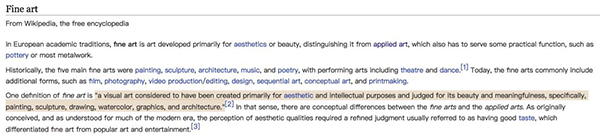
Let's first look at how the term Fine Art is interpreted in various "dictionaries". First of all, Cambridge Dictionary/Cambridge Dictionary gives a very simple definition, with only one sentence: Fine Art is an art that has no practical use value, such as painting, printmaking, and sculpture, but is respected because it is beautiful; Secondly, let's take a look at Wikipedia, which gives more understanding than Wikipedia: Wiki gives a definition based on traditional European aesthetics; Fine Art is the artistic expression of aesthetics or aesthetic feeling, which should be distinguished from applied art/arts and crafts. The so-called applied art refers to the art form that integrates decoration and design into practical objects in life. In traditional aesthetic consciousness, it refers to pottery, metal products, etc.
In the traditional art concept, pure art is mainly divided into five forms: painting/painting, sculpture/sculpture, architecture/architecture, music, and poetry/poetry, as well as the nature/drama and dance/dance belonging to the performing arts. Of course, nothing can remain unchanged for hundreds of years. The development of modern and contemporary art has also given a new definition to Fine Art, such as film, photography, design, conceptual art, printmaking, etc.
What is pure art?
In order to facilitate your understanding, I'd like to paste the original picture of Wikipedia. You can pay attention to the part I drew with marks. Here, I emphasize one of the definitions of Fine Art, that is, visual art based on aesthetics.
To sum up the understanding of the above two dictionaries, we can draw the key points:
1 Fine Art needs to have high aesthetic value;
2 Fine Art should be distinguished from Applied Art (that is, the Practical use mentioned in Cambridge Dictionary);
3 Fine Art has a wide range of forms, including music, drama, dance, poetry, etc.
After understanding what pure art is, let's take a look at what majors are included in Fine Art in colleges and universities. Here, we can also see the division of Fine Arts in several universities. This time, we choose RISD, MICA and RCA as the comparison. first RISD Rhode Island School of Design As the second largest art school in the United States and the third largest in the world, its humanities and pure arts have always left a relatively rigid impression. This time, we will see whether it is so rigid as everyone understands it; MICA, the first pure art school in the United States, need not say more; RCA is the first art school in the world and must be the focus of our investigation.
The division of pure art in RISD, MICA and RCA is roughly as follows:
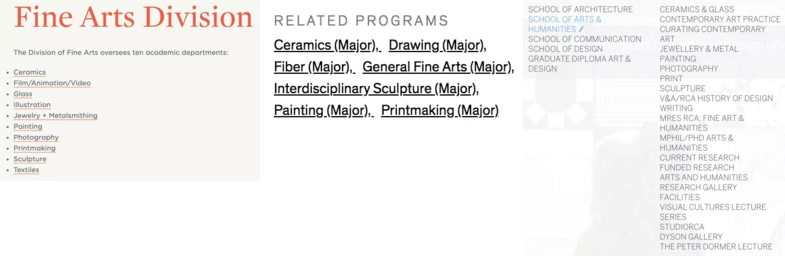
RISD on the left; MICA in the middle, RCA in the right
Different schools have their own classification methods for pure arts Art Design They are also different. For example, Ceramics and Glass, in the traditional definition given by wiki, should be included in the field of applied art. But these three schools all put them in the pure arts. RISD regards them as independent majors. MICA only has the major of Ceramics, while RCA puts them together.
In addition to these two majors, most students have the impression that jewelry design and fabric, which should belong to fashion design, are also divided into the field of pure art; Secondly, there are films/dynamic effects/videos and photography that seem to belong to film and television production; As well as interdisciplinary new media art, they have all become pure arts majors. Next, let's take a look at why these majors are pure arts majors.
Ceramics&Glass
We mentioned above that RISD and RCA have different classifications for them. In RISD, Ceramics is positioned as follows: raw clay of ceramics is a medium with strong expressiveness and diversified possibilities; Glass has also been given the definition of "similar". One word to pay special attention to is "artist's material". As the creative material of artists, glass has an extraordinary scope of expression and a space full of unlimited potential, which can be used to integrate sculpture, architecture, design, craft and decorative arts.
According to the above definition, we can understand that in RISD, Ceramics and Glass are only artistic expression media, that is, specific materials, which need to be combined with other art forms to complete, just like the pigments used in painting and the clay used in sculpture. Here, ceramics and glass are not specific to real objects, such as vases or pots and pans.
Of course, for students of these two majors, basic ceramic/glass firing skills are still required. But as RISD BFA Glass said in the course part, "Glass is a dynamic medium with limited possibilities and a surpassing amount of impact in the world of art and design." On the basis of such basic skills, you need to explore a breakthrough or innovative use space. Because glass is a dynamic medium with unlimited possibilities, it can have an amazing impact in the field of art and design.
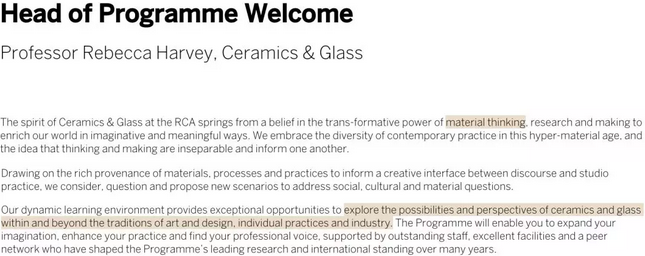
RISD has put forward a definition of "material" for Ceramics and Glass. When we see RCA and MICA, we will find that these two schools also agree with this view. First of all, although RCA puts these two majors together, it still does not affect its interpretation of these two majors. As RCA put forward in the professional description, the main core of this major is material thinking.
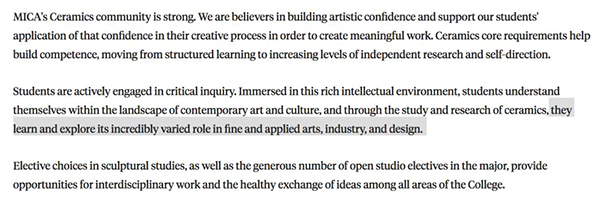
Secondly, MICA has no Glass major, only Ceramics. But in the professional introduction part, there is also a sentence: "they learn and explore its increasingly varied role in fine and applied arts, industry, and design." They/students learn and explore the various roles that ceramics play in pure art, applied art, industry, and design. It is easy to see here that, in fact, ceramics are also a medium of artistic expression for MICA.
Jewelry+Metalsmithing Jewelry and Metal Design
In the three schools I selected today, both RISD and RCA have divided jewelry design into pure art fields. I have seen several schools' interpretations of ceramics and glass before, and it may be speculated that jewelry and metal design should also be classified from the perspective of "art media".
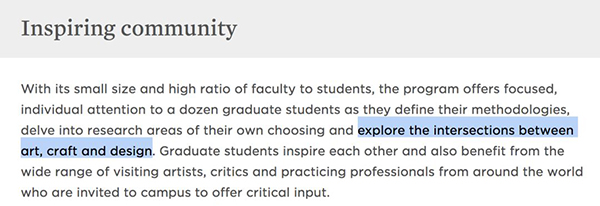
For example, RISD said "explore the intersections between art, craft and design", The major of jewelry and metal products is not only about jewelry itself. The focus of students' study is not the jewelry market or the combination of jewelry as fashion accessories and clothing design, but also as a carrier for artists to express their ideas and ideas, to explore the relationship between art, design and technology required to form jewelry.
Like the previous ceramic majors, not only RISD understands it this way, but RCA also understands it this way, except that it starts from the identity of artists and ordinary individuals respectively: for artists, it is very important to dominate the creation process of works through manual manufacturing or some digital technology, because this is the way we understand the world; As independent individuals, we are often fascinated by the rich and diverse materials and resources provided to us by the world. With the help of these resources and materials, our ideas and creativity can be constantly amplified and displayed in an artistic form.

Jewellery&Metal, jewelry and materials are the focus of the profession. The application of traditional materials, modern new materials and various crafts can meet the needs and desires of creators for expression. Therefore, the school also encourages students to continue to try and explore materials, and design and create in an open and critical manner.
Film/Animation/Video/Photography
At the beginning, we also said that in the field of contemporary art, these majors are generally divided into the field of pure art, but some schools will put these majors in Media Arts, such as UAL LCC, Film, Animation, which is under Screen School, while Photography is in Media School. And even RISD and RCA, which we use as examples, have different understandings about these majors. For example, RCA puts Animation under the Communication College.

Why are these majors also included in pure arts?
In contrast to RISD and RCA: RISD Film/Animation/Video, whether it is film, animation, installation art, or interactive media, they are all "the tools needed to create a creative vision" to express the tools needed for creative vision. In itself, they are not art, but the path through which art can be presented.
In the professional part of Photography, there is a sentence that has the same meaning: "RISD approaches photography as an ever changing set of technical, Conceptual and aesthetic conditions that exist within a broad social and cultural context.
In RCA's view, photography has become a very vague concept since its appearance. In the original definition of photography, it is used to record people or objects. As a photographer, it just "tells" the existing things. But in modern times, many artists regard photography as a kind of emotional sustenance and expression, even a special way of painting.
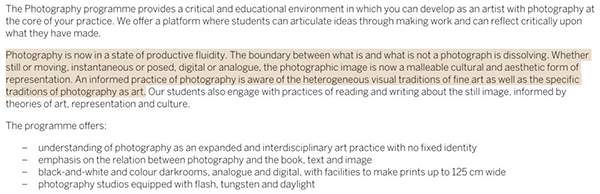
At that time, photography is no longer just a record. As RCA said, "The boundary between what is and what is not a photograph is dissolving, instantaneous or posed,digital or analogue,the photographic image is now a malleable cultural and aesthetic form of representation.” There is no absolute dividing standard for what is photography and what is not photography. Whether it is dynamic photography or static photography, or digital photography, or composition photography, it is a plastic form of cultural and aesthetic expression.
Textiles&Fiber
Students who often participate in natural light workshops or offline activities should not be surprised that these two majors appear in Fine Arts. For example, Megan Suttles, who served as the vice chairman of the admissions officer of Pratt Pratt School of Art for eight consecutive years during the 2018 summer school, once used 100 small objects in the workshop to interpret the meaning of sculpture; In this workshop, she extends the "traditional" sculpture. When creating, she regards the whole space as a canvas, and uses some ordinary and common materials to create "sculpture" through constant repetition and superposition.
Many of the students who came to participate in the sculpture used clothing fabrics for the first time, creating a new form of sculpture. In this respect, Textiles and Fiber are materials and media with creative attributes, just like the photography, ceramics and glass mentioned in the previous majors.
such as MICA Maryland College of Arts Although there is a strong scientific emphasis in the major, you'll explore both 2D and 3D approaches,and many fiber students create work that involves installations,performance,video,and other cross-disciplinary approaches.” Although this major has a strong sense of sculpture form, many students of this major have integrated installation, performance, video and other interdisciplinary works into their own creation through 2D or 3D methods.
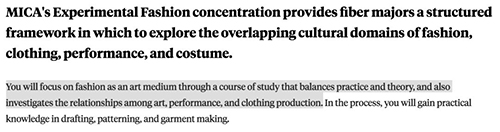
In MICA, even if Fiber is involved in Fashion, it is more inclined to Experimental Fashion, that is, exploratory research on material feasibility in the field of fashion. Students will focus on the field of fashion, which is what most of our students think of as the fabric in fashion design.
General Fine arts
Having said that all the above schools have majors, let's take a look at some special majors, such as MICA's General Fine Arts. In fact, Alessandra Torres, the current admissions officer from MICA, also briefly shared this major with us in our interview in the admissions officer activity season. Unlike Fine Arts, this major can be translated into "comprehensive art" in Chinese. The focus of this major is not any medium, art form, or domain specific knowledge framework. This major is an interdisciplinary major set up by MICA for pure art. You can see it correctly. The focus and core of this major is "interdisciplinary".

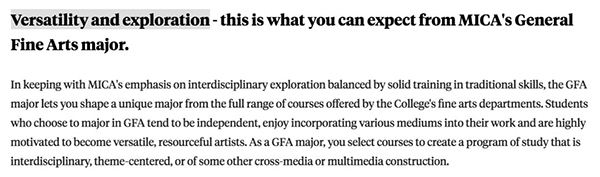
Students of this major still focus on painting, video, performance, writing, etc., but in addition to these traditional pure artistic creations, no matter what form you choose to express yourself, interdisciplinary is the core of their major. Interdisciplinary, cross media, in learning and creation, we should constantly integrate these two points. In particular, MICA directly expressed in its official statement that "Versatility and exploration this is what you can expect from MICA's General Fine Arts major." Multi functionality and exploration are the focus of this profession.
Interdisciplinary Sculpture
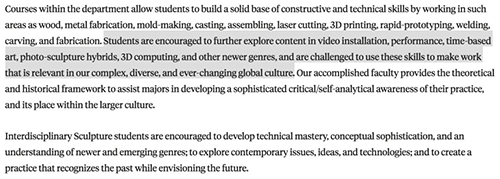
"Interdisciplinary sculpture", to be honest, is the first time that I have seen such a "blatant" placement of interdisciplinary in the name of a major. But like the workshop of Megan, the Pratt admissions officer, which I introduced earlier, sculpture can also be "interdisciplinary" or a multi media presentation, but MICA has expanded this "workshop" to a complete major.
Sculpture is the origin of contemporary art. In fact, many new artistic expressions can be regarded as sculptures, such as new media art installations, performance art installations, and interactive space experience. The original starting point is sculpture. For example, in fashion design, clothes are sculptures created by designers; In product design, we can also regard a specific product as a "sculpture".
Interdisciplinary Sculpture gives students the opportunity to explore "interdisciplinary" in such a highly inclusive and "primitive" major.

The key point of this major is to enable students to obtain their own unique artistic thinking and creative ideas through continuous exploration. The projects studied by students, like General Fine Arts, are not specific fields, but global social problems, life problems, etc.
Just like fashion design, even if designers incorporate various elements into the design, the final presentation needs to rely on the media of "clothing". However, the interdisciplinarity sculpture is different. Although it is sculpture, there are many forms of sculpture, and the final presentation can also rely on different forms. Compared with fashion design, More freedom.
Interdisciplinary and New Media
This is a special major, so I would like to talk to you at the end, introducing the institutions of this major, not RISD, MICA, nor RCA, but SVA. SVA's Computer Arts has always been famous. With this advantage, its Fine Arts also emphasizes the application of New Media. Although the Fine Arts in the undergraduate and graduate stage are directly based on specific majors, in the Continuing Education section, we can see SVA's understanding of Fine Arts through professional short-term courses. Among them, interdisciplinarity and New Media are particularly prominent.
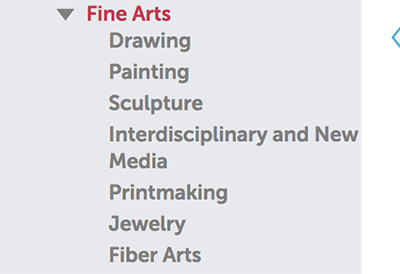
In fact, seriously speaking, this is not a major. After all, Fine Arts is a major in SVA, but even in the professional part of Fine Arts, we can see the following sentence: "In addition to traditional media, SVA offers experimental practices in digital sculpture and the emerging field of bio art.

Compared with the traditional definition of Fine Arts, SVA has fully endowed Fine Arts with a new concept. In addition to traditional media, Fine Arts is now an art form that combines new media technology to express. New Media and Bio Art have almost become necessary items. Compared with the three schools we saw earlier, SVA made a more decisive choice.
Looking at the definition of Fine Arts mentioned today and the specific Fine Arts majors I mentioned with RISD, MICA, RCA and SVA as examples, it is not difficult to find that, although in the traditional definition, pure art is the existence of difference and applied art, so far, the boundaries between the two have actually crossed.
Especially in the understanding of some concepts, like the glass mentioned above, it can be used as a glass product in applied art, as a "product", or as a material for artistic expression. At this time, it is not different from the painting materials we see in terms of properties.
Secondly, just like the glass profession, most people used to think that the professions that could not exist in the scope of pure art, such as films, jewelry, etc., actually regarded them as specific "works" rather than artistic expression forms. They can be counted as pure art when they appear as artistic expression media.
Finally, pure art is not unchangeable. The five major art forms in the traditional definition are Fine Arts. At present, they combine new media technology and digital media professionals, such as installation art, interactive sculpture, etc., also belong to Fine Arts.
Natural light recommends more topics for you:
Jewelry and metal design: Take RISD and RCA as examples to unlock the new expression of pure art jewelry design
Fine Art Sister Sharing Application for American Pure Art
This article belongs to the original article of Natural Light International Art Education Team. Without permission, it cannot be reproduced commercially in any form. If it is found, it must be investigated for legal responsibility.