Whether it is SAIC of the Chicago Academy of Arts or MICA of the Maryland Academy of Arts, the rankings of American pure art schools for studying abroad are very good. Which one is more suitable for you, SAIC or MICA? Two top universities with rich resources and strong artistic atmosphere have some significant differences in specialty setting and training direction. To help you better understand the pure arts major and find the best "trump card choice" for yourself, today we will analyze one by one through the university background, curriculum, enrollment requirements, etc.
SAIC and MICA:
01. College Background
Art Institute of Chicago SAIC
SAIC has always enjoyed a high reputation in the art education industry, ranking top 15 and US in this year's QS ranking NEWS ranks fourth. In addition, the Chicago Art Museum, the second largest art museum in the United States, is also an important part of SAIC, giving the whole campus a strong artistic atmosphere.
Students can imagine the classroom scene, shuttle between thousands of human art treasures every day, and surround the authentic works of Vincent van Gogh, Monet and other masters, and professors can teach us on the spot. This kind of learning resources and art atmosphere is really the most ideal classroom for pure art majors.
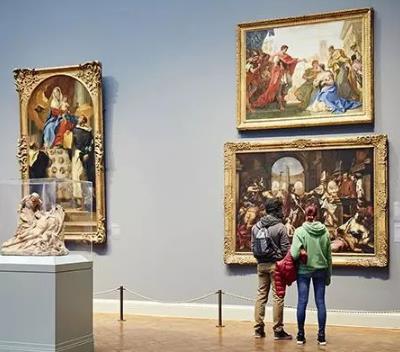
In addition to the museum, John M. Flaxman Library, the largest library in the United States, is next to the school. It has more than 120000 books, most of which are only open to SAIC teachers and students.
In addition, you may think that it is not easy for pure art graduates to find jobs because they are too "art". This theory has also been broken by SAIC. According to statistics, six months after graduation, the proportion of SAIC students in museums, galleries, independent studios or continue to study is as high as 95%, which is the leading level in the United States.
Maryland Academy of Arts MICA
MICA is one of the oldest art schools in the United States and the first to set up photography, illustration and other pure arts majors. It has accumulated rich teaching advantages in visual arts over the past century. Therefore, photography, plane, sculpture, painting and other pure arts majors are located in the US all the year round Top 5 on the NEWS leaderboard.

MICA campus is located in the old city of Baltimore, the United States, with a strong historical and cultural atmosphere. Because the campus is less than an hour's drive from Washington and less than three hours from New York, convenient transportation and developed regional economy, the school will often invite well-known artists and curators to participate in academic exchanges with students.
Compared with art schools located in New York, San Francisco and other big cities, MICA The campus covers a larger area and has a more beautiful environment, and the college is also adjacent to the famous Johns Hopkins University and Pipadi Conservatory of Music. Therefore, it carries out a variety of cross school elective courses for students' diverse learning needs. In addition, the school also provides students with advanced infrastructure, such as 24-hour multimedia equipment classrooms, personal studios, laboratories, etc.
02. Curriculum
Chicago Academy of Arts SAIC
SAIC curriculum also fully reflects the free direction of pure art. Undergraduate students do not need to choose specific majors or limit courses when they enter the university. Students can choose courses freely from many art media according to their interests or the direction of their works, As SAIC explained, "Our purpose is to provide you with a way of thinking and help you prepare for the development of diversity in the future."
At the undergraduate stage, students can choose three classes of courses. The first class is mainly studio courses. Except for architecture, most of them are pure arts: ceramics, fiber art, painting, photography, sound design, etc; The second is professional skills courses: interior design, clothing, visual communication, etc. The third is humanities, which is divided into two kinds of courses: art appreciation and critical research, and the proportion of credits for these courses is relatively high.
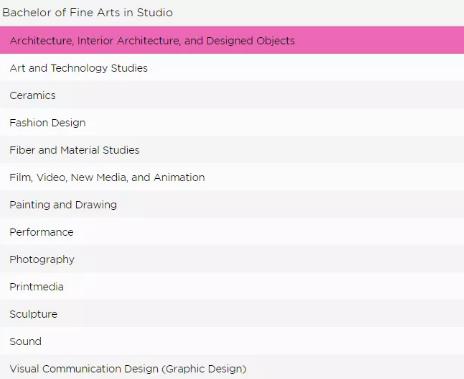
Next, we will focus on the curriculum of painting and drawing. Undergraduate painting courses provide students with more than 80 curriculum options, one of which is a painting practice course based on different media, including mixed media, collage, landscape, ink painting and other interdisciplinary scientific and technological methods;
In addition, SAIC also invited a variety of teachers to lead students to explore different experimental methods in the field of painting, including planing, astronomy, comic books, etc. In the senior grades, the school also carried out different types of courses to explore comprehensive materials, such as tempera painting, gypsum, batik, and some of the latest multimedia technologies.
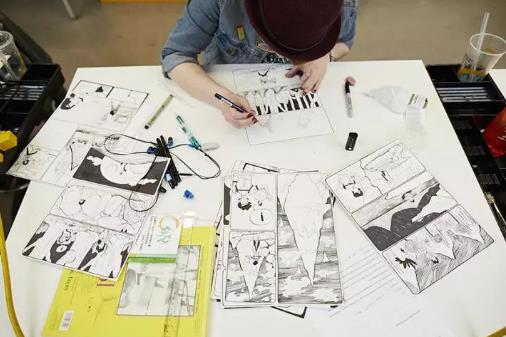
Students should not think that this kind of free combination of courses will be relatively easy, because there are many courses, and SAIC does not implement the GPA system, but only PASS and FAIL, as in China, which are all determined by the attendance rate and your creative level, so the learning pressure is not small.
The pressure of this kind of course is even greater when it comes to the graduate stage. Similarly, the freedom of course selection is also high, but the proportion of specific types of credits is specified. The total credit is 60 points (the calculation method of SAIC credits is also different from that of many schools), of which the studio course has a maximum of 39 points, and students can only choose series of courses with higher levels;
Art history accounts for 12 points, because we know that besides the pure art major, SAIC's architecture major is also their strong point, so in the curriculum of art history, only one must be contemporary architecture and design survey; The third type is elective courses, which require students to take at least four interdisciplinary courses and courses applicable to your graduation work field.
Maryland College of the Arts MICA
The courses of pure arts majors in MICA are also special. Students of all undergraduate majors do not need to choose a major in their first year of enrollment. They must complete the main courses of FOUNDATION and HUMANISTIC STUDIES, and then choose a specific direction according to the teacher's assessment and personal interests.
For the first year of FYE (First Year Experience) curriculum, MICA It is explained as follows: this year, we provided a comprehensive course with many ways and very strict. Through the thinking exploration reflection learning process, we helped students understand the correct relationship between artists or designers and the contemporary society. In addition to promoting students' in-depth thinking skills, the course also includes the challenges of philosophy courses, This program helps students to really think about their choice of future direction through practice.
MICA also has many courses in the pure art direction, including photography, pure art, illustration, painting, printmaking, as well as the recent popular new professional interdisciplinary sculpture and interactive device design.
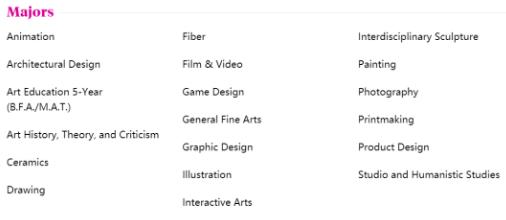
The first is the undergraduate course. Today we take comprehensive art/General Fine Arts as an example. In fact, this major is different from the pure art/Fine Arts in our impression. It takes "interdisciplinary" as the core of the major, and integrating multiple art media is a more comprehensive discipline direction. It is also a dominant specialty of MICA.
The curriculum of this major is relatively less free, and the next three years' courses need to be carried out according to the school's plan. However, the school still supports the students' personal development needs, and even sets up one-on-one courses for students with professors in the corresponding direction.
In addition, most of the courses are series courses, which are divided into junior, middle and senior grades according to grade, and other open elective courses are also divided into two categories. The first type includes 7 professional skills courses, and the second type is more open, with a total of four courses. Students can choose any other professional studio courses.
MICA graduate students' professional settings in the pure art direction are more streamlined, and there are also some interdisciplinary and even interdisciplinary cooperation projects, such as photography, sculpture, curatorial practice, etc. Today we will take illustration design, one of the most popular professions in MICA, as an example.
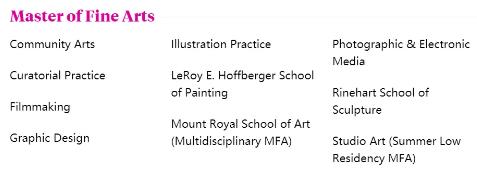
The full name of this discipline is illustration practice. It is a two-year MFA master's course. MICA believes that illustration is a field that is not restricted by specific media, and its purpose is to convey stories and ideas. Therefore, in their curriculum, students will also face the challenge of finding new directions for practice.
The total score of course credits is 60, which is mainly divided into the following categories: the first part is mainly based on the studio course, students explore new materials and make models in the process; The second part is a seminar style course. MICA will invite artists and critics from various industries to help students stimulate creative and analytical thinking;
In addition, another important course category is theory class and thesis writing, which aims to help students understand the history of illustration, and require students to pay attention to the contemporary social and cultural background. In the second grade, you need to develop a new creative media, including attached case studies, in combination with your understanding of the contemporary illustration market.
03. Admission requirements
Chicago Academy of Arts SAIC
The deadline for the 2019-2020 application quarter:
Bachelor of Arts - early application is November 15, 2019, and the regular application deadline is January 15, 2020;
MFA in studio graduate students - early application is December 1, 2019, and the regular application deadline is January 10, 2010;
Application fee:
Bachelor of Arts - $85
Pure Arts Graduate - early application $45; Regular application $90
Language:
IELTS 6.5 TOEFL 85; (Some undergraduate majors TOEFL 82)
recommendation:
One for undergraduate students and two for graduate students;
For undergraduates, it is preferred to be written by your teachers or educational professionals, who can evaluate your advantages, professional maturity and potential; If you are not in school and can not find a counselor, you can choose a leader in the work field to evaluate you from an objective perspective. It is better for graduate students to include both directions.

Student portfolio project of obtaining SAIC offer for natural light
Collection requirements:
Undergraduate - 10-15 Best works in the recent stage
Postgraduates - 15-20 images, or multimedia works within 10 minutes, or both
1. You can show us different works created by cross media or focus on one media completely;
2. The scope of works needs to include from observational painting to abstract expression;
3. There are no restrictions on specific media or techniques.
Personal statement:
Undergraduate: 250-500 words
Introduce your experience of artistic creation in detail, including what is the process of creation? Why you are interested in some materials, and how exhibitions, other activities or experiences you participated in helped you learn and create.
Postgraduates: 500-700 words
Describe your interest and experience in your chosen major, including your motivation and goals for choosing a certain direction, the reasons why you want to enter SAIC, and any expectations for the future.
Other materials:
Application form, transcript, resume, deposit certificate, etc
Maryland Academy of Arts MICA
The deadline for the 2019-2020 application quarter:
Bachelor of Fine Arts - the early spring date is November 1, 2019, and the regular application deadline is February 1, 2020;
Illustration Practice (MFA) - The early spring date is December 17, 2019, and the regular application deadline is January 17, 2020;
Application fee:
Bachelor of Arts - $70
Illustrative Practice (MFA) - no fee for early application; Regular application $75
Language:
IELTS 6.5 TOEFL minimum 80;
recommendation:
1-2 for undergraduates, 3 for illustration practice (MFA);
Collection requirements:
Undergraduate - 12-20 image works
Select recent works that can show your interest in art, and show your technical research in one aspect. It does not limit your use of forms and techniques, but we hope you can show your maximum potential.
Illustrative Practice (MFA) - no less than 20 works (images and videos are single pieces)
All works are uploaded online. Pay attention to the size and format of the images. In addition, 2D and 3D works are acceptable, even semi finished works can be accepted as long as you think it is the best way to express them, but pay attention to the proportion of such works in the collection cannot be too high.
Personal statement:
Undergraduate: about 250 words
MFA: no less than 250 words
1. Detailed introduction of the works in the works collection;
2. How will your current ability and experience help you to engage in illustration practice in the new era?
3. How do you view the future development of illustration? How will you use different materials to expand your idea?
4. Describe your ideal project and show your different thoughts on illustration practice.
Other materials:
Application form, transcript, resume, degree certificate, etc.
Through the above three rounds of horizontal analysis, SAIC and MICA made the following conclusions from the perspectives of college background, curriculum and enrollment requirements:
In terms of geographical location, school resources and faculty, SAIC is slightly better than MICA and SAIC, which study abroad in the United States for pure art, but the cost of living is relatively higher; The pure arts major of SAIC pays more attention to cultivating students' personal creativity. The teaching style is mainly free and practical, while MICA is more commercial, focusing on the combination with new technology and new materials; At the undergraduate stage, SAIC did not specify majors and hoped that students would receive comprehensive training. MICA, through the first year of FYI courses, allowed students to find their own direction to continue to deepen their study; In terms of enrollment requirements, there is little difference between the two universities in terms of rigid standards, but for the requirements of works collection, SAIC will require students to show diversified creation and personal style; However, the requirements of MAIC's work collections for each major are slightly different, and it is relatively necessary to show the skills and potential of this major.
In fact, no matter SAIC or MICA, or other art schools, they all have different training methods for the "pure" art that is not well defined. This is also because they train students as contemporary artists, give them enough space and support, and hope that they will go farther and farther in their respective fields. For students who apply for studying abroad in the United States, they must do a good job of research in advance according to their own goals and current situation, make the most suitable choice for their school choice, and at the same time, they must strive to improve their professional skills and thinking ability, and make full preparations for the collection of works, so that they can win!
Natural light shares more topics for you:
Pure Art Major Studying Abroad Compared with Pure Art under the Mode of Domestic Art Examination
What secrets are hidden in the works when applying for studying in the United States for a pure master of art
This article belongs to the original article of Natural Light International Art Education Team. Without permission, it cannot be reproduced commercially in any form. If it is found, it must be investigated for legal responsibility.