about Basic course of portfolio training , for most participants Training of overseas works collection Of the students may be a little confused, Training of art overseas works collection Why on earth should we take basic courses What about Is the training of basic courses for overseas portfolio necessary? What impact does the basic course of portfolio training have on subsequent learning? Basic course training of portfolio Is it really that important Today, the natural light will tell you comprehensively from the perspective of students' application for art study abroad and their study after admission How important are the basic courses in the training of overseas art works !
Why should I take the basic course training of portfolio?
Many students may think that, Basic course of portfolio training Isn't it just painting? What I want to apply for is a design major, which has nothing to do with painting. Should only students who choose a pure art major need to learn art basics? But that's not true!
First of all, let's remove the misunderstanding about the basic course of portfolio training. Drawing is not the only basic course. Taking natural light as an example, basic courses are divided into two categories: basic art courses and basic design courses, Generally, students with zero foundation, major transfer or weak basic ability need to learn basic courses In addition to painting courses such as sketch, sketch and color, we also provide many courses such as collage, material experiment, art history and aesthetic principles, which constitute a complete basic art curriculum system.
and Basic design courses include design psychology, plane composition, color composition, three-dimensional composition, thinking creativity, and software learning And other courses to help students build a systematic basic cognition of design and a solid theoretical foundation.
In addition, we also recommend students to participate in more creative workshops to increase their ability in these fields, such as material experiment workshop, mixed media workshop, interdisciplinary comprehensive creative workshop, etc.
Therefore, all the above contents constitute the basic course! Basic courses are not just about painting! The purpose of setting up basic courses is not just to let everyone learn painting, but to help everyone establish a relatively complete aesthetic cognitive system.
For example, in the basic sketch course, students need to understand the relationship between space, block, light, shade, contrast, and composition. These contents are used in illustration, animation, interior design, landscape design, architecture, visual communication, clothing design, and almost all majors; For example, in designing psychological courses, designers can sometimes be regarded as half psychologists, because design often has a psychological impact on people. Different forms and combinations of colors, graphics, words, and elements will give people different psychological feelings.
Another example is the color foundation. Color is very important for any design discipline. It is often affected by light, objects, and media, and even interacts with each other. In the color foundation course, exploring the relationship between colors can help students have strong color matching ability and relationship processing ability. Just like the recently popular "Yanxi Strategy", Yu Zhengyi changed the previous A-Bao highlight color system to use traditional Chinese color matching, and the picture quality of the whole play suddenly increased by 18000 levels!
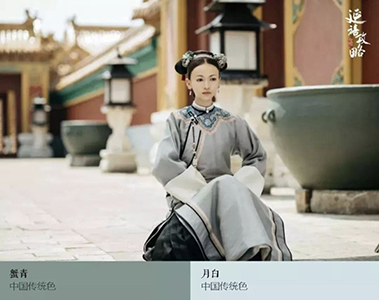
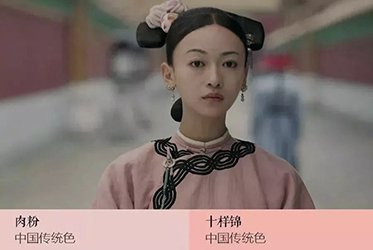
Picture source network
What can the basic course of portfolio training bring to portfolio?
For students studying abroad in art, the collection of overseas works should be the most important part of the submission materials. Therefore, everyone should pay attention to the requirements for the collection of relevant professional works of each college.
Requirements for professional works of most art colleges In China, they often require submission of observational painting, especially the application at the undergraduate level. For example, the art school with the highest employment rate in the United States SVA New York School of Visual Arts Application requirement On, it clearly reads:
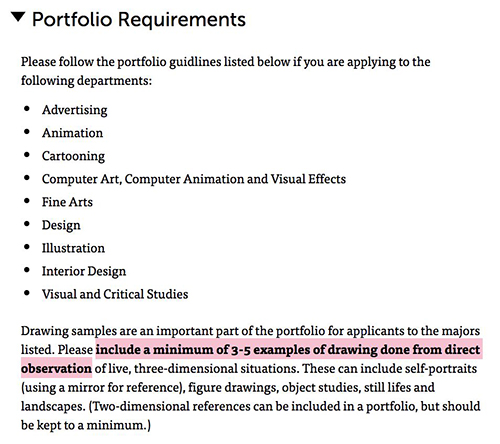
Is it necessary to train the basic course of portfolio?
Another example is Pratt Pratt College of Art, which is also one of the best art schools in the United States. In the requirements of various professional portfolios, the same demands are also put forward:
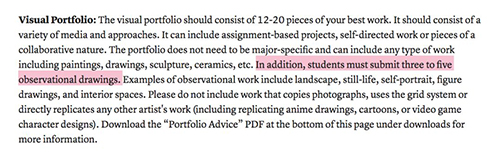
The photography major, which seems to have nothing to do with painting, also has relevant requirements. Although the school said "no", the second half of the sentence added: "But it is strongly recommended to submit":

thus it can be seen, Art colleges attach importance to students' basic painting and creative ability ; So, students Basic course training of portfolio is very important !
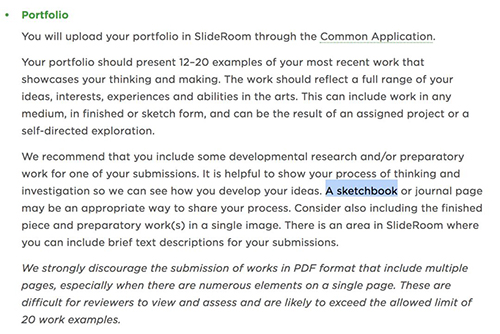
In addition to observational painting, many art schools also require students to submit their own Sketchbooks as part of the collection of works, so as to gain an in-depth understanding of students' Creative Thinking and Design Thinking in the Process of Creating Collections Sketchbook is mainly represented by collages, paintings, and material records.
such as RISD Rhode Island School of Design Portfolio Requirements Students submit Sketchbooks to learn more about students:
Another example is the UAL London University of the Arts, one of the most representative art schools in the UK, London University of the Arts Portfolio Requirements It is very clear that the work collection should include Sketchbook, and the UAL also gives further instructions on Sketchbook:
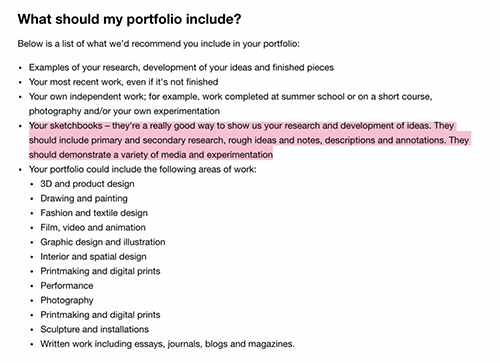
Setchbook is a good way for art schools to understand students. Through Sketchbook, schools can see the extension and depth of students' ideas. Sketchbook should also include the creation process from primary level to deep level.
In the application, observational painting often exists as an important part of the work collection, which shows a student's comprehensive artistic quality. For art schools, observational painting can help them see a student's basic ability, understanding of composition, line, color, space, and whether it can be in the form of vision, The ability to deal with the elements in an orderly and creative way.
Does not attend the basic course training of the portfolio affect the subsequent learning?
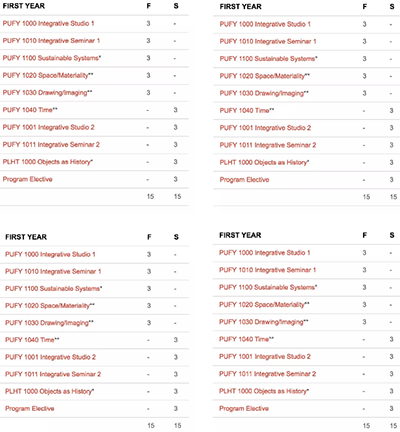
This can be seen from the curriculum of major art schools. For example, Parsons Design College, ranked second in the world and first in the United States, is taken as an example:
How does the basic course of portfolio training affect subsequent learning?
The above four curriculum arrangements are exactly the same. It is not that the natural light has inadvertently misplaced the picture. They are curriculum arrangements for different majors, respectively from Visual design, fashion design, photography, product design , four majors in almost completely different fields.
In addition to these four majors, the curriculum of Parsons' other majors in the first year of undergraduate stage is the same as the screenshot above, all of which are basic courses. No matter what major you choose to apply for, the real professional study starts in the second year, and even in the second year, the school will still arrange certain basic courses for students. These courses are generally carried out on a project basis. During the class, students will follow their tutors to explore the project system, from which they can gain more comprehensive aesthetic and design gains.
For example, let's take the drawing/imaging that we most care about as an example:
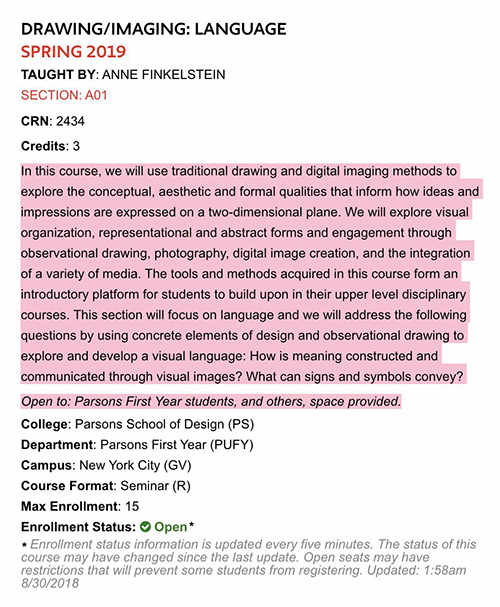
In this course, the school will guide students to discuss the characteristics of concepts, aesthetics, forms, etc. by exploring traditional painting and digital imaging. The creation results of these exploration contents will be presented in the form of two-dimensional plane.
Students will conduct comprehensive exploration and visual discovery through observational painting, photography, digital art creation, and the combination of various media forms. In this course, the specific creative methods and skills gained by students are a basic introduction to help students further develop before entering the senior courses The exploration focus of this project is mainly around the visual language. Through the creation of specific design elements and painting, we will explore and extend the content of visual language, guide students to think and solve: how to construct and convey the meaning of design through visual images? What kind of information can signs and symbols be used to convey in art?
Basic courses are the theoretical basis for all design and art. With the increasing difficulty of the courses, it is difficult for us to learn the next step without basic support when we enter overseas art colleges.
From the above curriculum, we can easily see that, Basic course training of portfolio It can help students master basic aesthetic knowledge, have higher visual aesthetic awareness than ordinary people, and have basic visual art application/creation ability. At the same time, it is not only the improvement of skills and "hands", but also the broader development in the way of thinking and the ability to look at problems, to establish a relatively perfect way of thinking and looking at problems, and to understand the reasons and significance of the visual design phenomenon around.
The lack of this aspect will lead to a gap in their own creation and learning. Especially in overseas art colleges, the teaching mode is biased towards projects and studios. Students need to have the ability of independent creation and practice, as well as independent thinking design thinking and creative logic, and further develop deeper critical thinking The establishment of independent creation consciousness and personal style, etc Basic course of portfolio training To take root.
In general, whether from our own perspective or from our future study, the training of the basic course of the collection of works is very important, and the basic course is definitely not just painting. The establishment of basic courses is to help students get started with design and art, and at the same time ensure that students can sort out their ideas, establish correct thinking patterns, design thinking, divergent creativity, etc. For example, natural light will provide students who need to improve their basic abilities with basic courses before the beginning of the portfolio course to help students quickly "transform roles". At the same time, a solid professional foundation can not only help students better and more quickly carry out the follow-up Creation of art works for studying abroad It can also help students to be more integrated into the next stage of the school in art colleges, and get a deeper comprehensive improvement.
Natural light recommends you the basic course training information of the collection:
University study abroad _Course_Teaching model_Differences between domestic education and study abroad
How to Study Abroad for Undergraduate Students in British Arts Universities
This article belongs to the original article of Natural Light International Art Education Team. Without permission, it cannot be reproduced commercially in any form. If it is found, it must be investigated for legal responsibility.