about RCA Royal Academy of Art IDE and IED are often confused by everyone. First of all, abbreviations are very easy to confuse, and many students in Natural Light have confused these two majors, so Natural Light feels it is very necessary to talk to everyone, IDE-Innovation Design Engineering , yes RCA Royal Academy of Arts and IC Imperial College of Technology ! It's totally different from IED!! Now, let's mainly talk about IED of RCA Royal Academy of Arts !! (For IDE, you can click here to learn: RCA Royal Academy of Art _IDE_GID_Service Design_Huangyi RCA and IC Imperial Technology Strong Joint Project
What is the major of the IED of RCA Royal Academy of Arts?
IED-Information Experience Design
Information experience design
MA/240 credits
2 years programme
Full-TimeStudy
IED/information experience design Application for art study abroad It is not very popular.) From the name of the major, we can see that it is a major related to information processing, and it is also a major combining rationality and sensibility. With "information" and "experience" as the core, we will build a connection platform for art, design, science, technology, etc., so that they can help each other. Designer approved Sound design, dynamic image design, experience design To transform information processing into a concrete experience.
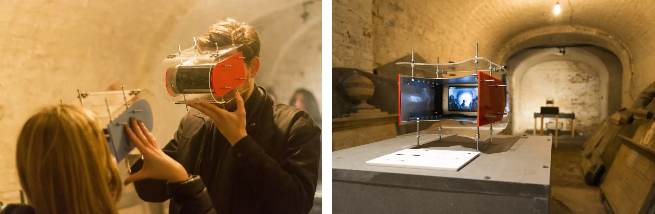
IED student work - "Cltr+See"
"Cltr+See" is a metaphorical interpretation of the concept of multiverse. This project provides a kind of situation for the experimenters. Two experimenters communicate visually with each other's eyes and their own eyes.
The information mentioned here is a kind of rational, data-driven, cognitive level data or specific file content. The fields involved also include all aspects of the world, including information technology, life sciences, physical research, mathematical research, sociology, economics, human history, and so on.
Experience, that is, design, is an expression of emotion and information. We can show it through sensory devices, performances, moving images, sounds, physical systems and other forms.
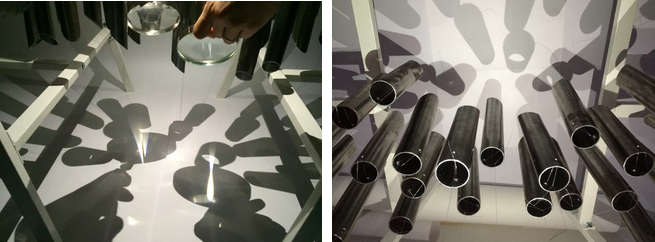
IED student work - "Chasing Particles"
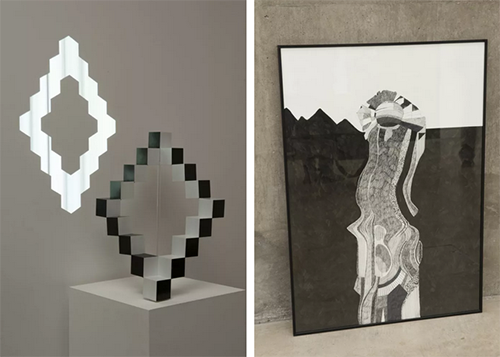
This is an immersive circular device created by using the principle of reflection and refraction. It can observe various possibilities when being felt by the outside world by quantum superposition of light particles moving in the metal structure.
It is precisely because of such professional content that students of IED major come from various fields such as art, design, computer, engineering, society and physical science. At the same time, in order to ensure that students have sufficient free research space, the school will also provide students with a wide range of social and academic content and courses to help students solve various problems through constant repeated examination, questioning, criticism and imagination.
The above is the basic introduction of this major, but even if it is a simple definition and explanation, I believe you can see that this is a major with ultra-high technical content, and any field of discipline you want or think of, it! All! Involved! And! It's so powerful!
RCA Royal Academy of Arts IED is mainly divided into three directions:
Moving Image Design
Sound Design
Experimental Design
Moving Image Design
This direction mainly studies the creation and propagation of information and paths in the large digital world behind the scenes. Moving Image Design (MID) is not a pure film specialty, nor is it a film and television production at the technical level. MID has broken away from the commercial restrictions of images and built a future dynamic image narrative mode with a new and breakthrough image creation concept.
This direction involves three areas:
Digital directing;
Time-based media and temporal narratives;
Moving image by and for design;
Sound Design
Sound Design (SD) is a "shocking" professional direction, which mainly studies the experiment and application of sound. SD's research field is not limited to film music, but involves all sound related professions and fields: journalists, musicians, scientists, recording actors, artists, and media practitioners. This paper studies the relationship between sound and the world through the voice of data combined with various sound contexts.
There are many research fields in this direction, including: Communication language, ultrasound, online/offline context, movie sound effect, game sound effect, urbanization sound effect, sound synthesis, digital music, electronic music, immersive music environment, reverberation, music feedback, acoustics, sound dynamics as social purposes Etc.
Experimental Design
Royal College of Art The teaching points in this direction mainly focus on experience and interaction, and create a new interactive design method through interdisciplinary ideas and programs. Experimental Design is the extension of the other two professional directions, which serves as the basis for exploring and expanding the mode and method of creating change experience from information.
Students in this direction have the opportunity to cooperate with professionals in various backgrounds, such as exhibition designers, installation artists, computer scientists, architects, physicists and biologists. Like the other two directions, ED also discusses various issues in social, economic and humanistic fields through its professional way.
Although divided into three directions, the three directions are also closely linked, and such a major is also very powerful in guiding students' comprehensive literacy! For example, the curriculum is very comprehensive.
RCA Royal Academy of Arts IED professional courses:
A. Intellectual Engagement
B. Technical Skills
C. Professional Development
A. Intellectual Engagement/Professional and Practical Participation
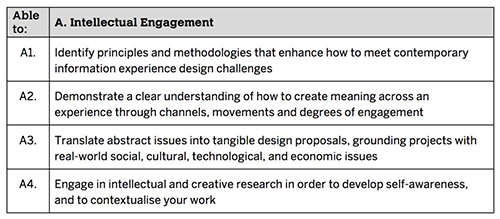
Master basic professional skills and knowledge; To fully understand the core connotation and significance of information experience design by participating in various projects; Have the ability to transform abstract problems into concrete design schemes, and connect design schemes with social, cultural, scientific, technological, economic and other issues in real life; By participating in creation and research, we can cultivate our own art and make ourselves have the corresponding working ability and background.
B. Technical Skills
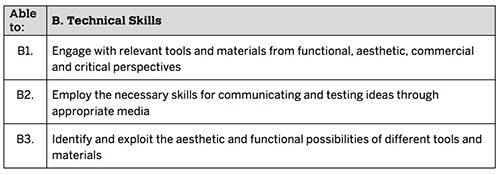
Be able to participate in the exploration and practice of relevant materials from the perspectives of function, aesthetics, business and criticism; In the process of practice, can make full use of the corresponding skills, and through the appropriate media to show their ideas; Master the characteristics and plasticity of various skills and materials, and be able to skillfully use them.
C. Professional Development
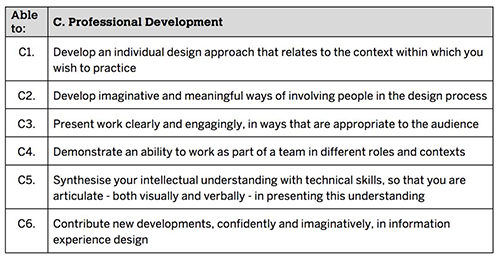
Be able to formulate relevant personalized design methods according to their own interests; Through the imaginative and meaningful experience of design creation, people can also participate in the design process; Show your works clearly and interestingly with works suitable for the experiencer to experience; Express ideas through a variety of technologies and skills, so as to facilitate the understanding of the experiencer from the perspective of vision and language; In this professional field, promote the development of the professional field through confident and imaginative ways.
Through the school's Integrated Learning Outcomes, we can easily find that IED is mainly aimed at cultivating students' analytical ability, critical thinking, and the ability to provide an innovative solution by combining technology with aesthetics. In order to enable students to have such ability, the proportion of school curriculum is also very "particular".
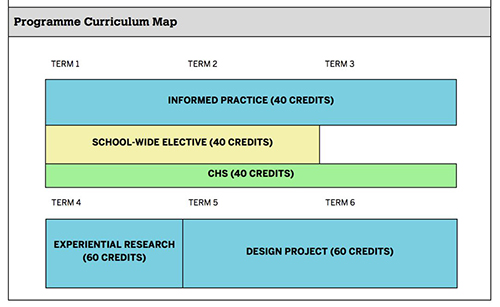
School Elective/School Elective - 40 credits
Informed Practice/Cognitive Practice - 40 credits
Critical and Historical Studies (CHS)/Critical and Historical Studies - 40 credits
Experimental Research/Practical Research - 60 credits
Design Project - 60 credits
Through the course arrangement, we can easily find that the main learning of this major is accomplished by combining practice. RCA also provides students with a variety of practical opportunities and spaces to ensure that students can master this major in full practice.
IED student works
YEAR 1:
In the first year, students will learn professional theoretical knowledge and practical content. In combination with the tutor's explanation of the basic knowledge of the specialty, students' practice is mainly carried out in the courses of School Elective and Informed Practice. In the first year, students will generally complete in-depth research on 4-5 projects, and have a deep understanding of the specialty through experimental creation of various skills and materials.
Since the second semester of the first academic year, students will follow their tutors to attend various campus seminars to improve their creation and learn more professional skills.
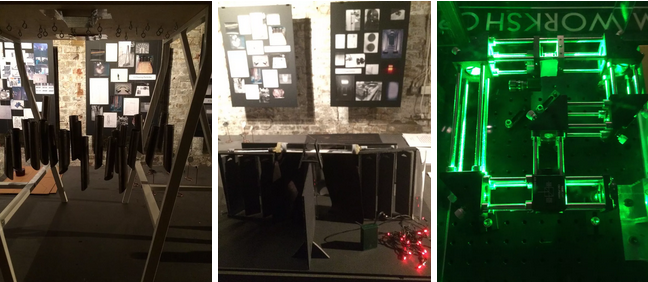
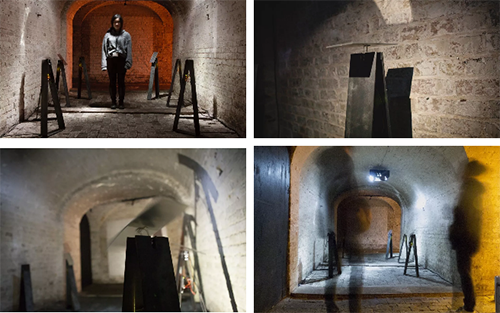
IED student work - trying to capture the dynamics of quantum particles through light
YEAR 2:
Through the first year of project practice and campus seminars, students should have a certain professional foundation and in-depth learning ability in the second year. Therefore, the course of the second year mainly focused on the in-depth research of a certain field.
We all know that in order to enable students of all majors to acquire strong comprehensive abilities, RCA encourages cooperation among all majors, and is also very open on the student background, allowing students of all professional backgrounds to apply for the majors they are interested in. Therefore, in the curriculum of the second year, RCA has a more open attitude and encourages students to conduct interdisciplinary creation and research.
For example, the following project explores the relationship among data, people, objects and space in the context of digital city information. This project was jointly completed by 11 IED students, 6 sculpture students, 5 architecture students, and 4 Imperial Digital City Exchange students.
The courses and practices that students participate in need to complete the following projects and contents:
Tutorials
Projects
Elective Projects
Year 2 Crits
Workshops
In all courses, CHS, namely Critical and Historical Studies, should be emphasized in natural light. CHS provides a systematic knowledge framework for first-year students, so that students can freely carry out interdisciplinary practice in this framework with theory. The tutor of CHS will also provide one-on-one personal guidance for each student. After this part of the course, students need to submit a 6000-10000 word paper to summarize their own course gains. This paper is very important! How important is it? If your thesis does not pass the examination, you will not be qualified for the graduation design! It can be said that it is very strict!
What are the requirements of RCA Royal Academy of Arts for IED application?
Applications Online Applications (no application fee)
Language-IELTS6.5 (writing 6.0); TOEFL93
Statement - 1 copy/500 words, briefly describe the reasons for choosing IED and RCA
Portfolio - no more than 20 pages of individual project works, and each project needs a description of 100 words; Dynamic video works cannot exceed 5min. Works over 80MB can be submitted by adding Vimeo or YouTube links
Assessment
Interview
The above is about Study abroad application RCA Royal Academy of Arts IED All the information of, such an interesting and high-energy major should go?! If you want to know more about your major, please look for natural light!
Natural light recommends RCA Royal Academy of Arts:
Go to the Royal Academy of Arts to apply for a study in the planning booklet, thank you for taking it
The Royal Academy of Arts applied for a full professional Grand Slam/case. It's really not difficult to apply for Royal Art in six systems of natural light
This article belongs to the original article of Natural Light International Art Education Team. Without permission, it cannot be reproduced commercially in any form. If it is found, it must be investigated for legal responsibility.