The autumn wind is cool and the harvest season is approaching. Recently, the natural light has also received a good news. After successfully advancing to a famous school for further study, four senior students of the 18th and 19th sessions of the class of landscape architecture have joined hands again to form a dream team and won the Oscar in the landscape design industry - the 2020 ASLA Students Awards Urban Design Honor Award.
As the only award-winning non North American college team in the urban design category of Students Awards, the four students can be recognized by the American Landscape Award, which is the highest honor and surprise for both students and natural light, while behind the surprise is the polishing and accumulation of students' professional ability for several years, which is the persistence and cultivation of natural light as a leader, It is the inevitable result caused by the collision of numerous factors. From the training course of the works collection that connects with the overseas teaching mode, to the successful offer to enter the Dream School, to the professional recognition of the students by the industry authority, the picture of the scene after scene, step by step, and the natural light is always paying attention to the growth of each student.
Just like our slogan USING ART TO DESIGN YOUR FUTURE, the offer of a famous school is only the first step. We are more looking forward to the continuous creative energy of students, and are committed to creating a deeper and broader teaching platform to help students realize their artistic dreams and measure the infinite future! recommend: Where to study in landscape design? AA or UCL?
Now let's review the story behind this surprise with the four award-winning students!
2020 American Society of Landscape Architects
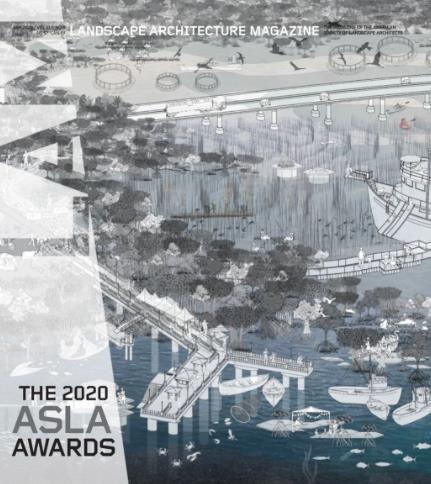
The American Association of Landscape Architects (ASLA) was founded by several outstanding American landscape architects in 1899. As an internationally renowned event in the industry, the ASLA competition is known as the "Oscar of the landscape industry".
ASLA issues invitations to the global industry and academia every year. After professional evaluation and screening, it issues professional awards and students awards for outstanding projects. The latter is divided into eight categories, including general design, residential design and urban design, according to different research themes, Each category has an Award of Excellence and several Honor Awards. These wonderful works represent the bright and all inclusive future of the landscape design industry.
The year 2020 is an unusual and challenging year for the whole world. Due to the impact of the epidemic, this year's ASLA entry and review process has been more transferred to the online, but the competition is still fierce. This year's student awards have a total of 560 entries and 35 winners.
Among these 35 outstanding works/teams, there is such a "team" that they are college students and even more intimate partners; They are "study groups" and comrades in arms along the way. They have all spent an unforgettable period of study in natural light, and then came to Europe's famous universities to continue their postgraduate studies. In addition to their personal growth and academic excellence, what is more valuable is that each of them has always been carrying the dedication and enthusiasm to landscape design, and constantly exploring and making progress, In addition, it maintains high efficiency and cohesion in team cooperation.
In addition, they are also the only group of non North American college teams that won awards in the ASLA Students Awards Urban Design category.
Today, let's get closer to this special team and the project that won the Honor Award of the 2020 ASLA Urban Design category - "Coexistence between emergency and normal: reconstruction of the diversified use of water resources in the high fire prone area of the wilderness city interface area (WUI)", and learn about the story in the creation process, While explaining how the project will bring more vitality and possibility to the fragile environment with the concept of sustainable landscape design in the year 2020, when the project has an "ill fated future"!
Project name and team profile

Guang Yang
Students of Natural Light 2018
MLA Landscape Architecture
The University of Edinburgh
Shuai Pan
Students of Natural Light 2018
MSc Landscape Architecture (Full Award)
Land Landscape Heritage
Politecnico di Milano
Lanxin Zhong
Students of Natural Light 2018
MSc Landscape Architecture
Land Landscape Heritage
Politecnico di Milano
Lihao Zhu
Natural light 2019 students
MA Landscape Architecture
The University of Sheffield
entry name
[Coexisting between emergency and normal]
Reconstruct the diversified utilization of water resources in the wildland urban junction area (WUI) with high mountain fire incidence
![[Coexisting between emergency and normal]](/Uploads/ueditor/image/20200927/5f6fff4636cf4.jpg "[Coexisting between emergency and normal]")
Q&A
Q1: What are the opportunities and preparation periods for participating in ASLA competitions?
A: It was in February that we decided to take part in the competition to commemorate our college career. However, it was not clear which competition to take part in, IFLA or ASLA, at the beginning. Finally, we decided to take part in ASLA in April. Then we spent a long time in the topic selection stage. It took us from one and a half months to about two months to determine the scope of the site and the theme. Then we started to draw pictures in May, which took us two weeks (note: there should be applause here), and finally submitted the results.
The project is located in the west of Greater Sydney, between Penrith and Richmond. It is run through by two rivers, and is also a typical fire flammable area in Sydney. Different from the traditional urban design policy of the Wilderness Urban Interface Area (WUI) focusing on prevention, this experimental project attempts to explore a dynamic way to coexist with potential mountain fires in this area. The new city will be able to meet people's need to live freely in emergency and daily situations. At the same time, the two rivers also play their potential value in combating the threat of mountain fire.

Vision&Methodology/Credit:Shuai Pan ASLA Website
Due to the unpredictable nature of mountain fires, the risk of damage to houses and infrastructure in fire prone areas and wilderness urban interface areas (WUI), including residents' daily life, is increasing. Contrary to this, with the rapid urban expansion and growing population pressure, cities have no more choice to relocate residents to additional land.
Some Australian cities, such as Sydney, are surrounded by dense forests and have to expand the land of the Wilderness Urban Interface (WUI). Interestingly, although fire damage has increased in those areas, the number of people who want to live in the suburbs with rich natural scenery is also on the rise. Therefore, this project wants to explore a practical solution to develop a new urban area of the Wilderness Urban Interface (WUI) under the inevitable threat of mountain fires.
Q2: How to determine the topic and site of this project?
A: In recent years, Australian mountain fires have had a great impact on the local environment. As a discipline closely related to the environment, whether landscape can bring more reflection and response to the disaster is our original intention.
At the beginning of site selection, we started from the east coast of Australia, gradually screened the site location along the distribution of cities and fire frequency on the east coast, and then determined Canberra, Blue Mountains National Park, London and other areas. Finally, we determined our current site according to the feasibility, fire impact and other comprehensive factors. Our site, Londonderry, is not so well-known as other plots, but fire is a relatively urgent problem for the local people. What's more, the special point of the site is that there are two rivers in the east and west, which has laid a good ecological foundation for our future strategy.
Due to the arid summer and recent climate change, Australia is one of the countries most vulnerable to mountain fires in history. However, this seasonal disaster seems increasingly difficult to avoid in Australia. Although man-made ignition events can be easily avoided under a strong regulatory system, it is difficult to prevent natural mountain fires triggered by high temperature or lightning. Instead of the traditional urban design method focusing on prevention in the Wilderness Urban Interface Area (WUI), this project has experimentally formed a site with two scenarios to explore a multi-functional solution in the Wilderness Urban Interface Area (WUI).
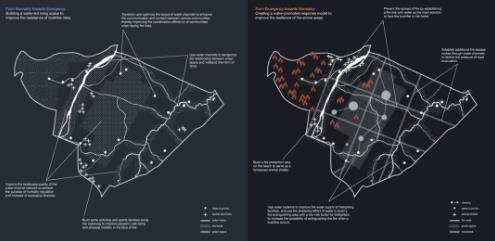
Spatial Structure in Two Tenses/Credit:Shuai Pan ASLA Website
Strategy 1: From emergency state to normal state
The purpose is to create a "water promotion" response model that can improve the disaster resistance of fire prone areas.
The following are four measures:
1. Construct additional waterways for evacuation to relieve the pressure of road evacuation in emergency;
2. Build a water based fire belt in the forest land to organize and delay the rapid spread of mountain fire;
3. Turn some flood lands into fire prevention "temporary shelters" to provide temporary shelters for homeless animals in burned forests;
4. Optimize the maintenance and supply of water resources by rebuilding the water network, so as to protect firefighters and increase the possibility of fire fighting.
Strategy 2: From normal state to emergency state
The purpose is to build a water led living space to enhance the resistance to mountain fire hazards.
The following are four measures:
1. Change the water oriented urban space in the Wilderness Urban Interface Area (WUI) to reduce the fire threat to the city;
2. Optimize the layout of water system network to enhance the connectivity between communities and coordinate the efficiency of responding to fire threats;
3. Improve river landscape quality, enhance biodiversity, and coordinate air humidity;
4. Build sports and recreational facilities along the river to improve the living environment and physical quality of residents in fire evacuation.
Q3: How to deal with "remote cooperation"+"remote research"?
A: I had planned to go to Australia for field research, but due to the impact of the epidemic, I had to stay at home. In terms of "remote cooperation", we achieved it through regular online video conferences. In fact, the efficiency is quite high. It may be the tacit understanding of long-term cooperation, but also based on the smooth communication and action of the team. In terms of "remote research", due to limited conditions, we collect many site information through government websites, official portals, and other geographic information data websites.
Based on the analysis of the on-site situation, the concept of water orientation is proposed, which provides an antidote for "flammable" cities. The two main rivers and their tributaries guide the design practice of this project. In this design, the role of water in the Wilderness Urban Interface (WUI) is reconsidered. Generally, water only has a single function of extinguishing fire. So in common sense, when water is in the "battle" stage, it naturally has the power to face fire. However, water has enough talent to repel mountain fire in the whole process.
Therefore, in this project, we explore water with a wide range of uses. When mountain fires force people to be vigilant under any circumstances, we try to discover more potential of the current rivers. The design aims to use sufficient water resources to build a demonstration model for the new city of the Wilderness Urban Interface (WUI). Create opportunities for people to coexist with fire and find a balance between normal life and sudden fire. Here, water is the tie or fulcrum connecting normal conditions and emergency conditions.
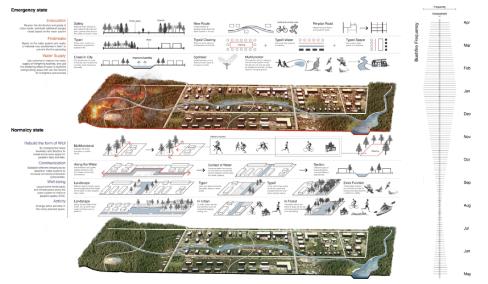
Two States in the City Centre/Credit:Lihao Zhu ASLA Website
Q4: How to divide work and cooperate during the competition?
A: In terms of content, we will discuss the overall idea/design strategy/framework structure as a whole; In terms of performance, specific division of labor shall be carried out according to the direction of individual expertise, and then overall arrangement shall be carried out to ensure the overall smoothness and coherence and the relative unity of style. In terms of drawing division, it is roughly as follows: general arrangement, strategy analysis (Yang Xuexue); Overall plan and logical framework (Mr. Pan); Various analysis and details (Zhong); GIS direction analysis, Detail (Zhu Xuexue).
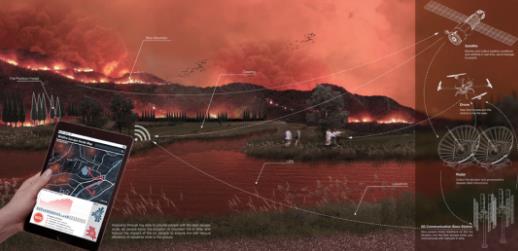
Escape Guide Kit/Credit:Shuai Pan ASLA Website
Q5: How to overcome problems or bottlenecks?
A: In retrospect, the whole process was relatively smooth. After all, we have worked together for many times. In terms of bottlenecks or difficulties, it is difficult to determine the theme and site selection in the early stage. At the beginning, everyone had their own ideas and ideas. Everyone's opinions were very interesting. Although there were many highlights, they were scattered, and they did not find a definite direction, It is difficult at the beginning of everything, and it is difficult to determine the theme. The way to overcome it is to discuss the advantages and disadvantages of each scheme together, and finally decide by voting after comparison.
ASLA Official Comments
This proposal responds to the catastrophic mountain fire phenomenon in Australia in 2019-2020 and puts forward strategic suggestions for the Wilderness Urban Interface (WUI). Different from the usual preventive measures, the project explores water resources as a way of symbiosis with inevitable mountain fires - coexistence of daily state and emergency state. This virtual plan, located in London, New Wales, calls for connecting the existing waterways, providing navigable evacuation routes for people and animals, and providing fire fighting water for trees. Adjust the forest boundary, plant cypress and other plant species with certain fire resistance, enhance the firemen's ability to fight against fire, protect vulnerable residents, and combine other strategies to make the Wilderness City Interface (WUI) livable while giving early warning for the recurrence of mountain fire.
This competition is another cooperation of the four students during their overseas study. They have participated in the Aoya Cup together from 16 years of undergraduate study, to 17/18 years of preparation of works collection, to 20 years of graduate study, and to participate in ASLA together.
The distance between dream and reality is paved by countless sweat and persistence. For them, ASLA may be just a small milestone in their professional journey, and there are more exciting opportunities and challenges ahead. Another application season has arrived in the twinkling of an eye. Do you feel more energy from it as you pursue your dreams?
More recommendations for studying landscape architecture:
How about the landscape design major of UCL Bartlett School of Architecture?
How to build a high-quality collection of works for landscape design majors studying abroad?
This article belongs to the original article of Natural Light International Art Education Team. Without permission, it cannot be reproduced commercially in any form. If it is found, it must be investigated for legal responsibility.