Rhode Island School of Design applied for independent proposition in the quarter, and went online more than a month in advance! Remember the fear dominated by RISD last year? Do you still remember that at that time, it was changed to a totally different work collection requirement&independent proposition? This year, RISD returned with a "magnificent turn", and this time, the topic is more wordless and has a wide range of changes, not only in terms of topic types and requirements, but also in terms of work types, in addition to visual items, it has also added written statements for the first time! As always, this year's natural light, of course, also brings a new way of solving problems for everyone at the first time - Entry's own way of solving problems.
How to solve the independent proposition of Entry in Rhode Island
What is the independent proposition of RISD?
Before specifically analyzing this year's proposition, let's first understand what RISD Assignment is:
When assessing applicants, many art schools will not only require students to submit regular materials and personal works collections, but also set up a set of independent topics according to the assessment points they focus on for more in-depth and targeted assessment.
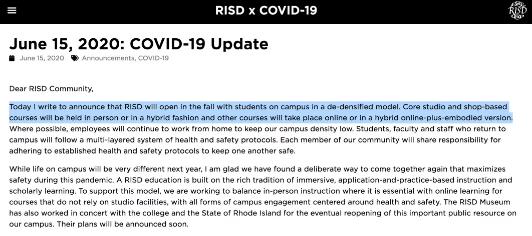
RISD will be officially opened this fall, and students will learn online+offline hybrid mode
RISD's independent proposition is aimed at all undergraduate courses Application for art study abroad The additional examination questions of applicants will set corresponding topics or requirements according to the current art development trend and changes in student assessment points every year, requiring applicants to submit proposition works uniformly, which is a very important part of the application materials.
In the three years from 2016 to 2018, Rhode Island has always given specific keywords, and students choose a word for creative thinking:
2016 - construction light、contain
2017 - plastic collect、threshold
2018 error verify、forge
In 2019, RISD overturned the usual routine of previous years and proposed a second visual presentation for Natural Worrld. The new Assignment almost hit the Parsons Challenge. In addition to the new portfolio requirements, we also saw the change of RISD's commitment to innovation.
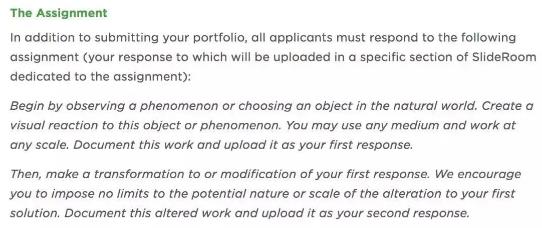
Requirements for independent proposition of RISD in 2019/2020 application season
Judging from the adjustment trend from the main proposition in recent years, RISD has increasingly focused on the experimental and conceptual nature of students. The latest examination questions in 2021 also continue this trend and play to the extreme: this independent proposition is divided into two parts, the first part is the work of visual display, and the second part is the written description, but also extends around the first part, so next, we will focus on the requirements of the first part of the visual work.
PART 1: Visual items
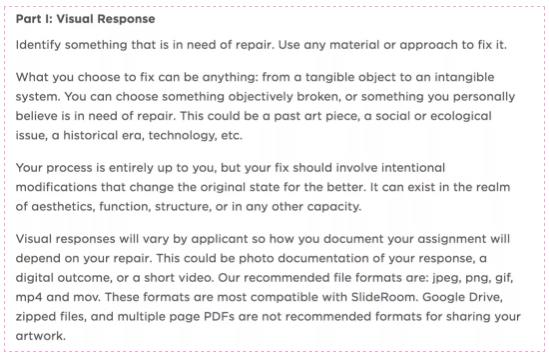
First, determine the items to be repaired, and repair them with any materials or methods.
The content of repair can be anything: from tangible objects to intangible systems. You can choose what is objectively damaged, or what you personally think needs to be repaired. It may be past artworks, social or ecological problems, historical stories, technical means, etc.
The design process is entirely up to you, but the repair should include a deliberate modification process that can be better presented than the original state. This change can include aesthetics, function, structure or any other aspect.
The visual presentation mode is determined by the applicant, and the form depends on how you record the design process and repair. The format can be a document, a picture, or a short video. The recommended file formats are: jpeg, png, gif, mp4 and mov.
First of all, after reading the full text, the first impression will be that this year's examination questions are particularly abstract, without specific requirements or subject restrictions, and even the presentation method can be selected independently. But we also noticed that the full text has one of the most important keywords: REPAIR - repair/repair/recovery.
In the first sentence of the proposition requirements, it is mentioned that "Identify something that is in need of repair/Confirm an object that needs to be repaired", so we should understand the key to the proposition, first understand the meaning of Repair from the meaning of the word, and the following is the interpretation from Cambridge Dictionary:
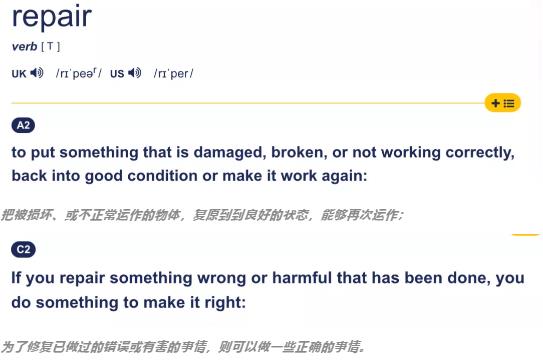
The above two explanations generalize the word repair from two levels: one is to change the objective damage; On the one hand, it also means to change the wrong way or practice from a non physical level to achieve the purpose of repairing the internal or external.
This also provides us with two different ideas on the topic selection.
Then, the content behind the proposition is explained from the content, form and optional scope around the theme of the repair: Use any material or approach to fix it.
This sentence explains the materials and methods that we can choose in our creation. Like the topics in previous years, RISD does not make any restrictions. Therefore, we can boldly understand that creative methods and presentation forms are not limited to the scope of students applying for majors, but can spread creative thinking;
We can consciously show our other strengths and advantages beyond the portfolio project in combination with the form of other disciplines or completely according to our own creative theme;
In terms of material selection, RISD also gives students a high degree of freedom, and some unconventional materials and presentation methods are also one of the angles that students can think about.
The second paragraph gives the scope of the applicant's selection of "objects to be repaired": What you choose to fix can be anything: from a tangible object to an intangible system - the content you choose to repair can be anything: from tangible objects to intangible systems.
This sentence is also very critical. The range of options actually corresponds to the previous definition of Repair. We can select some damaged physical objects, but also some harmful or need to be repaired states.
This range can be large or small, it can be about our individual, it can also be an objective existence, it can be a relationship, a social situation, a person's personal image, and even a globalization problem that needs us all to solve.
In fact, the perspective of thinking given by colleges and universities has further expanded the scope of our topic selection. Compared with some changes and remolding objects from the perspective of morphology, we can achieve the combination of appearance and internal and complete the purpose of an overall repair through visual transformation, material selection, technical intervention and other comprehensive means.
Finally, we also remind you that you should not confine yourself to the concept of repair. For example, we can imagine that the things/events corresponding to repair are not necessarily damaged, but may be "not perfect", and need to be made up and adjusted to make them more perfect.
But your fix should involve intentional modifications that change the original state for the better.
In the end, no matter what theme we choose, the final result leads to RISD or sets certain restrictions. First, the design practice of this object after repair must be changed, and more perfect and better than before.
This change and "better" can include external aesthetic value, functionality, structure or any other aspect. In fact, through our design process, the original problem has been solved or improved.
Therefore, our work is not only to raise problems and repair plans, but also to really practice from the creation, which can be through research, experiment or the final landing, even if the change is only a small part, but from the perspective of project work, it must be a complete and different from the original state of presentation.
How you document your assignment will depend on your repair - The way of visual presentation depends on how you record the design process and repair.
Finally, the college gave us suggestions on the submission format of our works. This form is determined by how we repair it, not by the professional latitude we apply for. Students can choose photos, documents, visual images, videos, etc.
PART 2: Written statement (within 250 words)
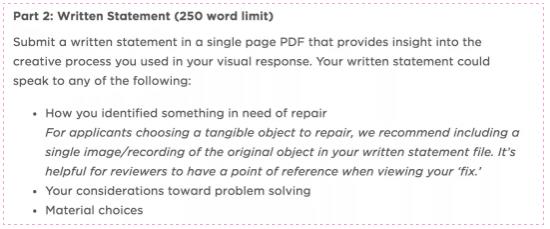
It is required to submit a written statement in the form of a single page PDF to deeply elaborate the creation process in the above visual project, which needs to involve the following aspects:
1. How to find the problem and determine the scope to be repaired;
For applicants who choose tangible items for repair, the university suggests that the written statement should include images/records of the original items.
2. Thinking about the way to solve the problem;
3. Selection of materials
The written statement in the second part is also the first time RISD has added to the requirements of independent proposition. In addition to thinking about elaborating the design concept and design process systematically and pertinently through words, we should reflect the design highlights;
More importantly, from the requirements, we can also see the assessment points that colleges and universities focus on. One is the perspective of assessing applicants' perception and thinking, which can reflect students' observation ability, artistic quality and critical thinking;
The second is how students use their professional ability, creative thinking, and design skills to solve problems, which is also the assessment point that colleges attach great importance to - practical ability;
The last is the choice of materials. The visual transformation of abstract concepts through the use of media is also the core proposition that RISD has been deepening and cultivating students in recent years.
Above all, we have broken down the assessment points and creation requirements of RISD 2021 Entry's independent proposition in detail, and we hope to provide some perspective and objective suggestions for students by interpreting the academic development trend and application experience over the years.
In addition, the natural light also brought a surprise gift to everyone! On line analysis of RISD's independent proposition, the way of 2020/2021 Meishen is fraught with difficulties. In the face of this RISD's act of evil, you may think that going south and going south? So this time, the natural light directly invited the students from RISD Pure Arts and the teaching and research supervisor of the works collection. From the perspective of both college and major, the natural light strongly interpreted the demon making caution machine in Rhode Island this year with spherical thinking! Analyze the proposition word by word, from the literal meaning to the connotation behind, from cultural awareness to artistic ideas, and take you to the RISD Assignment in an all-round way! Compared with the change of independent proposition in 2016-2020, combined with the development of contemporary art and the change of teaching philosophy of overseas art colleges, let's ride the wind and waves to win RISD Assignment together with the Natural Light Teaching and Research Center!
Course time:
15:00, Tuesday, June 23
Course content:
The course mainly explains in detail the requirements for the 2021 portfolio and new additional topics updated this year in Rhode Island. By reviewing the characteristics of the proposition of the previous year and last year, and analyzing the specific cases, students can understand the changes of Rhode Island proposition in recent years. The teacher will lead the students to analyze the new proposition word by word, analyze the content of the topic, key words, and obvious differences from the past, and explain to the students several creative ideas given by the teachers of the teaching and research team. The course will help students expand their thinking and divergent thinking through examples, and give some suggestions for the preparation of the writing part. It will also remind the problems that are easy to encounter in the preparation process, so as to avoid the wrong creative direction. Finally, the course will analyze the requirements of colleges and universities for students' ability and the trend of application this year through new topics, works and requirements.
Course instructor:
Rhode Island School of Design /Pure art
Mr. Chen graduated from the School of Fine Arts of Tsinghua University with a bachelor's degree in ceramic art design, and graduated from Rhode Island School of Design with a master's degree in pure art. As a comprehensive media artist, Mr. Chen has rich experience in 3D modeling and installation art in practice, as well as practical experience and theoretical knowledge in digital media, sound and plane art.
Her works have been nominated for the award of the Guan Guo Art Exhibition, and many contemporary art exhibitions and design innovation exhibitions all over China. She has exhibited in many galleries, art galleries, museums, the United Nations, art exhibitions, non-profit organizations and other institutions in the United States, and participated in the resident artist program in the United States and South Korea, He held a personal exhibition at California State University, Long Beach, and three exhibitions in South Korea.
More recommendations on independent topics for studying in Rhode Island:
Exclusive sharing by RISD admissions consultant in Rhode Island: how to choose art schools for studying abroad
This article belongs to the original article of Natural Light International Art Education Team. Without permission, it cannot be reproduced commercially in any form. If it is found, it must be investigated for legal responsibility.