The independent proposition of RISD has changed? The requirements for the portfolio have also changed? It is believed that students who are preparing to apply for RISD this year, like natural light, have already prepared for RISD of Rhode Island School of Design to continue to "play devil" and change topics this year. But this time, RISD The monster not only changed the independent proposition, but also changed the requirements for the collection of works, which is no less than a huge "BOOM" for students who have prepared more than half of the collection of works! Let's have a look!
RISD Portfolio Requirements:
2019 RISD Portfolio Requirements:
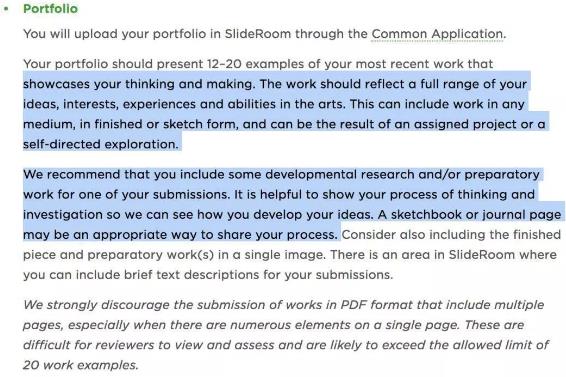
Screenshot from RISD official website in 2019
Requirements for RISD portfolio in 2020:
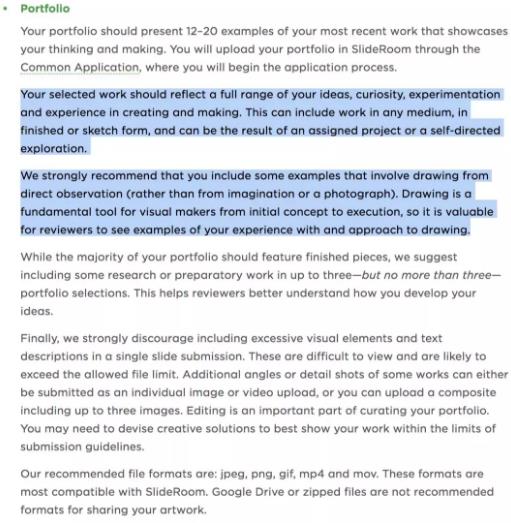
Screenshot from RISD official website in 2020
By comparison, I have also marked the major changes for you, especially the comparison of the second paragraph of the two figures:
2019: The school strongly recommends that the portfolio submitted by applicants include some contents of development research and preparation stage. These contents can help the school better see how the applicants think, research, create, and put their ideas into real works.
2020 Entry: RISD Rhode Island School of Design It is strongly recommended that the applicant add some directly observed paintings (rather than imaginative creation or photo works) to the collection of works. For visual creators, painting is the basic way/tool to realize ideas from the initial concept to the final specific implementation. Therefore, for RISD, it is very important to see the applicant's experience and method ability in drawing.
This year's work collection requirements given by RISD replace the previous part of "research" ability display, and then propose a more basic, but also slightly "harsh" limit - basic painting ability.
Painting is a very basic and basic ability in art design, but at the same time, it is also a "key" that many students are particularly easy to ignore. When choosing a major, many students unconsciously think that only pure art majors need very strong painting ability. If I choose a design major, then painting ability is not so important.
This idea is definitely a serious mistake! As for why, RISD also directly and clearly shows the reason: painting is the basic way/tool to realize the idea from the initial concept to the final specific implementation. For any visual creator, painting is the basic ability that needs to be mastered most.
RISD's emphasis on students' basic abilities may be seen in teaching and courses in the past. For example, students must participate in three core studios in their first year of enrollment, one of which is DRAWING:

Screenshot from RISD official website
With regard to the change of the collection of works this time, RISD put forward the requirements for "foundation" directly, which shows that RISD attaches great importance to students' basic artistic quality. For students who want to apply for RISD, if your basic ability still needs to be improved at this time, you must make up and enrich as soon as possible in the next collection preparation!
At the same time, it should be noted that RISD does not emphasize research this time, which does not mean that research is unimportant; It does not mean that we can ignore the focus of the previous investigation - the display of "process".
It must be clear that for art schools, the works/projects you apply for can only be considered as completed when they show inspiration, research, scheme, material test, detail display, model making, and finally shooting and typesetting the finished products. In other words, a complete work should include "process".
So even if RISD changed its emphasis this time, don't submit a whole painting to the school! These works are only part, not all! Reasonably arrange the layout of the collection and the proportion of the collection display, so as to display your comprehensive artistic ability more richly!
RISD independent proposition Assignment:
What is RISD Assignment? We all know that art schools need to submit collections of works when applying, but some art schools are often not satisfied with seeing the contents of students' works. In order to better investigate and screen each applicant, art schools such as RISD and Parsons will set a slightly difficult assignment for students, that is, independent proposition, which can be basically understood as "divergent creative proposition composition of art schools", so as to see the potential of students more intuitively and "fairly" from the perspective of schools.
The independent proposition given by RISD a few years ago has always been a real "proposition composition", giving keywords and topic entry points, and students can use this hint to divergent thinking and create.
2016 - construct, light, contain
2017 - plastic, collect, threshold
2018 - error, verify, forge
From 2016 to 2018, basically RISD assignment is in the form of the topic point given by the school, based on which students can carry out creative thinking divergence and further create. Although the theme keywords are changed every year, the specific routine remains unchanged.
But this year is different. It may be that RISD itself is "bored", or it may be that the applicants are afraid of getting familiar with the past routines. This year, they play cards completely against common sense, just to make you not understand. It seems to be particularly "headstrong", but it seems that there is a little Parsons Challenge?
Independent proposition of RISD in 2020:
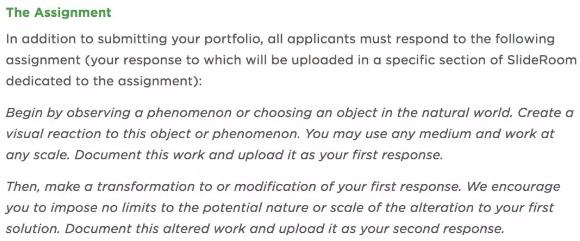
Screenshot from RISD official website
Let's first take apart this independent proposition and extract the key words: Begin by observing a phenomenon or choosing an object in the natural world Create a visual reaction to this object or phenomenon. You may use any medium and work at any scale; When you select an observation object, the next thing you need to do is to show it in a visual form; In the process of creation, you can use any media and creative materials, and there is no limit to the scale and form.
The above is only the first part of the whole independent proposition, and then there is the second requirement: make a transformation to or modification of your first response We embrace you to impose no limits to the potential nature or scale of the change to your first solution; Based on the second project of the first project, RISD hopes that students can fully demonstrate their potential without any restrictions.
Although RISD says no limits, it does not mean that you can really NO LIMITS when you create. Now, let's take a look at the important precautions hidden in this assignment!
This time, the RISD proposition is divided into two parts, and these two parts must be submitted! It doesn't mean that just submit the final finished version of the second work! So this proposition is similar to Parsons Challenge! Parsons Challenge is based on an existing work in the work collection to carry out "upgrading and transformation" in other dimensions. This RISD first gives a proposition of no limits, and students build projects and themes independently. This is the first work; The second work is the student's second play based on the previous work. So please pay attention to the big housework! I will show the screenshot highlighted in red again. This assignment needs to be submitted in both the front and rear parts!
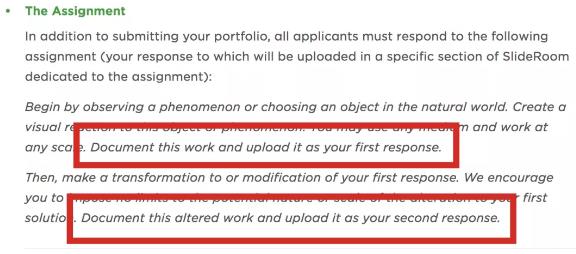
Screenshot from RISD official website
Natural world
“observing a phenomenon or choosing an object in the natural world”
Observe what? How to observe? RISD gives the instruction: "a phenomenon or an object in the natural world." The focus here is "natural world". Why not the world, instead of adding a "natural" restriction in front?
Let's take a look at the Oxford Dictionary. In the definition of Natural, the etymology of Natural is "having a certain status by birth".
That is to say, in any state, Natural, whether representing nature, original nature, or blood origin, emphasizes a characteristic that is naturally possessed, and more or less has the meaning of "talent".
So here, although RISD has not given a specific proposition this year, it has also made a simple limitation on the scope of topics, that is, your starting point of observation should be within the natural world.
Visual reaction
Create a visual reaction to this object or phenomenon.
You may use any medium and work at any scale. In the process of creating this project, you can use any way, medium and form you can think of, as long as its final presentation is a work based on "vision".
It's not hard to see that RISD actually gives applicants plenty of space and opportunities to show their abilities as much as possible, as long as you can visually express what you are observing to other viewers.
But the difficulty here is, what is the content of Visual Reaction that RISD wants to see? We are going to move out of Oxford Dictionary again to see what "reaction" means: reaction does not mean the true restoration or reproduction of a thing or state, but emphasizes the thinking, feeling, and reaction to events.
That is to say, when we are creating, the visual content displayed must be the feedback and feelings generated by our thinking, rather than the straightforward restoration.
When we see a thing or phenomenon, each of us will have his own thoughts and feelings in his heart. This feeling is always the most unique and very "personal". This actually corresponds to the student qualities that RISD has always attached great importance to - unique creativity, thinking awareness, and personal style. Even in this almost unlimited assignment, you also need to show your unique ideas and opinions on things.
RISD does not limit how to show it specifically, as long as you can feedback your own feelings and psychology about this event/phenomenon/thing in the most suitable way and in a unique and creative way.
Transformation/Modification
make a transformation to or modification of your first response. We encourage you to impose no limits to the potential nature or scale of the alteration to your first solution.
The last point is simply Parsons School of Design The upgraded version of Parsons Challenge is modified or transformed based on the previous works, but the prerequisite is that "impose no limits to the potential nature or scale of the change to your first solution". The real "no limits" finally appears at this time.
However, the test point that needs attention at this time is the scale and depth of the work. This kind of creation without theme is often loved by students, but it is always the most "drag" people, because there is no limit, so we need to be "cautious" everywhere. How to avoid the theme becoming empty and boring? How to prevent the works from becoming general and tasteless? How to find the points and clues that can diverge without limitation?
No matter what kind of creation method you choose, and no matter what kind of media and form you use to show, it should be clear that no work can be created without breaking away from the main line of essence, that is, logical clues and central starting point. This work also needs research, thinking, exploration, experiment, and consideration of its final positioning and orientation, as well as the depth and breadth of divergence, in order to effectively create with ideas and style.
Natural light shares more topics for you:
Open course of RISD enrollment consultant, RISD college interpretation and portfolio application guide
American Rhode Island Design Institute, studying in RISD Rhode Island has changed its own topic
This article belongs to the original article of Natural Light International Art Education Team. Without permission, it cannot be reproduced commercially in any form. If it is found, it must be investigated for legal responsibility.