The application season finally started in a tense atmosphere, but! The lovely students of natural light have begun to get offers! Today's interview student Saier has taken the lead in winning the offer of RCA Royal Academy of Arts. Behind this offer, its winner, Saier, is also a shining "restraint" girl. Like all young Dreamers, she is full of energy, but different from any art student abroad. Now, let's get to know the student who first got the photography major of British Huangyi and the first Huangyi offer.
Her footprints are all over China, but also overseas. She likes to experience different cultures and is keen to record every good place in life. Although the university is an international finance major, rational data can not prevent her from loving photography, even if it is the background of applying for the photography major of British Royal Art from zero foundation, It doesn't stop her from learning and creating for 4 months to gain the recognition of Huangyi. Therefore, today we can't wait to invite Saier to talk about her photography collection, application and understanding of photography.
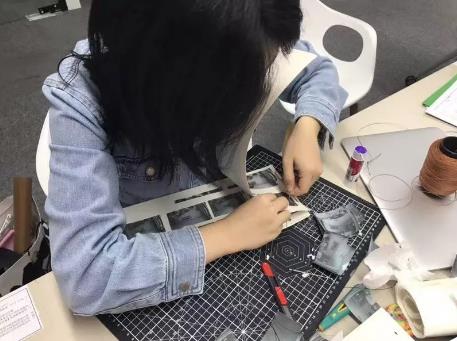
A serious Saier
In 2020, the first Huangyi offer student for Huangyi's photography major:
Q1: Where to study abroad when learning photography
Hello~My name is Saier. Originally, my major was international finance, and I applied for the photography direction of British Royal Art, which was a professional transfer application. Previously, I had zero foundation (I have been exposed to photography, but I haven't studied it systematically). It has been more than 4 months since I signed up. I have had 3 or 4 basic courses, and now I have Royal College of Art And then apply for LCC, St. Martin, Birmingham, Goldsmiths and UCA.
Q2: How did you decide to go to the UK?
At the beginning, I decided to choose a major, that is, I wanted to learn photography. Then I decided to choose between the United States and the United Kingdom, considering that photography majors in Britain and the United States are very good. Then I began to choose schools.
Compared with the United States and Britain, the United States may be biased towards business as a whole, especially for graduate students, which is a bit too direct for me. So considering that I am not so basic and not very mature in ideas and ideas, I prefer the UK. Because I want to improve myself first, whether in ideology or aesthetics, I think it will help my future development.
Even if I want to do commercial photography later, it can ensure that I know how to find my own inspiration to make myself better. If I learn some business methods directly from the beginning, I think my ideas will be easily exhausted, because photography is a profession with high requirements for inspiration and ideas. I still need ideas to support my future development. So I decided to apply for the photography major of Royal Art.
Q3: Before you officially start to learn photography systematically, do you often take some photos yourself or join an interest group?
When I was in school, I did not participate in the photography interest group, but my interest in photography and knowledge are accumulated from some small life details. For example, I like taking pictures and traveling very much. I have never been to some areas in the north of China, and I have also been to many countries abroad.
Secondly, I usually have a habit of taking my camera with me. When my friends go out, I like to take pictures for them. I like and enjoy the process of taking pictures of others and beautiful things. In addition, I also have a habit of buying magazines. I have bought magazines of all Chinese brands in every issue. I have several bookshelves full of magazines in my home.
In the past, I used to work as a hobby, not as a major. If I had my first formal contact with photography, it was when I was about to graduate from college that I found an internship. This internship had nothing to do with my major. It was an assistant to a photographer who had just arrived in Shenzhen. His requirements for recruiting interns were not necessarily to learn photography, But aesthetic awareness should be better. I passed it at that time.
During this internship, the photographer taught me some commercial shooting techniques, such as how to use lights and equipment. Under his guidance, I began to take some small personal works. Because I don't really want to make photography into a mass production thing, I only have about ten sets of works that can be taken out directly.
I think these habits and details, as well as the process of continuous accumulation, have greatly helped me to choose a photography major and understand photography.
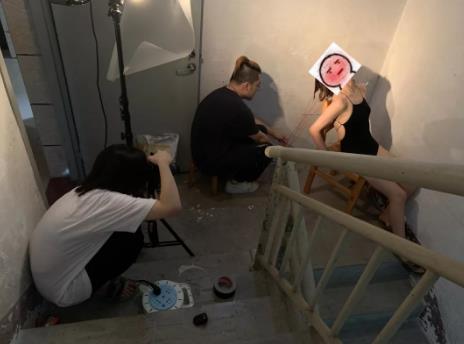
Saier is shooting works
Q4: In the preparation stage of the portfolio, have you considered making preparations according to different school styles?
I have considered these.
At the beginning, my teacher and I explained the general style bias between Britain and the United States. The British language is biased towards research, which is very different from the United States. That means you need to show a lot of processes to reflect the source of ideas and so on.
In terms of schools, my favorite schools are LCC, Saint Martin and Huangyi. Huangyi is a very research-oriented school. It is very academic and cares about your source of inspiration, so in the direction of investigation, it will be more interested to know whether your creative theme has been deeply thought about, whether there is a deeper meaning, and so on. So according to this requirement, I submitted three works when applying, all of which I think are of profound significance.
Because the Deadline of Huangyi is very early this year, I only submitted three complete projects when applying for the photography major of Huangyi, and one work is still being optimized and modified. This work will be submitted when LCC and St. Martin apply. As we all know, Saint Martin's strong specialty is fashion design, and LCC is a relatively commercial school, so they may want to see the way and process of combining the use of colors, lights, props, and these different media. So the project I am currently improving will be completed with the concept of color, They will also integrate these elements and media.
Q5: Can you share with us some items used in this application for Huangyi?
My first project is about "hysteria". In this project, I want to discuss some mental diseases that often occur among contemporary young people, such as depression, anxiety, delusion of persecution, etc. The number of patients with these diseases has been growing. For example, many stars have also been exposed to depression, so I want to explore the reasons behind these diseases.
During the early research of this work, I read a lot of news reports and materials, and then I knew that these diseases were not inherited or carried from birth, but were basically affected by external factors. So I used the method of combining virtual with reality to express this series of works. I used many concrete things to represent those invisible pressures and influences, such as some bound language, moral norms, difficulties in life, etc.
For example, in the first piece of this project, I shot a person's hair tied by a red rope. I want to use this way to express a passive and constrained feeling, so as to express the pressure brought by the outside world, such as some social ethics.
Q6: How did you come up with such a way to express yourself?
First of all, the work about depression, because I have friends around me who suffer from depression. Secondly, I like to discuss the deepest things about human nature. The darker things are, the more I want to understand and dig them out. Especially the two views of "human nature is evil" and "human nature is good". My own heart has always been very tangled, so I want to use my work to discuss with you.
Another example is my second project, in which I used X-ray, which is about "fear" in human nature. Many people are in the state of "fear" when we are in the two states of "accepting new things" and "overthrowing old ideas". In this process, the things you once feared may be solved, but it is very likely that new fears will replace them. So in this project, I did a space experiment, using video in addition to photography.
The last work I think is quite wonderful. The topic of "peeping" is finally presented in the form of manual books. I have installed a surveillance camera in my home for two weeks. During these two weeks, I can't help but want to "peek" through the mobile phone screen.
Because people have a desire to peep, and peeping is actually the representative of "the evil of human nature", which is a very instinctive behavior, but most of the time our reason will restrain this behavior and prevent it from happening. So in this work, I want to start from myself, dig deep into my own voyeuristic desire, and see how my psychological activities change when I peep at others, so I made the final work.
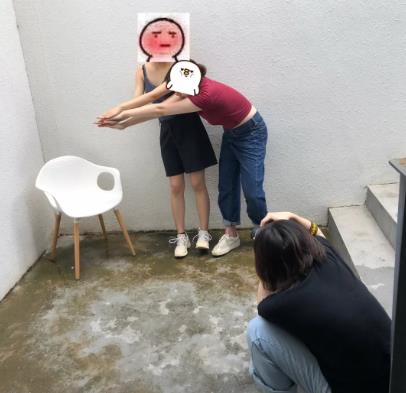
The shooting scene of Saier's works
Q7: This year, Huangyi's application requirements changed suddenly, especially when it proposed to shoot a two minute video. How did you prepare this video in a short time?
In this video, I first asked for the teacher's advice, and the teacher gave me several clear directions:
First of all, introduce yourself in the shortest language, such as your original major and personal situation; Later, I will introduce my own works. I can take out one of them in detail or several of them in general. In this part, I will talk about the second one in detail. I pulled it out, magnified it, and explained my creation process in detail. A small suggestion is that the number of words in this part should be controlled at about 150.
The last is the end. The end should be limited to 50 words. It mainly talks about the understanding of Huangyi, their cognition, why they choose Huangyi, and what they want to get in the future.
After receiving the teacher's guidance, I completed an initial draft, and then handed it to the teacher to help me modify and adjust it. According to this draft, I began to record and shoot officially.
Q8: During the preparation of the professional photography works collection for applying for British Royal Art, did you encounter that link that is more difficult and has gone through more running in?
The most difficult is the first project. First of all, this is my first time to make a collection of works, so I encountered many difficulties. This project needs to be shot outdoors. The shooting location was chosen for a long time. Most of the sites were rejected because of insufficient light and poor effect. At that time, the weather in Shenzhen was very hot and I had to move things constantly, but the teacher also helped me find a place to encourage and support me.
Secondly, in the first project, I divided many small works to express, which involved the choice of materials, such as rope. At the beginning, I only thought of using ordinary rope, but the teacher told me that different kinds of rope would affect the different display effects of the works, even the binding method of the rope, and would also affect the expression of the theme The presentation of visual form and so on.
The second project is also about space, so the teacher has been helping me arrange the space, adjust the layout, and then help record the completion process of the project.
So the teacher's help to me is very comprehensive, including my thoughts, some very detailed handling, and finally going to the venue.
Another thing I want to say is that the teacher took me to try again and again. Project I and Project II were both completed after many failures. In order to achieve the best results, I have been doing things again and again. My teacher pursues perfection very much. Even if he is only a little short of perfection each time, he will feel that he can't do it. He will have to start over again. He is very strict with me.
Q9: Will your emotions change in the process of repetition? For example, how do you deal with frustration and disappointment caused by failure?
I don't have too many such emotions during the repeated process. The more painful part is that I am easily affected. For example, when conducting research, it is easy for me to unconsciously participate in that role or scene. In many cases, the more I see and think, the more uncomfortable it will be.
However, I won't feel uncomfortable when I do my work, because every time we retweet, we are trying to do better. If I want to apply for good results, it is necessary to retweet, because every time we retweet, we see flaws or can be re optimized.
Especially like Studying abroad in photography This is a very "visual" profession. Most of the time, what others see first is the visual effect presented by your works. Only when your vision is the best, can others see the theme and meaning behind your works. So this requires me to do my best. Once I find something bad, I must change it! Until you can't pick out the bad things at present.
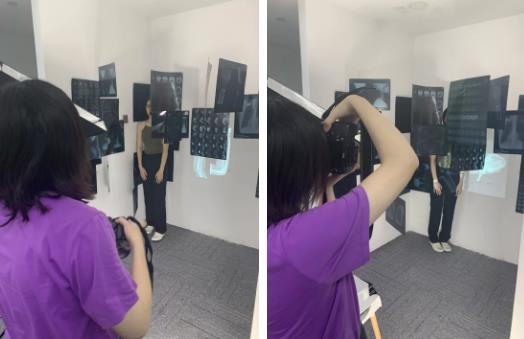
Saier is preparing the second portfolio project
Q10: Can you tell us about your learning experience in natural light? What do you think?
I think teachers in Natural Light are very targeted and purposeful. Each teacher will provide me with suitable learning methods and complete the course with me according to my personal situation and my current situation.
My own photography teacher is a very thoughtful teacher, and I think it enlightens me a lot. When I first came to natural light, he first introduced photographers, because I had accumulated some photography methods during my internship. At that time, I knew more about photography methods and equipment selection than other students, so the teacher discussed with me to reduce this basic course, Put more time where I need to make up.
My basic courses and early courses started from knowing different photographers. My teacher introduced me to many photographers. I saw and got great inspiration from them. My teacher would also be patient to explain their works to me, so that I could feel how these photographers think about creation. Then I will look back on myself, how can I inspire myself and how can I deal with my own ideas.
At the beginning of the work, when I had an idea, I would immediately communicate with the teacher. In fact, I gradually found that this was the first time for me to deal with such a relatively complete and systematic work, so many ideas were relatively simple. But the teacher has been patiently telling me how to refine these ideas, how to make them more "advanced" and thought-provoking, or how to use more accurate photographic language to describe and investigate.
Secondly, the teacher will also tell me some of his own known theories, or my own unknown theories and fields, to help me start questions and think. For example, in the first project, I didn't know that Freud had a theory about "self" at the beginning, but my teacher told me that I was inspired to find relevant books and materials. Because of this, I was able to do the first project successfully and finally have such a profound theme.
Q11: In addition to the teacher's guidance, do you think the usual workshops and reviews are helpful for learning?
Because I was short of time, the workshop did not participate, but it was reviewed by an admissions officer before I participated. It was done by Ms. Chris of natural light.
I showed him the two projects I had completed, and he praised the work as a whole, but gave me some key suggestions on some details. For example, for the second project, he asked me, "Why does the video of this work have only one angle?" Then he suggested that I could look at it from more directions or angles, and I might find many different things.
I was awakened at that time and thought his suggestion was very interesting, because I was not very satisfied with the performance of the project at that time. I always felt that there was something missing. I wanted to shoot videos again, but failed many times, so I wanted to give up this way. But I never thought that I could change my perspective or give the project more other perspectives to show, so when Chris put forward this proposal, I thought it was great.
Another thing was that my third project (voyeurism) was only prepared after the theme was determined. Chris and I first briefly explained my ideas, shooting ideas, etc. He asked me, "Have you read the book<1984>? I think you can read it, maybe you can get some inspiration!"
Later, I found this book to read. It is a book about the theme of dystopia. Many of the inspiration for my third project really comes from this book. For example, the diary of the hero in the book gives me great inspiration.
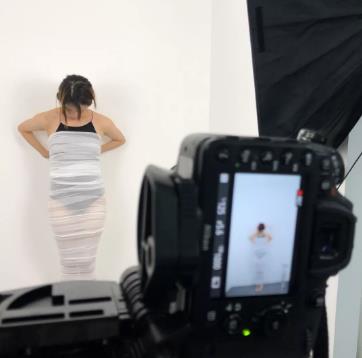
The shooting scene of Saier's works
Q12: Now the first round of application for Huangyi's photography major has ended, and the second round has just begun. What suggestions do you have for students who are preparing to apply and want to apply for Huangyi in the future?
It's mainly a two minute video.
I think that when recording this video, the speech and language expression must be fluent and logical. Don't stutter, read the script, or have too many editing traces. Don't think of it as an exaggerated work of art. I think the school can see whether you have faked or prepared carefully. The second is to be confident. The admissions teacher should be able to see your state. If you are confident, it will be much better.
Q13: Can you share your thoughts on learning photography?
To learn photography, I think it is more important to go out and look at more works from the people or things around, not just to see their visual effects, but to deeply analyze the more fundamental content and theme.
I can give you an example, that is, Japanese photographer Hiroshi Sugimoto. I was a little inspired by his book. He won't tell you how to complete the shooting, he will only tell you where he came from to shoot these themes.
In addition, photographers must be clear about their position and adjust their state. They should not think that they are good at understanding lighting, props and photography skills. Real good photography works have souls, which can let everyone know what the core of my expression is.
Then we should learn to recognize "beauty", look and feel from around us, and then learn how to record them.
Note: Since Saier is still in the process of application, it is not convenient to make the collection of works public, but the natural light will continue to pay attention to your developments. Students can also look forward to the interview and case summary of Saier's professional tutor~
In the sharing of Saier's application for the photography profession of British Huangyi, we saw a future photographer who was full of love for photography. She was methodical, thoughtful, good at finding beauty in every detail of life, and willing to analyze human nature and explore the dark side of human nature. We also believe that Saier In the future, we will definitely grow up and become a different photographer. I hope that today's sharing of Saier can bring a little support and inspiration to every one of you who is on the road to art study, and natural light also hopes to light up the beacon that belongs to you for every one who expects to shine.
Photography Collection for Studying Abroad
This article belongs to the original article of Natural Light International Art Education Team. Without permission, it cannot be reproduced commercially in any form. If it is found, it must be investigated for legal responsibility.