The Visual Arts School of the Royal Danish Academy of Arts offers three-year BFA courses and three-year MFA courses. Students will benefit from basic research, four visual arts colleges, one art, writing and research college, and ceramics, architecture, wood, plaster, 3D, graphics, color, photography, video and sound laboratories. How about studying at the Royal Danish Academy of Visual Arts?
Budget for studying abroad: € 9600-13000
Language score: IELTS 6.0; TOEFL:/
Application date: March 15
The School of Visual Arts provides all aspects of advanced art education: teaching, professional growth and research in all aspects of visual arts.

For more than 260 years, the Royal Danish Academy of Visual Arts has realized this function in the context of changing artistic roles and functions. In the past, the status and importance of artists, works of art, art exhibitions, art markets and other concepts and roles may be taken for granted, but now, these concepts and roles are being continuously discussed and negotiated. These discussions are an important part of today's art education and research, as reflected by the Royal Danish Academy of Fine Arts. Recommended by colleges: Major setup of Paris National Academy of Fine Arts
The Visual Arts School of the Royal Danish Academy of Arts is developing continuously, which is partly due to the experimental development and research of the school, because they have broken through the boundaries in their respective disciplines.
History of the Visual Arts School of the Royal Danish Academy of Arts:
Charlottenborg's house, built between 1672 and 1683, Ulrik Frederick Gyldenl ø ve, the governor of Norway. However, the building was not named after him, but after his widow, Queen Charlotte Amalia: she bought the palace after the death of Christian V and lived here from 1700 to 1714.
When the Royal Academy of Fine Arts moved in in 1753, the building belonged to King Frederik V. Most rooms are used as artists' homes and studios.
Artist's home and classroom side by side
On the first floor of the wing room facing Nihafen, there are separate rooms for different schools: "basic painting", "advanced painting", plaster school and model school each have a room. The architecture college has two rooms on the same wing.
When the College took over the entire complex in 1832, the professor's residence and studio were placed on the second floor, and the rooms on the first floor were used as classrooms - except for two formal reception rooms: the Kuppelsal and the Antiquities Hall.
The rooms in a series of different positions of each school have been in the school since ancient times, but the major reorganization in 1842 brought stability: the overall layout was still basically intact at this time, until 1996, when the architectural college moved out: the north wing of visual art (opposite), and the wings of architecture and architectural art. Recommended by world famous schools: How is Venice Academy of Fine Arts?
When the first decade of the twentieth century came, all the residences of the former artist were transformed into classrooms, with only two apartments on the first floor facing Kongens Nytorv.
These two apartments were home to artists until the early 1960s, when they were reused. Today they are used as principal's offices, administrative and operational offices.
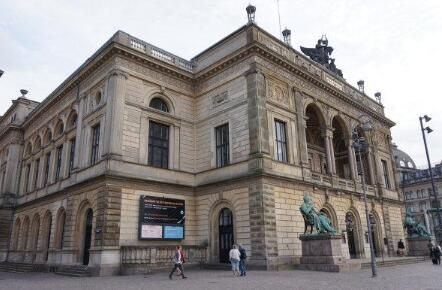
Visual arts schools elsewhere
Frederick Schulms Kanal's School of Visual Arts
Since the era of Professor Wiedewelt (1761-1802), Frederiksholm Kanal's so-called "Materielgard" has been the home of sculptors. This includes college sculptors and others.
In 1945, when Johannes Bjerg, who lived in material garden, was appointed as a professor, he gave his studio to the college. Since then, from 1945 to 2011, this place has been called the School of Visual Arts.
HIRSCHSPRUNG
Since the late 1960s, the School of Visual Arts has set up rooms in the former tobacco factory (and adjacent buildings) in the Peder Skrams Gade/Heibergsgade area of Copenhagen, which is owned by the art sponsor and tobacco manufacturer Heinrich Hirschsprung.
Today, these buildings are mainly used for basic research, but also the location of several visual arts school laboratories.
Royal Danish Academy of Arts The School of Architecture has moved away
In 1974, the School of Architecture and the School of Visual Arts of the Royal Danish Academy of Arts became two independent colleges, each with its own president. In 1996, the School of Architecture moved into Holman's new site, partly because of space constraints.
This article belongs to the original article of Natural Light International Art Education Team. Without permission, it cannot be reproduced commercially in any form. If it is found, it must be investigated for legal responsibility.