On October 14, UAL released the ninth new college, the UAL Decolonising Arts Institute, on its official website. Although the release was silent, once released, it still caused quite a stir in the art world. Less than a month has passed since the last release of the new college, the SDI of the School of Social Design. So quickly, the ninth college has landed. The Ninth College of UAL DAI, College of Decolonization Arts.
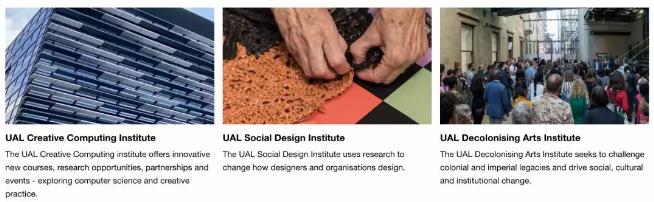
It is said to be the ninth college, but in fact, from the perspective of nature, it is still a college with some sense of "research institute". This is the same as the CCI of the newly opened college last year and the SDI of the newly opened college last month. But to be honest, my only surprise at the opening of this college is that the time is so fast London University of the Arts The choice of the topic of "decolonization" by the UAL is not surprising. And after thoroughly digging this college, I am more sure that the establishment of DAI is not only limited to the research and development of a single "college", but also a "major transformation" of the whole nine colleges of the UAL, from the teaching system to the future planning!
First of all, why am I not surprised:
On the one hand, from the perspective of historical reasons, "colonization" has always been a legacy of British development. Britain was once a country with colonies all over the world. For example, in recent years, it has been unable to leave Europe for a long time. One of the important reasons is the border problem between Britain and Ireland, which is one of the longest colonies of Britain.
As we approach Brexit, from the perspective of Britain's overall social and historical development until now, decolonization is indeed a necessary direction for Britain. Especially for British universities, the topic of decolonization will also be more widely concerned by various universities.
On the other hand, the development and process of art are often inseparable from the changes of the times. Students who usually pay more attention to world art topics may find that decolonization has always been a topic that always arouses heated debate in the art process. Since last year, especially this year, the world's art environment has been more "crazy" about "decolonization" as a hot topic of discussion. For example, in order to change the state of "white supremacy" in the art world, and a series of racial problems caused by it, many art institutions and world-class art exhibitions are re discussing various problems existing in "decolonization" (especially the problem of indigenous).
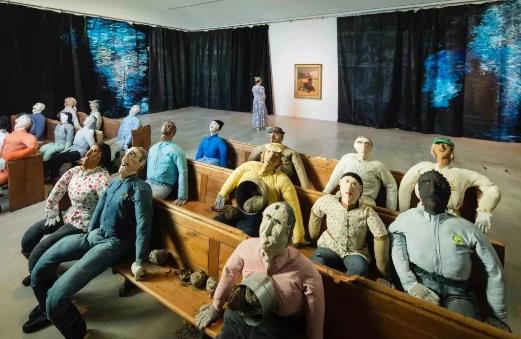
In 2017, the artist Dana Schutz's "Open Casket" exhibited at the Whitney Art Museum caused worldwide controversy. This work depicts the funeral of the African American boy Emmett Till; Another example is Auther Jafa, the winner of the Golden Lion Award for Best Artist at the 2019 Venice Biennale, who is committed to exploring the racial issues in the United States with his works of art; Like the 10th Berlin Biennale, it is the first time that Pan African curatorial team has been fully used; And Oscar Murillo, one of the winners of this year's Turner Prize, whose entries also attempt to indirectly cause people to think about colonial issues.
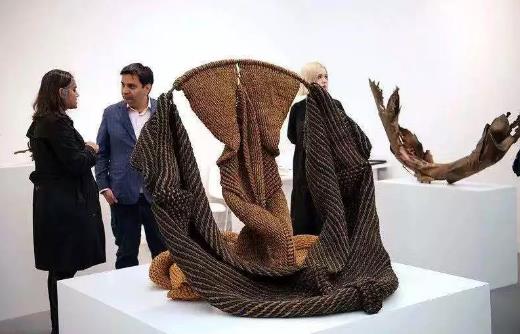
Until a while ago, the London Frieze Art Fair, which was officially opened to the public on October 3, was the most "decolonized" exhibition in the past. In particular, a new "Woven" unit has been added to discuss the issue of colonial culture from the perspective of weaving art
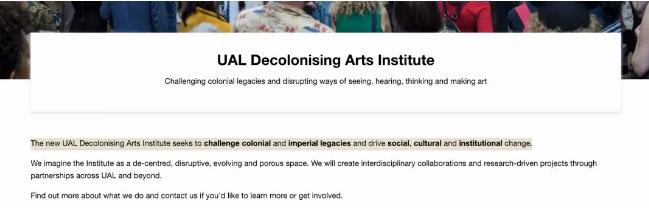
A series of events and historical reasons imply the inevitable result of the completion of the college. As the homepage of the college official website says: The new UAL Decolonising Arts Institute seeks to challenge colonial and imperial legacies and drive social, cultural and institutional change.……We imagine the Institute as a de-centred,disruptive,evolving and porous space.
The new college will be committed to solving colonial problems and problems left over by the empire, so as to promote social, cultural and overall system changes For this reason, the DAI of the ninth college of the UAL is conceived as a divergent, breakthrough and developing multi-dimensional open space.
To understand what Decolonizing Arts is, first understand what decolonization is. Decolonization, literally and in its own sense, refers to the abolition of colonial rule by colonial countries over their subordinate countries. But what decolonization needs to do is not to decolonize simply through a single document. More profoundly, it needs to "free people's minds from colonial ideology", especially those deep-rooted and inferior ideas.
For this reason, decolonization has always been controversial in all kinds of discussions, although it has a certain direction. In the field of art, the most frequently discussed controversial topic is nothing more than: Is the "cross-cultural, cross regional acceptance of more artistic and ideological dimensions" often mentioned in the western world before, a discrimination based on the "white supremacy"?
This time, the UAL directly proposed that when building this new college, it would first consider the interpretation of decolonization proposed by Indian writer Arundhati Roy: What colonization of who are we talking about/ Whose colonization are we talking about? Colonization is not only a two-way issue, but also a historical issue of the global environment, which needs to be analyzed in combination with different directions and individuals.

For this reason, the UAL also proposed a more clear research direction and future development intention: the foundation of the establishment of the college is derived from the AHRC Black Artists and Modernism Research Project (BAM), which is an artist project to study African and Asian cultural heritage in British public art and collections. This time, UAL also hopes to further explore how we recognize or forget some artists, works of art, and history based on this project, so as to continue to explore this project in depth.
"Black culture" has always been a hot and controversial point of concern in the art world, especially the saying "black culture is the favorite of the art world" was widely spread in the art field. While decolonization is more concerned today, many art institutions and artists are beginning to reflect: behind this saying, Does it imply the excessive consumption of black culture and the deliberate uproar of the art world and world culture?
This is also "confirmed" by the BAM mentioned in the DAI plan of the ninth college of UAL. In About BAM on the official website of BAM, a paragraph in the literature of Kobena Mercer is quoted:
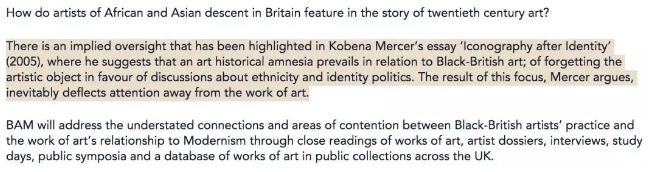
In this document, Kobena Mercer mentioned an implicit "omission" - for (British) black art, people often habitually turn their attention and discussion away from works of art, and have more discussions on racial identity and political issues.
For this reason, many people have neglected the influence of black artists and their works on the development of art. Even if an artist is extremely talented and creative, when he is black, people will pay more attention to the political and social impact of his own as a black, and the topic of discussion will also focus on the political significance behind the work, rather than the response he brings to the world as an artist.
This is unfair and discriminatory for those talented artists. In fact, this situation does not only happen to black artists. Then, in order to allow more people to truly face up to these artists and works of art, contemporary society needs to decolonize, so as to equal the coexistence relationship between artists, works of art, and the big art environment.
This introduction, in fact, just shows that the DAI of the ninth college of the UAL is actively facing and thinking about this problem:
-What does it mean to decolonise the arts?/ What does the art of decolonization really mean?
-How do we decolonise the curriculum and the university from within?/ How can we decolonize the curriculum and university teaching from our own perspective?
-How can we work to dismantle and transform what we know and what we do?/ What can we do to disassemble or transform some behaviors we know and are already doing?
Based on these thinking and research priorities, the UAL also tries to rely on DAI to complete:
-Recognise local and global movements to decolonise./ Recognition of indigenous and globalized decolonization movements;
-Explore postcolonial, Decolonial and interactive thinking and practice./Explore the concepts and practices of post colonialism, decolonization and cross cutting;
-Collaborate with individuals, Collectives and organizations across the arts and education;
-Gather strengths, amplify voices, and listen differently.
As it is a new college, so far, the UAL has not given the college's major and curriculum arrangement, but also said that in the pilot school year, the school will conduct research and practice from the following directions:
First of all, DAI proposed to cooperate with TrAIN Research Centre and LCF in terms of visiting scholars and professionals.
TrAIN Research Centre, full name of Research Centre for Transnational Art, Identity and Nation, is a research center/organization for architecture, art, communication, handicraft and design based on history, theory and practice.
Here, students and teachers can explore the impact of national culture on artworks and handicrafts in the global context through cross media and interdisciplinary cooperation.
The current ongoing projects of the Research Center include the BAM project we mentioned today, followed by Decolonizing the Archives – Researchers in Research Program/Decolonization "Researchers in Research" program. Researchers in Research is a project that provides short-term residency for UAL students to carry out professional practice and in-depth development.
The purpose of the previous project is to help students have more convenient opportunities to research and create, such as exploring the development of new design concepts in the 21st century, the future planning of current art, and creating by combining humanistic history and other factors. At the moment when the UAL proposed decolonization, the project also needs to rely on resources such as archives and libraries for further improvement and reconstruction.
"Decolonization" is not just about this project. DAI will also consider Decolonizing the Arts Curriculum summer conference/summer art curriculum plan and Decolonizing British Art – De centering, Re colonizing and Re viewing Artworks and Collections/The overall decolonization of British art, that is, the repositioning and re discussion of works of art and collections.
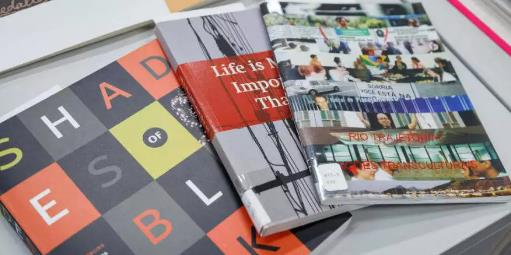
The last point, I think, is the most special one - Listening Zones. This is an experimental public plan project, which will cross with the Decolonising the Arts Curriculum Zine project currently under way.
Although it is called "Listening Zones" in the title of the plan, looking at Decolonising the Arts Curriculum Zine shows that this project is more like an opportunity for artists, scholars, students and professors to communicate and listen to each other.
For example, the published Zine # 1 is defined as follows: the purpose of the publication is to solve the differences in the experience and achievement of international students and students of color in the teaching environment. This Zine is aimed at all students and faculty of the UAL. Rather than being a magazine, it should be defined as a medium to raise awareness and invite everyone to have an open dialogue. So that we can further develop our understanding and action on decolonization in the creative teaching practice. UAL hopes that every reader can get inspiration from it.
As an ongoing project, the establishment of Zine will serve as one of the tasks and responsibilities of future UAL students and faculty. However, it is not a textbook or manual, requiring students or teachers to do xxx, but more like a tool to help everyone discuss and spread ideas from the perspective of creativity and design.
Today's natural light Portfolio Coaching The agency shared with you the DAI of the ninth college of UAL, Decolonizing Arts Institute/College of Decolonization Arts. As a country that has been deeply involved in colonial issues for a long time, decolonization/decolonization is one of the thorny issues that Britain is currently facing, both in terms of current national development and overall world development. The "urgent" establishment of the DAI by the UAL is a direct look and positive response to the colonial issue. The UAL hopes to solve the colonial problems accumulated over hundreds of years through DAI, so as to improve the development of the local and the world.
But then again, decolonization is not a problem facing Britain as a country. It is a historical and social problem that the whole world needs to deal with. Because of the existence of history, the current world will be what we see now. For future artists and art circles, it is the goal that all people should work together to change the status quo more consciously and with ideas, and let the world "de" colonize.
As mentioned in the foreword of Decolonising the Arts Curriculum Zin, which we mentioned at the end of today:
The institutional inequality and existing barriers stem from the historical problems that have always existed in Britain. This idea of racial colonialism has been deeply embedded in the current system.
W. E. B. DuBois once said: "A (education/society) system/constitution cannot protect people or things that should not be protected. The problem we are facing today is that the current higher education system is still marginalizing some marginalized problems/groups, and to change this situation, some previous ideas must be lifted. More and more international voices are indicating "decolonization", from school curriculum to campus construction to discrimination faced by students and teachers and staff
Until 2016, a student led campaign called "UAL SO WHITE" officially exposed these problems and prompted us to take urgent action and reflection. Although there is still a long way to go in the future, we hope to change the existing teaching structure and cultural transmission mode of the UAL through what we do today.
Decolonization has never been a problem that needs to be solved by an institution alone, but only when an institution such as UAL first makes changes from its own perspective can it affect individuals and groups more widely
In my opinion, such a huge change made by the DAI of the ninth college of the UAL, the College of Decolonization Arts, can be understood as a re "transformation" of all colleges and a reflection and exploration of the past and future teaching directions.
This article belongs to the original article of Natural Light International Art Education Team. Without permission, it cannot be reproduced commercially in any form. If it is found, it must be investigated for legal responsibility.