In this year's QS World Ranking, UAL London University of the Arts jumped to the second place on the list, winning the best result in the past five years. At the same time as the ranking was announced, we guessed that the UAL could become a dark horse, which has a lot to do with the CCI/Creative Computing Institute, which was newly opened last year. Recently, the UAL released another blockbuster news - SDI, the 8th college, the Social Design Institute, officially launched! Today, we are going to talk about the UAL Social Design Institute SDI.
In recent two years, the speed at which UAL has set up colleges and new majors has been amazing, and there is even a feeling that it is not doing anything but opening new majors... First, the CCI Creative Computing Institute mentioned above, then CSM has opened a new Biodesign/Biological Design, LCF+UCL+Loughborough Design for Disability and Innovation/Medical Interactive Innovation. However, at least from the above updates, more and more attention has been paid to cross-border concepts and global awareness.
Recently, many students have asked me about this new college in a low voice. After all, UAL London University of the Arts Making so many changes in a year has left many students confused and even anxious. Especially at the time node of the current application season, the sudden opening of a new college is really stressful. So, today we will talk about the UAL Social Design Institute SDI in detail.
Unlike last year's official release of the school after the completion of the CCI, this year's SDI is particularly "informal" - there is only one page on the official website, and there are no more than 10 pages including the second jump page. But after carefully browsing the settings and pages of SDI, I found that SDI had been active since the middle of this year. Moreover, I think it is not so much a new college as a research institution/institute, because compared with other colleges and universities, teachers teach students courses, transfer knowledge, and students master certain abilities through practice, SDI The purpose of the project is to cooperate with students, teachers and other schools in the UAL to achieve the goal of changing the current design status and paying more attention to "sustainable design".
Several research directions are all based on the existing Research Center of the UAL, but before the formal establishment of SDI, these parts were relatively independent. Although most of them have a long history, they were independently managed by six schools of the UAL. Therefore, compared with the traditional sense of college or major, SDI's positioning is more high-end and forward-looking - because here, students and teachers are integrated, and they are team partners who work together to create for the same goals and ideas, rather than a simple relationship between instructors and receivers.
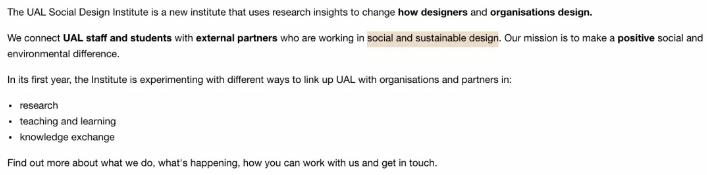
For example, the positioning given by the UAL highlights the importance and height of the new college in the future - The UAL Social Design Institute uses research to change how designers and organizations design/ UAL SDI will use various "studies" to change the design methods of designers and design organizations.
Compared with CCI, the UAL has higher expectations for this new college - it is committed to changing the current design status and the design methods of designers. It is no exaggeration to say that the UAL hopes to redefine "design" through SDI.

The figure is from the official website of UAL-SDI
The above sentence further illustrates the understanding of the UAL to the current environment: challenging research and practice in social design and design for sustainability/ Advocate research and practice in social design and sustainable development. In the specific interpretation part of the college, SDI has given such key points as "social and sustainable design" - social design and sustainable design.
The figure is from the official website of UAL-SDI
It is these two key points that directly remind me of the changes of a series of American art schools last year, such as the new major NCSS/Nature – Culture – Sustainability Studies of RISD Rhode Island School of Design last year; For another example, MICA has opened a special public creative center Center for Creative Citizenship/CCC (previously, MICA has opened an independent MA in Social Design).
In terms of British colleges and universities, Edinburgh opened a new major - MA Design for Change when closing the application channel for product design last year. The name of the major directly indicates "for Change".
The above three professional and research centers are all committed to solving some current social and global international problems - such as population, disease, socio-economic, crime, desertification, human rights, racial discrimination, future climate change and development, etc. These are highly coincident with SDI.

The figure is from MICA-CCC official website
First of all, sustainable design/sustainable design: in recent years, "sustainable design" has become a hot topic. From the domestic garbage classification plan to the accelerated melting of Arctic glaciers, people have put forward more long-term ideas for design - "recyclable", "renewable" and "sustainable".
Social Design should be unfamiliar to most students. What is Social Design? Compared with the design behavior based on senses in traditional cognition, Social Design is more like the reformulation/design of social rules and social forms. In Wikipedia, Social Design emphasizes not the designer's design behavior and action, but the designer's social role and sense of responsibility based on psychological and moral sense. The purpose of social design is to cause social change. In this process, there will inevitably be many related people or events. In particular, even social marginal groups need to be included in the consideration of social design.
Compared with the "traditional" design market orientation, Social Design emphasizes the designer as the leader to trigger people's thinking, help the society further change the status quo, and optimize the current social form. Another example is social design Maryland College of the Arts MICA put forward such a point in the category of ideal students: believe that design and design process can and should play an active role in social creation.
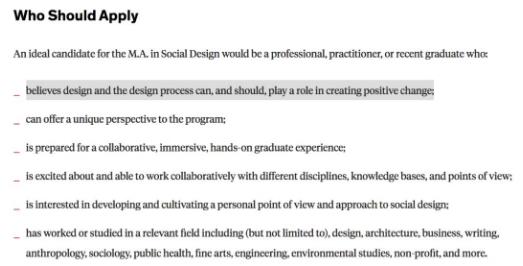
The figure is from the official page of MICA MA in Social Design
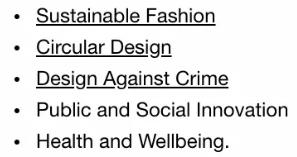
In general, both Sustainable Design and Social Design are not groundless, but inevitable due to the trend of global social formation in the whole world. This time, the UAL put these concerns and ideas on SDI, and the specific implementation method is mainly through Research/Research; Teaching and Learning; Knowledge Exchange. At present, several key directions given by the UAL are:
Sustainable Fashion
Circular Design
Design Against Crime
Public and Social Innovation
Health and Wellbeing
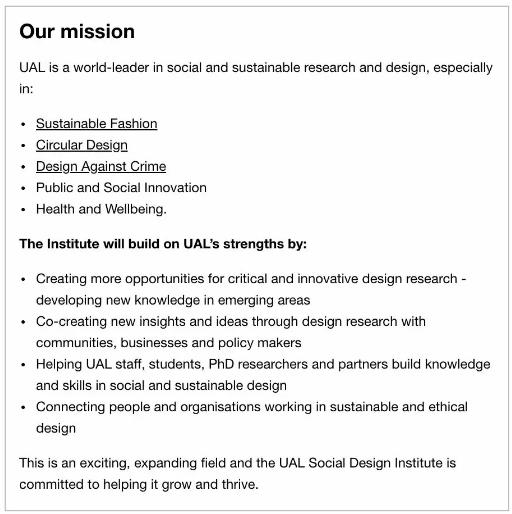
The figure is from the official website of UAL-SDI
At the beginning, I mentioned that SDI is the "collection" of various departments of the UAL Research Center, and Design Against Crime is one of them. The DAS Research Center of the UAL was established in CSM/Central Saint Martin in 1999 and officially established as a research center by the UAL in 2005. It is part of the National Crime Reduction Program/Crime Reduction Plan of the UK. Interestingly, in the introduction to the history of DAS, the UAL emphasizes practice led research/practice oriented research.
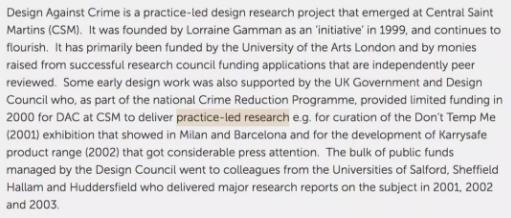
The figure is from the official website page of the UAL-DAS
The specific functions and definitions of DAS are to solve safety problems with design ideas and practices without affecting the design aesthetics and visual effects. Here I also highlight another key point to help understand social design - socially useful design. The projects that DAS is responsible for are very special:
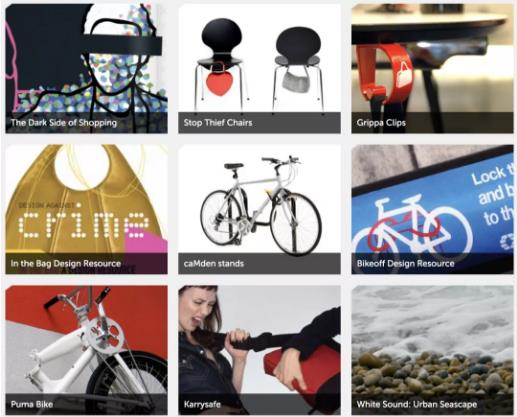
The figure is from the official website page of the UAL-DAS
Take a project included in SDI: on June 7-8 this year, a project named "Tricky Design Symposium: Design Ethics for a Complex World" was completed.
Although the project only lasted for two days, people of different identities participated in the project in these two days, including social citizens, designers, political scientists, activists, educators, etc., who jointly thought about and discussed the ethical problems in the design, and carried out discussions on applied ethics based on specific cases.
In these two days, all participants discussed their views on the following issues, and reinterpreted these ideas with specific cases:
Panel 1:How can we design with others in an ethical way?
Panel 2:How does ethics shape the things we design?
Panel 3:How should design intervene in the public sphere?
Panel 4:Can new ecologies provide a more equitable path for design?

The figure is from the official website of UAL-SDI
On the second day of this project, the seminar raised some questions that are worth thinking about. Here I will just list two cases to share with you:
Case A: A student is interning in a textile company. They are required to design an electronic textile prototype with detection function for a luxury car to better monitor the heart rate of drivers and passengers. Do you need to consider ethical issues in this process? Should students participating in the project remind users?
Case B: A student with visual impairment is currently learning fashion design in LCF and has joined the graphic cutting class, but the teacher did not realize that he would meet physically disabled students before, so the teacher did not have any teaching experience for disabled students and did not understand the relevant teaching terms and methods. From the teacher's perspective, Is there a moral problem?
In addition to the above two cases, we also raised a lot of questions that can be considered:
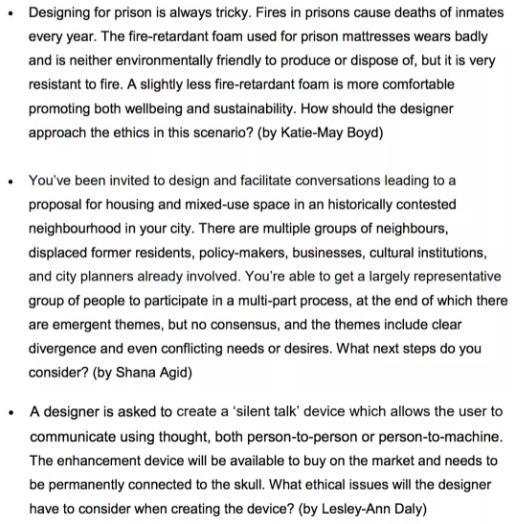
The figure is from the official website of UAL-SDI
We often hear and say such a sentence - "The essence of design is to solve problems". In the past, most people's definition of design was more limited to "solving problems" at the visual level. How to change people's views and cognition of an object through reasonable planning and layout; Until modern times, the concept of "interdisciplinary" was more and more put forward, and design began to combine other disciplines more widely to "solve problems".
But as can be seen from the previous cases, SDI definitely wants to do more than solve problems through design. It is more social and inclusive to solve the problem that we cannot see. When designers can carry out really useful "design" in the global environment with a higher social awareness and a high sense of responsibility, then they can really "solve problems".
In fact, even though the UAL did not release SDI this time, many students have no idea about Social Design, but in the actual design, many students have been on the road unknowingly.
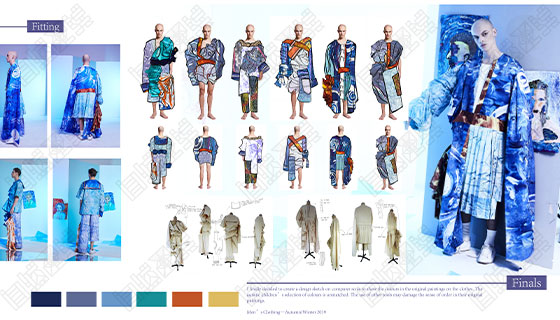
Student Works of Natural Light
In the past, we often said that the British and American countries have obvious styles and preferences in the collection of works, so when preparing the collection of works, we need to focus on it. But looking back today, whether it is RISD, Edinburgh, MICA last year, or CSM, LCF, and SDI that we briefly mentioned today. For these newly opened majors and colleges, we can sum up two keywords - "CHANGE" and "USEFUL". But this CHANGE does not mean that it is more interdisciplinary, creative and cross-border; And USEFUL is not only practical, or easy to use. On the whole, they mean more "socialization", more "sense of responsibility" and more "social value".
For future designers and students who are preparing work collections, the phrase "the essence of design is to solve problems" still exists, but it is no longer a one-way topic based on the design market. As advocated by SDI, we should use sustainable design and more responsible design to influence our society and living environment. Even the marginal groups and phenomena in the society, designers should also optimize their future development with a positive attitude.
The establishment of the UAL Social Design Institute SDI is not only an inevitable trend of the development of global contemporary culture, we can also go further, which is also a practical action of the "social person" that the UAL hopes to become. For those students who are preparing their portfolios, I hope that today's interpretation of SDI can also be an inspiration in the creation of your portfolios.
This article belongs to the original article of Natural Light International Art Education Team. Without permission, it cannot be reproduced commercially in any form. If it is found, it must be investigated for legal responsibility.