RIT is one of the oldest science and engineering universities in the United States, but what many students do not know is that science and engineering may be the signboard of its establishment, but art and design disciplines are the real top strengths of RIT. RIT's majors in photography, visual communication, industrial design and jewelry design are all among the top ten in the United States, and it is a truly undervalued art school. Today, let's take a detailed analysis of the MFA course of RIT Visual Communication to see where the design of this university of science and technology is strong.
How about RIT visual communication major?
RIT Visual Communication
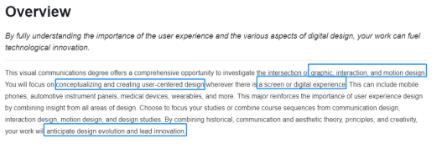
First of all, we can clearly see the differences between science and engineering universities and art universities in setting courses. The RIT directly indicates that "our visual communication courses generally require students to study the intersection of plane graphics, motion design and interaction design".
After the bottom card is clear, the definition of visual communication specialty is further detailed. Regardless of whether it is presented on the screen or other digital media, students have only one goal, that is, to focus on establishing a user centered design concept and further completing the design.
Similarly, in the MFA major of visual communication, RIT will also combine visual communication with various scientific and technological projects across disciplines, such as medicine, wearable devices, mobile communication devices, etc., in combination with its own institutional expertise. In the process of these interactions, RIT also highly emphasizes the user oriented design concept.
It is also worth mentioning that RIT attaches importance to interdisciplinary ideas in the setting of visual communication MFA major, which is also reflected in the relevant statements of the learning plan. Colleges and universities specially emphasize that in the current society, the boundaries between the major design fields are constantly blurred, and the visual communication specialty came into being in such an environment.
Therefore, it is necessary to apply for study across disciplines, and the designers of visual communication have also been given a new responsibility - to shape the experience, and explore more possibilities in the new major of visual communication through the strong scientific and technological background of RIT.
MFA Official Website Curriculum of RIT Visual Communication
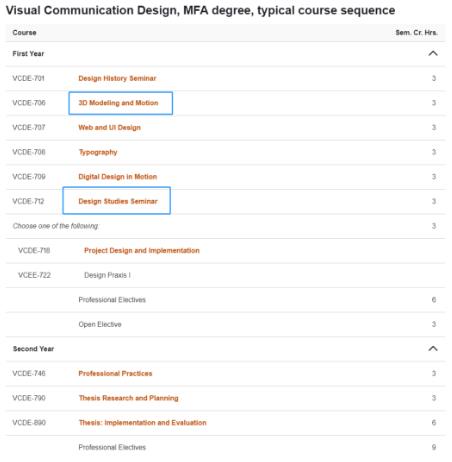
When detailed into the curriculum of each academic year, RIT shows us more concretely the technological advantages of the University of Science and Technology. The two-year course distribution is very simple and clear. The first year is specialized courses related to visual communication, while the second academic year focuses on the practice of visual communication and graduation design.
We noticed that MIT also reserved a place for 3D modeling and animation among the six professional courses in the first year. Such setting is rare in the visual communication profession. Because although visual communication is an interdisciplinary emerging specialty, due to the reason born out of graphic design, the design industry generally tends to study relatively flat visual experience.
RIT attaches great importance to 3D Visual Arts The emphasis on direction is actually the trend of the current integration of visual communication, UI design and UX design. Mastering 3D skills has greatly broadened the direction of personal development for students, whether it is project production during school or employment options after graduation.
The visual communication design of RIT is relatively consistent with our positioning and expectations for science and engineering colleges. While emphasizing professionalism, it also makes use of its own scientific research background to have more in-depth interaction and cooperation with emerging technologies such as 3D. At the same time, the college itself also has its own interpretation and insight into the visual communication specialty. Scientific and technological innovation is RIT's specialty.
More relevant recommendations of Rochester Institute of Technology:
Application Requirements for Film Animation Major of Rochester Institute of Technology
This article belongs to the original article of Natural Light International Art Education Team. Without permission, it cannot be reproduced commercially in any form. If it is found, it must be investigated for legal responsibility.