CalArts of the California Academy of Arts has cultivated a large number of excellent animation producers and directors. The animation specialty is affiliated to the Film/Video Academy in CalArts of the California Academy of Arts, which is generally divided into experimental animation and character animation. Different from other art colleges, CalArts adopts a teaching plan based on different majors. Experimental animation majors provide undergraduate and graduate courses, while character animation only has undergraduate courses. Now, let's analyze and discuss the curriculum of CalArts animation major in California Academy of Arts. What is the legendary curriculum that leads the innovation pioneer of the entire animation industry?
CalArts Character Animation
Undergraduate courses
Before in-depth understanding of experimental animation, let's quickly go through the professional description and curriculum of character animation, which is more conducive to comparing the focus of experimental animation.
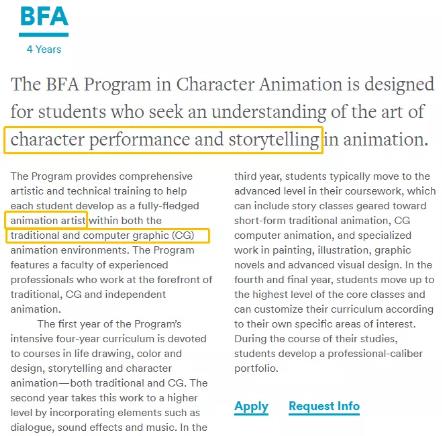
Overview of CalArts Character Animation
From the overview of the official website, we can see that the teaching focus of character animation is to learn the performance and narrative art of animated characters. Teaching methods include traditional hand drawn animation and modern CG animation dominated by computer.
The teaching goal of character animation is relatively inclined to steady basic animation knowledge and cultivate high-quality animators. This can also be confirmed in the detailed curriculum of our major.
The teaching objectives listed on the official website are detailed and grand. In general, the role animation major hopes to cultivate all-round art talents based on animation creation. In addition to the necessary animation ability of animation specialty itself, it also includes early visual effects, conceptual design, narrative structure and adaptability to various working environments.
As an old animation school, the United States CalArts The four-year curriculum of the character animation major can be regarded as the most standardized process model in the animation industry.
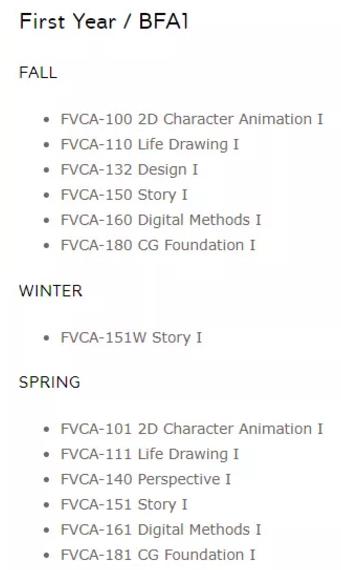
Curriculum of CalArts Character Animation Major in the First Year
From the most basic sketching, to the early conceptual design, to the use of digital art and computer graphics, and even to the refinement of the layout of animation, all have been arranged clearly. Even the transition from story design to animation storyboard drawing has professional course guidance in the first two years.
Students who are interested in animation should all know that storyboards are a major feature of animation, and also a test for budding students to change stories from words to visual images. CalArts' meticulous curriculum is very conducive to students' transition and transformation in this process.
After a rough understanding of CalArts' textbook like character animation course, students must be more curious about the experimental animation course. Next, let's take a look at how the experimental animation course, known as the creative pioneer in the animation industry, will surprise us.
CalArts Experimental Animation
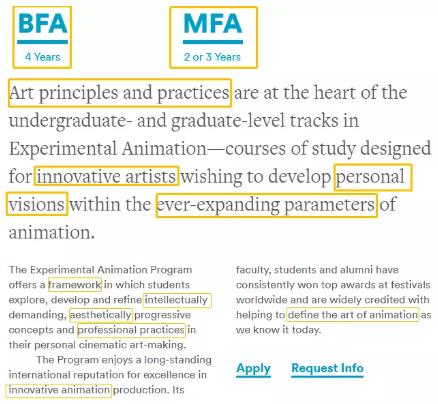
Overview of CalArts Experimental Animation
In the course introduction of experimental animation on the official website, we can see that the status of "art" has been raised very high, and the definition of student identity has also weakened the concept of animators and emphasized artists instead. The college official said that the art principle and art practice are the core of the experimental animation specialty, and the vision of creating this specialty is to refresh and expand more possibilities in the animation field through the independent personal characteristics of students as artists (not animators).
As for what the college provides to Animation Design Study Abroad The teaching guidance of students is summarized into three categories: intelligence guidance, aesthetic education and professional practice. It is worth noting that in the animation form proposal officially put forward by the Academy at the level of animation technology support, in the general animation concept, 3D animation, which is parallel to 2D animation, has become stop motion animation, while 3D has been replaced by the concept of motion capture, programming, digital production, etc., which has intersection with 3D but is not all 3D.
This may be a bit abstract, so let's take a look at the curriculum assigned by CalArts Experimental Animation.
Undergraduate courses
The first is the undergraduate course. In addition to the general requirements of animation majors on background knowledge (animation history), software skills, teamwork and professionalism, there are two special requirements that deserve attention in the learning objectives. One is the expression of students' unique personality, and the other is interdisciplinary methodology.
These two points are the biggest differences between the so-called "experimental animation" and "character animation", and even the animation majors in other colleges. CalArts' experimental animation specialty is also famous for its innovation and avant-garde.

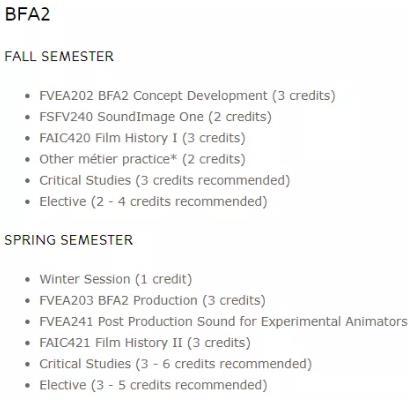
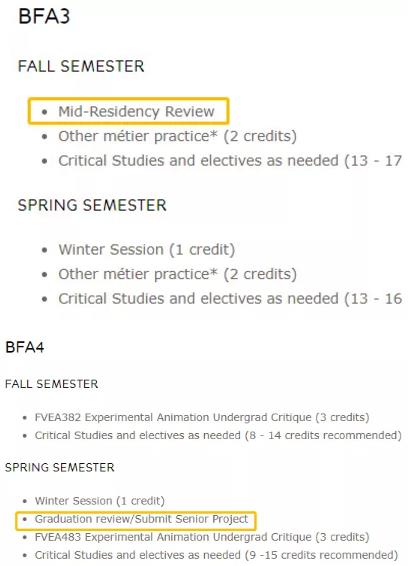
CalArts Experimental Animation Undergraduate Course
Further refining to the undergraduate curriculum of a specific academic year, we can find that in the first and second years of undergraduate education, students will participate in the production of an independent animation project. In the third academic year, in addition to the concept review of the graduates, more attention was paid to other relevant practical courses in the school and explore more possibilities of animation. The last academic year focuses on graduation design and some critical academic research.
As a four-year undergraduate course, this kind of curriculum can be said to be "full of dry goods". At a glance, almost no semester can be "paddled" with relief.
In addition to learning the professional knowledge of animation itself, students are also required to take four public art courses: art, music, drama and dance. Under such a high intensity and wide range of interdisciplinary tasks, students can complete an animation work with their own personal characteristics after completing the four-year undergraduate course.
Postgraduate courses

CalArts Experimental Animation Postgraduate Course Overview
From the curriculum overview of graduate students, we can clearly contrast that compared with undergraduate students, the college official has emphasized the role of creativity and leadership in graduate courses. Even the graduate students majoring in experimental animation will become creative pioneers in the animation industry.
Such "blasphemy" is not CalArts' blind confidence, but in fact, a large number of excellent animation innovators, including Siqi mentioned above, have graduated from CalArts' experimental animation graduate programs.
In the animation/film column of the official CalArts blog, which is used to count outstanding alumni, the excellent CalArts' positive reports are updated almost every week. So how do these excellent graduates do it? Let's explore the curriculum.
The graduate courses of experimental animation are divided into two years and three years. Two years of courses are only for undergraduate students majoring in experimental animation, and the difference from three years of courses is only in some basic knowledge and course intensity. So we use three years of postgraduate courses as examples.
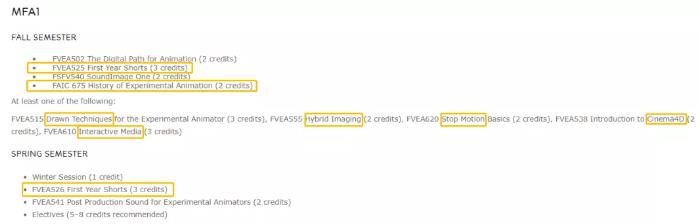
First Year Course Plan for CalArts Experimental Animation Postgraduates
First, let's take a look at the curriculum arrangement of the first year. Based on the short-term animation project that runs through two semesters of the year, audio-visual courses for experimental animation and the history of experimental animation are interspersed.
Here, the natural light has to sigh that experimental animation is really the trump card specialty of CalArts. Because experimental animation has always been defined vaguely and ahead of time in the big concept of animation, most of the academies are still in the process of exploration, but CalArts has been able to summarize its audio-visual characteristics and development history, and set up separate courses for large-scale teaching. This achievement is far from being achieved by "creative attempts" overnight
In addition, it is worth noting that there are five optional compulsory courses, namely, hand drawn experimental animation, C4D introduction, freeze frame animation, interactive media and hybrid imaging. These five refining directions also basically include all feasible trends in the current animation profession.
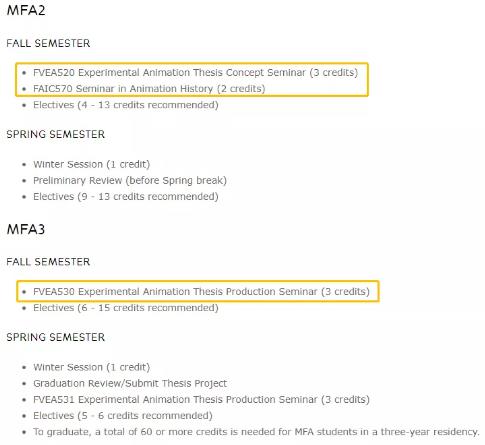
The Second and Third Year Curriculum Plan for CalArts Experimental Animation Postgraduates
In the second and third years of the curriculum, we can clearly see that the focus of teaching has shifted to the development of students' personal characteristics. Compared with animation majors in other schools, CalArts has higher requirements for theoretical academic knowledge. And it is worth noting that most academic research courses began to appear in the form of "seminars" in the second year, even including animation history.
We seem to understand why CalArts animation majors at California Academy of Arts are so confident, because their teaching process is not one-way. As the official website said, their graduates will become innovative leaders in the experimental animation industry, and every "seminar" teaching in the teaching process is also updating and creating a new history of experimental animation.
More recommendations:
How to do animation works?
This article belongs to the original article of Natural Light International Art Education Team. Without permission, it cannot be reproduced commercially in any form. If it is found, it must be investigated for legal responsibility.