Is there a one-year master's degree in water in Britain? Many students' concept of "one year system" is mostly limited by the United Kingdom, especially compared with the United States, which also has a large number of choices. It seems that most majors are from two years ago. What's more, for such majors as architecture, the length of the master's degree will even be three years. But in fact, the one-year school system is not exclusive to the UK. Take the United States as an example, there are also many schools and majors that have one-year master's degrees, such as SVA Fashion Photography/Fashion Photography and Digital Photography/Digital Photography, both of which are optional for 1 year full time or 2 years part time; Another example is Penn University's Historic Preservation/Historic Preservation, which is also an annual system. In addition, the most common 15 month schooling system in the UK can also be seen in the United States. For example, the famous NYU Tisch MA in Cinema Studies is a professional project with a period of 15 months and three semesters. Therefore, the one-year program is not exclusive to the United Kingdom. American masters who focus on theoretical research and academic research also have one-year programs and 15 month programs. So, compared with Britain and the United States in similar majors, is the one-year system really water?
Is there a one-year master's degree in water in Britain?
First of all, why do some students think that the British one-year master's degree? One of the most direct reasons is that the length of schooling is too short, and I feel that I can't learn anything in one year, especially for students who have no experience of studying abroad before their master's degree. One before me Portfolio training Students have shared some of their feelings with me: I felt that I had just arrived in the UK, and that I could fully adapt to the teaching style and learning methods of overseas art schools at the beginning, but I had not yet regained my consciousness, and as a result, I was about to graduate
In just one year, most schools will be divided into 2-3 semesters. Apart from holidays, it seems that there is really little time left for full time study. This is one of the key reasons why many students think that the annual water system is the most important. Secondly, a small number of students' doubts mainly focus on academic certification. When searching for "British one-year academic certification" on the Internet, we will see many answers: the British one-year master's degree is not recognized in China and cannot be certified.
This is indeed a problem for many students who plan to return home after graduation, but is it really so? Yu Bochen can tell everyone here that this is absolutely a rumor! Rumor! Rumor! One year degree in the UK can be certified in China, but there are several reasons for the unsuccessful certification, including the school's failure to be recognized, incomplete certification materials, and various problems during the study period, leading to only obtaining a Certificate.
To solve the problem, let's compare Harvard GSD Architecture and UCL Architectural Design MArch with other majors to see the difference between 2-3 year and 1-year architecture majors.
The architecture majors of Harvard GSD and UCL ranked first and fifth respectively in the QS world rankings in 2019. From the perspective of rankings, although UCL architecture only has one year, its overall strength is higher than that of Harvard.

Image from QS official website
University College London UCL Architectural Design MArch
This is a professional project focusing on research topics, which is aimed at students who already have architectural or related professional experience. In terms of teaching, it is mainly carried out with the project as the core. The major is mainly devoted to exploring the interdisciplinary relationship and application between architecture, design, and cutting-edge technology.
In the course, students will spend 2/3 of their time on projects in the research room and studio, combining research and innovation in large-scale practical projects to learn. For example, there are nine research projects in 2019-2020, all of which are large-scale global projects:
Monumental Wastelands:Speculative Climate Immersions and Post-Anthropo(s)cenic Assemblages;
Architectural Production:Manufacturing-led Design;
Living Architecture:Artificial Intelligence and Autonomous Generative Design;
Automated Living;
Organic(5&6);
Biospatial Design;
Material Mixes;
Architecture for the Augmented age

UCL Architectural Design RC 5&6
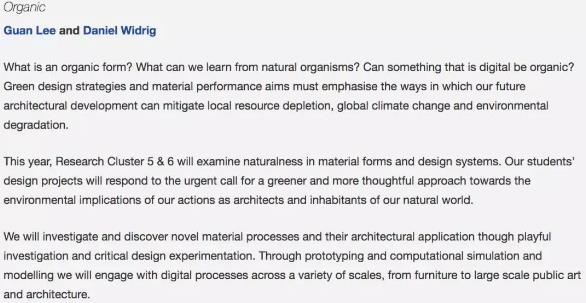
The 5th and 6th projects are together to discuss the topic Organic/Organic. Based on this topic, students will conduct group research and find specific research directions by themselves.
Under this topic, students need to first think about what is organic form? What can we learn from natural biology? Can digital things become organic? Can design and materials with green and sustainable performance help future buildings reduce resource depletion? Will it affect global climate change and environment?
Under this broad topic, students will respond to how to make buildings and residential behaviors more "green" in a natural and sustainable way in combination with specific design projects.
In the specific research process, students will also study and discover the application of new materials and processes in architecture through many interesting experiments and rigorous design experiments. Through prototype design, computer bionics, modeling and other ways, he has participated in the digital architecture field of various scales from furniture to large-scale public facilities, buildings and so on.
UCL Architectural Design RC 5&6
Harvard GSD Architecture
Harvard GSD's architecture majors are divided into two types. Among them, the MArch II is mainly for undergraduates majoring in architecture, or applicants who already have relevant professional learning and work experience at the same level. In terms of setting, this major also emphasizes that the main line is design, so we mainly use it to compare with UCL Architectural Design.
In terms of teaching, in addition to compulsory courses, this major also emphasizes the requirements for elective courses. Most of these elective courses are a series of high-density studio projects, which is similar to UCL. They are mainly studio projects, and students will conduct research in groups.
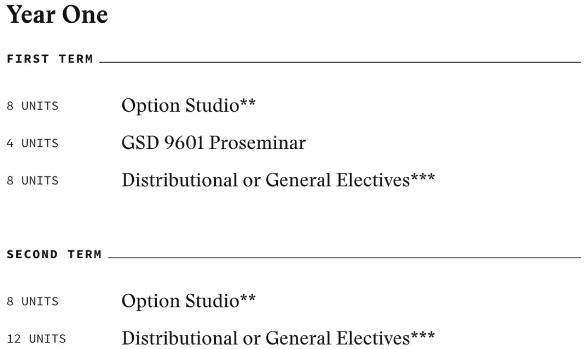
Although the major has two years, from the perspective of the curriculum framework, there are only a few required courses, and they are all concentrated in the first year. In the second year, students have two choices:
Drawing from Harvard GSD Architecture MArch II
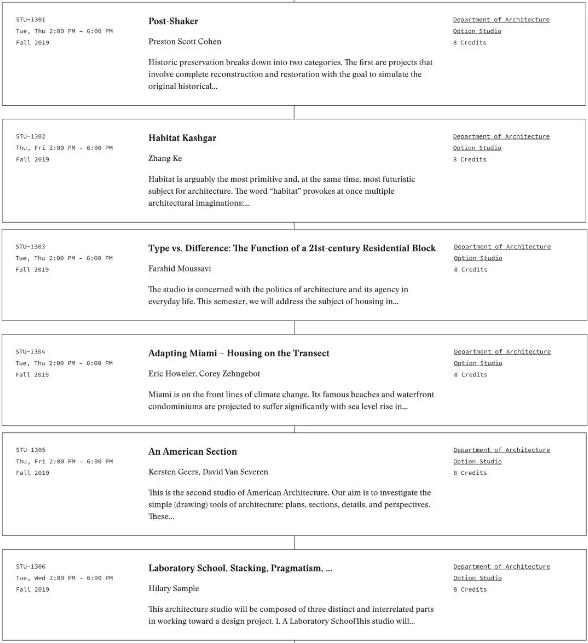
In addition to Option Studio, students can choose to continue Option Studio or academic thesis research in the second academic year. Among the most important Option Studio, we can choose a few to briefly discuss the very global and profound topics, such as functional differentiation of 21st century housing, architectural characteristics of different ethnic groups, experimental architectural design, etc.
Drawing from Harvard GSD Architecture MArch II
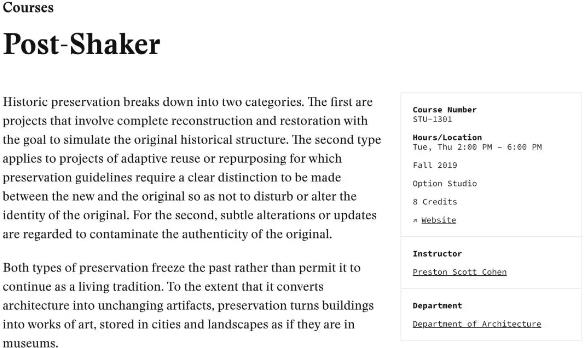
For example, in the Post Shaker topic, the school proposed such a premise:
The historical protection we are familiar with at present is mainly divided into two directions. One is to completely rebuild and restore historical buildings, which aims to restore the structure and shape of historical buildings through simulation; The other is mainly applicable to reconstruction or reuse projects. In this type, a clear distinction needs to be made between the original building and the new reconstruction project to avoid damaging the original building form, because even the very small changes to the original building are, in the eyes of most people in the industry, also damaging the original building.
Although these two forms are the current mainstream, to some extent, they are actually the "freezing" of the original architectural history, and they are not things that can continue. That is to say, this kind of protection only turns the building into cultural relics or artworks and stores them in the macro museum of urban landscape.
Therefore, students who choose this topic should first imagine that Mount Lebanon Shaker Village in New York will be turned into an art district to re arouse the role of historical buildings. The difficulties and environment faced by this project are necessarily very complex and huge. Students need to break these two restrictions and give reasonable reuse methods through different methods.
The research project site includes Shaker buildings from the late 18th century to the early 20th century. They have the most modern sense of the traditional context, and they are the buildings that many modern minimalist architects are interested in. Shaker believes in and practices pacifism, gender and racial equality, and individual independence. Their belief in leaving the world has created a unique culture related to Utopianism.
In such an environment, facing such a big topic, students need to have a very comprehensive professional ability, which includes not only the professional knowledge of architecture itself, but also the knowledge reserves of history, humanities, society and other related knowledge.
Drawing from Harvard GSD Architecture MArch II
Through simple comparison, we can easily find that, in general, compared with undergraduate students who mainly focus on their professional foundation to study, the courses at the master's stage, whether it is one year or two years, or whether it is in the United Kingdom or the United States, are more inclined to research projects, rather than learning to take notes and draw pictures in the classroom.
So, does the UK have a one-year master's degree? In fact, it is not true, but compared with the multi year master's program, the one-year program is more targeted at students who already have solid professional ability during the undergraduate period. From the perspective of curriculum, it is basically carried out in the form of studio combined with project. The number of courses is relatively small, and it is difficult to see basic professional basic courses, software learning, professional history, etc.
This article belongs to the original article of Natural Light International Art Education Team. Without permission, it cannot be reproduced commercially in any form. If it is found, it must be investigated for legal responsibility.