Harvard University Graduate School of Design (GSD) has always been a well-known institution for everyone to sit on the altar. In particular, the Harvard University Graduate School of Design (GSD) is famous for students majoring in architecture, and has trained a number of masters: Philip Johnson, Lawrence Harprin, Ian McHager, I.M. Pei, Yu Kongjian GSD architecture in Harvard is divided into two major categories: architecture department/Architecture and landscape architecture department/Landscape Architecture. Does Harvard GSD apply well? Today, natural light will introduce some GSD of Harvard Design School to you.
Harvard University The Department of Landscape Design is the first and by far the most outstanding academic course of landscape design in the world. It cultivates students to devote themselves to studying the relationship between cities, environment and culture, and to promote the better development of the world from different dimensions. The Department of Landscape Design is divided into four directions: Landscape Design I, Landscape Design II, Landscape Architecture and Urban Planning and Design.
The most distinctive course form of Harvard GSD Architecture Department is Gund Hall Plan, which integrates students and teachers from architecture, landscape architecture, urban planning and other design departments in the form of studio courses. To help architecture students to discuss, communicate and achieve interdisciplinary cooperation in an open form, and Harvard plans to cooperate with the "neighbor" MIT School of Architecture to carry out this plan.
According to different application conditions and curriculum, Harvard GSD Architecture Department is divided into two majors: Master in Architecture I/Architecture I and Master in Architecture II/Architecture II.
Master in Architecture I/Architecture I:
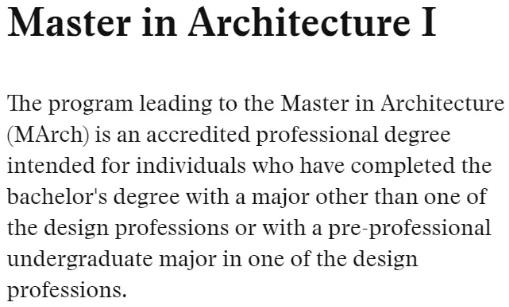
This course is divided into five semesters, mainly for students with non architecture discipline background and non five-year architecture discipline background. First of all, this course will offer a series of preparatory courses for students with non architectural background.
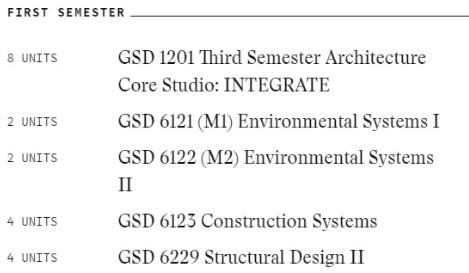
Including four undergraduate courses: calculus; Physics (based on algebra, covering mechanics and thermodynamics) and two architectural histories; In addition, students also need to supplement the relevant software courses of architecture, including Rhino, V-Ray, AutoCAD, Illustrator, Photoshop
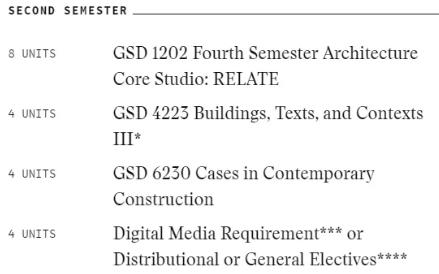
For students with architecture background who only need to pass the examination of four undergraduate courses, they can consider entering the third semester of the curriculum plan directly, so that the required learning courses will be reduced to two and a half years.
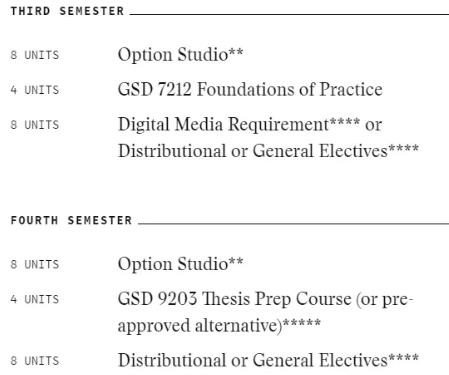
To sum up, for the six semester courses, Harvard GSD Architecture has prepared very intensive and comprehensive knowledge courses for students, including seminar courses on history, theory, technology, social environment and professional practice, as well as a series of studio courses based on Gund Hall Plan, with special emphasis on students' mastery of architectural design methods.
Master in Architecture II:
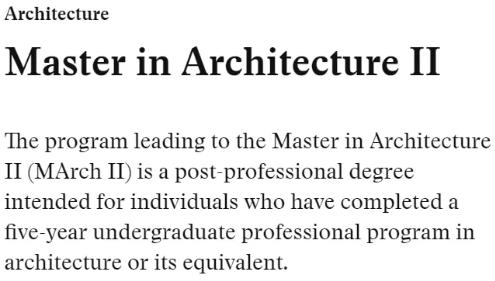
The courses of Harvard GSD Architecture II are mainly aimed at students who have completed the five-year architecture discipline or have many years of work experience in the construction industry. Therefore, the focus of the curriculum plan is to extend students' divergent thinking in the professional field, especially focusing on design practice.
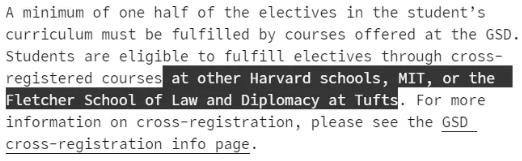
Students also have a high degree of freedom in course arrangement, and more than half of the credits need to be completed by students choosing the elective courses provided by GSD. This part of elective courses is also a joint cooperation project between Harvard, MIT, and Fletcher School of Economics and Law.
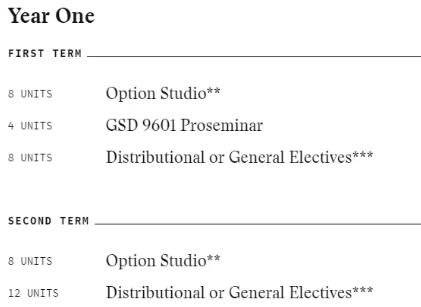
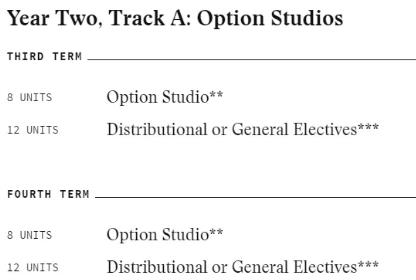
From the above figure, we can also see that the compulsory courses of Architecture II are relatively few, but the College strictly requires the proportion of elective courses, including at least 4 technical elective courses, at least 4 professional practice courses, and at least 4 visualization and production techniques courses.
Students will also improve and expand their theoretical and analytical skills through this highly customized and interdisciplinary learning approach, and strengthen their skills in mastering the knowledge of diverse social disciplines.
Harvard GSD Architecture Application Requirements:
1. Different directions have different professional backgrounds, see above for details
2. Collection:
a. Within 30 pages (excluding contents and cover pages)
b. Video works can be submitted as an auxiliary, with the number less than 3 and the video length not exceeding 60s
c. Students of MARCH I can submit other forms of creative works, such as sculpture, painting, etc.
3. Language: GRE score verbal 157 quantitative 159; analytical writing sections 4.0; TOEFL 90+
4. A written statement of no more than 300 words and answers to the following questions:
a. In the process of architectural design, what attractive places have been found?
b. Your original major or background can Studying abroad in architectural design What are the advantages of learning?
c. How do you understand "Less is more"?
d. Tell an experience of overcoming difficulties
(MArch II is no more than 1000 words, indicating the direction and field that I hope to study in the future)
5. 3 letters of recommendation
Does Harvard GSD apply well? Today, Natural Light introduced to you the study abroad courses and application requirements for architecture major in Harvard University. I hope it can help you. If you still want to know more colleges and majors, please come to Natural Light for free consultation.
This article belongs to the original article of Natural Light International Art Education Team. Without permission, it cannot be reproduced commercially in any form. If it is found, it must be investigated for legal responsibility.