Art is different from other disciplines. In the process of artistic creation, the emotions and aesthetic feelings it contains play a very important role in improving the overall quality, especially the cultivation of observation, creativity and imagination. Therefore, in recent years, more and more authorities in the education field have emphasized the necessity of adding art discipline to general education. Students who plan to apply for art studies in the United States will often see the word "foundation year". The word "foundation year" here is different from the British preparatory course. In this year, no matter what major you apply for, you will first learn the common skills required by each discipline extensively, so as to lay a solid foundation for future professional courses. They will also learn the knowledge of other disciplines related to art and design, so that students can explore the direction they are interested in. After the foundation year is over, professional courses specializing in a certain discipline will begin. Today's natural light is introduced to you by Parsons Design College. Why are Parsons not specialized in the first year of undergraduate study? What are the advantages?
Why are Parsons not specialized in his first year of undergraduate education? What are the advantages?
Let's analyze it from the course arrangement of Parsons foundation year.
Freshmen of all majors in Parsons' first year of undergraduate study will learn the same basic courses. The purpose of these courses is to make students familiar with the basic skills and learning methods of art and design, cultivate the basic concepts and critical thinking necessary for later learning, and make students' creation not limited to a single subject. Some courses also have a choice of direction. Students can also choose their own direction according to their own interests in the first year.
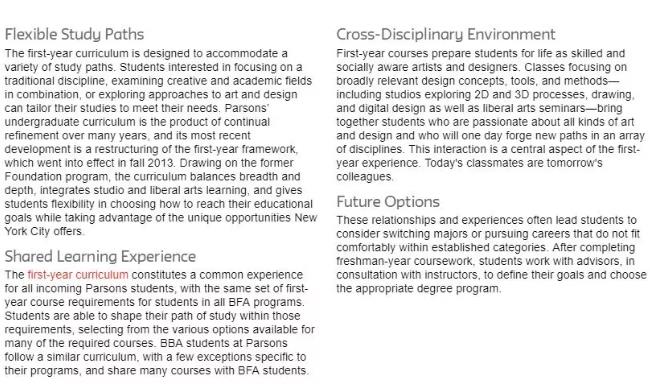
Why set the first year regardless of major? Parsons Parsons School of Design Four characteristics and advantages of the base year are given on the official website:
Screenshot from Parsons official website
1) Flexible learning direction
Parsons' first year course is designed to enable students to contact various professional directions in a variety of attempts. No matter which field they are interested in, they can find their own development direction in the basic year of balancing depth and breadth, integrating studio courses and general education courses.
Because the students who studied abroad in art for undergraduate courses must not have contacted the art education of the university in high school, nor have they personally experienced the specific learning content of their chosen major or other majors. Therefore, colleges and universities will set a foundation year to tap students' expertise while consolidating the foundation, and help students find the specialty they are really good at. Whether in courses in all directions or in the process of doing homework, students can re understand themselves and find out which direction they are more sensitive to.
2) Shared learning experience
In the first year of Parsons' course, students from all majors took classes together, so they could get in touch with more different students. Especially when you are in a good school, the students around you are excellent, and you can learn different things from each other in learning. The influence of people around you will also be very helpful for professional learning. At the same time, making more friends can also accumulate more contacts for the future. Today's students may be the future partners.
3) Interdisciplinary atmosphere
Students who have applied for art study abroad should all know that foreign colleges and universities attach great importance to students' interdisciplinary thinking. The first year's courses are very comprehensive, including many skills that designers and artists should have, such as painting, design concepts, software skills, 2D, 3D, general education, seminars, etc, Gathering students who are good at different directions in class can not only inspire students' interdisciplinary thinking in practice and discussion, but also cultivate the skills needed for future interdisciplinary works.
4) Select again
At the end of Parsons' first year of study, many students will find that they are not suitable for the major they chose or have a new career direction they want to develop. After completing the basic year's courses, they can have an opportunity to negotiate with teachers to redefine their goals and select the major that suits them.
Setting the basic year will prevent students from blindly choosing a major that is not suitable for them without knowing themselves and their major. If students enter the major at the beginning of enrollment, it will not only waste one year of time when they find out that they can change their major, but also spend more energy to make up for the first year's courses.
What is the specific course of Parsons' basic year of undergraduate study abroad? What did you learn from it?
Parsons students majoring in pure art and design should complete a total of 7 courses in the basic year, including: drawing image/integrated studio seminar 1/integrated studio seminar 2/objects as history/space material/sustainable systems/time
1)drawing/imaging
What is the meaning of painting and images? Their greatest significance is not only to meet the aesthetic requirements, but also to have a certain painting language on this basis. So: how to construct and convey meaning through visual images? What can images and symbols convey? This course combines traditional painting and digital media imaging methods to explore the application and expression of concepts, aesthetics and forms in two-dimensional plane. Students in this course will explore visual language by observing painting, photography, digital image creation and the integration of various media. In this process, they will learn the ways and methods of painting and image expression, and lay a good foundation for later professional courses.
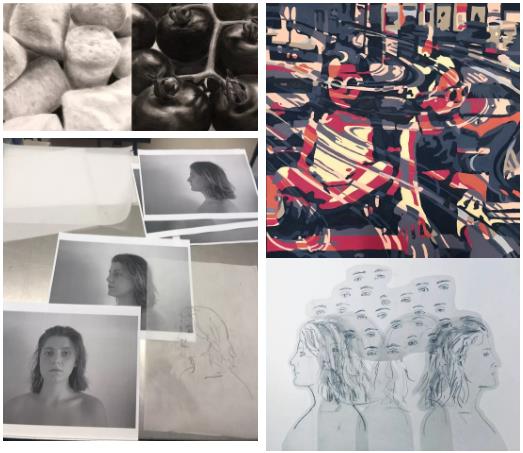
Student works, pictures from Parsons official website
2)integrative studio/integrative seminar 1
Parsons Studio and Seminar are two independent but complementary courses. In the studio, the student union cooperates to complete some interdisciplinary projects. In the seminar, they learn how to clarify the creation background and concept of the work, including critical thinking analysis, demonstration and discussion, reading and writing. That is to say, the two courses share the same theme, making works in the studio course and expressing works in the seminar course.
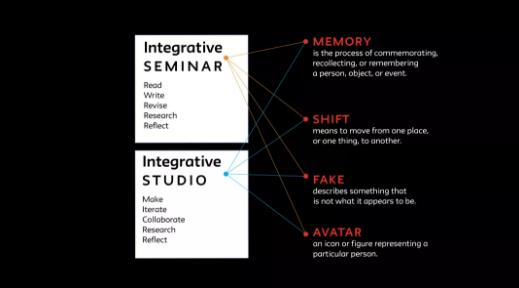
The combination of these two courses can cultivate students' three abilities. First, the analysis and production skills of visual images and the practice of interdisciplinary projects; The second is the practice of reading and writing ability, so as to cultivate the basic ability of academic research from the beginning of freshman year. The third is the dialogue between writing and practice. For example, many students have the skills at hand and can use pictures to express their thoughts, but do not have the ability to use words. Some students may lack the ability to turn ideas into practical projects. In this course, students can exercise both abilities through sorting out research, design, creation and other processes.
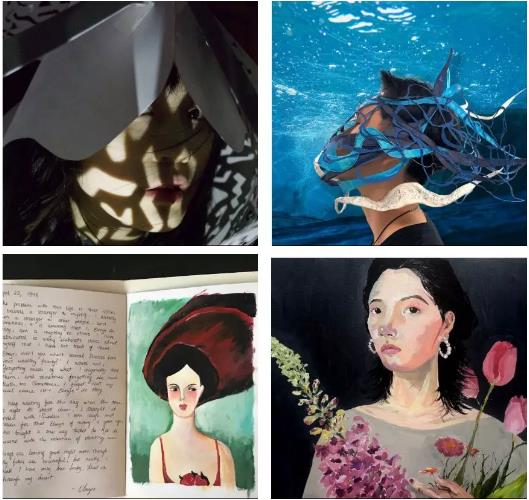
Student works, pictures from Parsons official website
3)integrative studio/integrative seminar 2
Parsons' course is an advanced studio and seminar course, which has the same form, but will change four new themes. It also needs to strengthen skills in depth while thinking about problems and solving problems through some observations. The problems revolve around different majors, such as the complexity of architectural space; The influence of materials, history and human body on fashion; The relationship between design and human behavior.
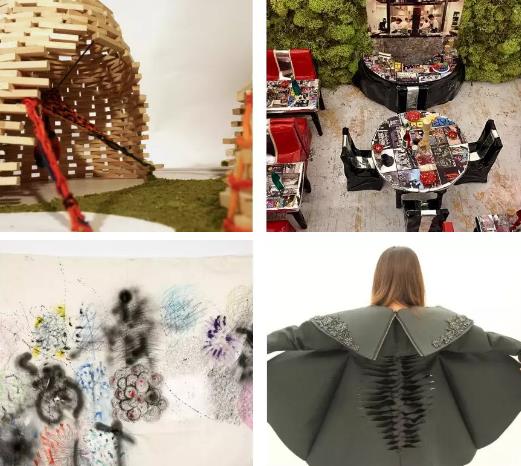
Student works, pictures from Parsons official website
4)objects as history
The research objects of the course are mainly important cultural relics in art history, including daily utensils and monuments displayed in museums. In the course, we will deeply explore the social structure reflected in the objects according to the production methods, production reasons, who makes them, for whom, how to use and other issues. The time scope of the research starts from prehistory to the emergence of large-scale industrialization, and this time axis leads students to understand the development of different cultures in different ages and backgrounds.
5)space materiality
The main content of the course is to explore the properties of materials, such as extensibility, weight, texture, color, durability, smell, sound, taste, life cycle, ecological impact, etc. After understanding the essential properties, the course will further explore the use of materials and their expressive significance. In addition to the materials themselves, the course will also explore the relationship and influence between materials and people, materials and space, and train students' ability to constantly think in creation.

Student works, pictures from Parsons official website
6)sustainable systems
What is the biggest challenge that designers face when designing a product? How does the product adapt to the society, economy and environment? What is a sustainable product? This course is to let students get their own answers through observation and thinking. The course focuses on four themes: climate change, materials, energy, and water, and combines field visits, lectures, workshop discussions, and workshop experiments to design works that can solve problems after field visits and discussions.
7)time
Time has always been a common theme in art, and time has also been widely used in art and design. The purpose of this course is to explore the culture in time, the impact of time on various works of art, and the concept of time in different art forms.
After reading the curriculum of these seven basic years, students should also find that although Parsons' courses are all exercises to strengthen basic abilities, such as painting, writing, drawing, research and discussion, they cover a wide range of majors, such as pure art, illustration, fashion, interior, products, film, art history, etc.
In general, for students who just graduated from high school and entered the undergraduate program, colleges and universities regardless of their majors have more advantages than those that began to learn professional courses in the first year of college. First of all, we can consolidate various basic abilities in the university education model, so as to lay a solid foundation for more professional learning later. Secondly, the more important thing is to find out your real interests and advantages. If you make a mistake when applying to a college, you can have a chance to re understand your choices in college. The last point is to explore more interdisciplinary projects in multidisciplinary attempts.
The above are the advantages of Parsons universities and colleges regardless of major. Some students may be convinced that their foundation is good enough after objective consideration, and they have made clear the choice of major and future career. They hope that the basic year will be a relatively minor factor in choosing a school. Although this situation is very rare, it is also true. Students are still unable to be 100% sure that there are no variables in their study in art schools. Therefore, it is suggested that students consider their own situation when choosing schools for art study abroad. If you have any questions, you are also welcome to contact us backstage, and we will answer them for your personal situation.
Natural light shares more topics for you:
What rumors have you heard about the application of Parsons School of Design for studying abroad
Parsons enrollment conditions summary, art study application step_material requirements_IELTS score!
This article belongs to the original article of Natural Light International Art Education Team. Without permission, it cannot be reproduced commercially in any form. If it is found, it must be investigated for legal responsibility.