Recently, Natural Light received a lot of questions from students studying abroad in film major, such as: "Is basic humanities courses important for film majors to study abroad?" "What are the benefits of boring basic humanities courses for film majors? Is it really necessary to learn?" Today, Natural Light will look at the curriculum of several art colleges, What are the benefits of basic humanities courses for film majors to study abroad? Take SVA, Emerson and NYU movies as examples.
SVA New York School of Visual Arts
SVA New York School of Visual Arts Film It has always been a favorite of many students, and in recent years, there have been many students who have won awards at student Oscars.
It is said that SVA is "the art school with the highest employment rate in the United States". In fact, this kind of Titel also relies on the form of SVA teachers. One of the advantages of studying film in SVA is that most of the teachers in SVA are semi full-time, that is, they have their own work at the same time as working in SVA, such as participating in the production of commercial cinema films.
Such mentoring experience will bring students a very full experience in film creation. Combining practice with the concept of cinema film, it will bring students a real experience of shooting and creation during their study. However, such a model does not mean that students will directly start their study on the specific division of professional directions when they enter the school. Students still need a solid "foundation accumulation".
Compared with the academic film major, SVA New York School of Visual Arts It gave many students a new film interpretation, integrated multimedia and market-oriented structure, and built a film learning atmosphere. The key word given by SVA for this major is "independence".
SVA also has a different understanding of the definition of "independence": for film creators, it is creative DNA and an important factor that makes SVA artists different. The goal we want to achieve is not only to find a job, but also a love to support your life.
With such a unique understanding, will SVA pay more attention to students' personal consciousness and relax the cultivation of literacy direction? Looking at the course distribution, we can probably get the answer:
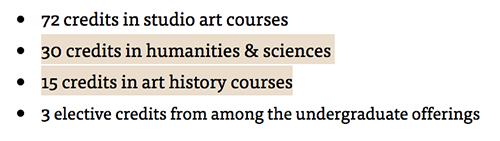
A total of 120 credits of courses, in addition to studio based courses accounting for the most college points, humanities and art theoretical courses also accounted for 45 credits. In addition, some of the studio based courses are also within the scope of general education courses.
Screenshot from SVA official website
The courses in this part mainly include Film History and Criticism, Acting for Filmmakers, Fundamentals of Narrative I and II, Writing and Literature I and II, and The Language of Film.
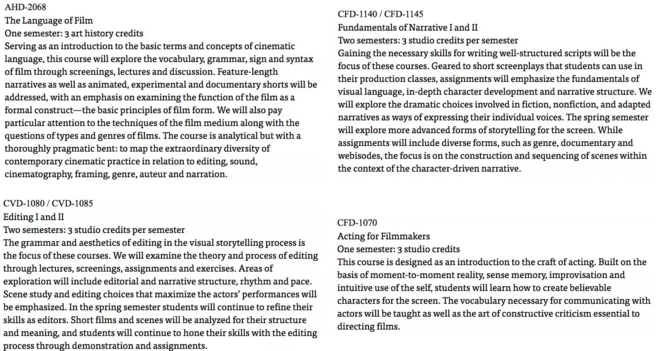
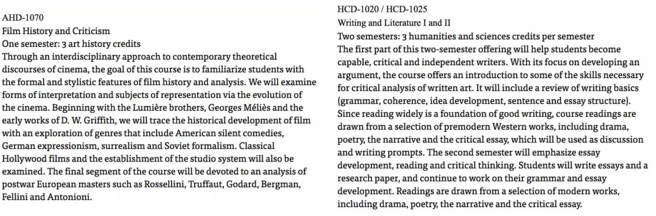
Screenshot from SVA official website
For each course, take Film History and Criticism/Film History and Critical Theory as an example. This course is not taught directly in the form of lecture, but by combining film screening, students can get familiar with the analysis form and style characteristics of film history.
From the Lumi è re brothers, Georges M é li è s and D W. Griffith's early works began to explore the historical development of films, various genres including American silent comedy, German expressionism, surrealism and Soviet formalism, as well as classic Hollywood films.
The special point of this course is that, in addition to the film art schools mentioned above, the last part of the course will also be devoted to the analysis of post-war European film artists, such as Rossellini, Truffaut, Godard, Bergman, Fellini and Antonioni, which are also modern and contemporary classic film artists.
Or we can take another look at Writing and Literature I and II/Literature and Writing I&II. This course seems not too much involved with film majors, but at SVA, this course is a compulsory basic course for film majors, and it still needs two semesters.
In this course, the first part of learning will help students to become competent and critical independent writers. Students will acquire critical reading and writing skills through a series of modern western written works; The second part of the study focuses on the text content of drama literature and opera types.
For students, simple reading is not enough. They also need to express their understanding and ideas in words. That is to say, students need to complete a series of film reviews and book reviews. These words are completely different from what we wrote in primary school. It requires students to critically discuss their works and give their own views and ideas.
Such a series of courses seem boring, but they also help students establish their own understanding of film related art forms, from a simple viewer to a thinker of film creation.
Emerson College
Emerson is located in Boston, Film major of Emerson College In particular, it was founded in cooperation with Paris College of Art (PCA). Students who choose this major will not only take classes in one city, but will study in Boston, Paris and Holland. What is very different from the independence proposed by SVA is that Emerson advocates students to explore the understanding and shaping of film art in the context of contemporary art.
In terms of specific creative expression, students are not only limited to experimental films and videos, but also gallery installations, internet and public media art. The school hopes that students can define the meaning of films themselves, and shape new film art through diversified cultural expression.
It seems that the film major of Emerson College is more experimental and creative. Does that mean that the school will "ignore the foundation"?
Let's still look at the specific professional curriculum. The first year's curriculum is actually a very basic professional course, and students will not be exposed to the core professional content. In general, it is to have a general understanding of the major before starting the follow-up study:
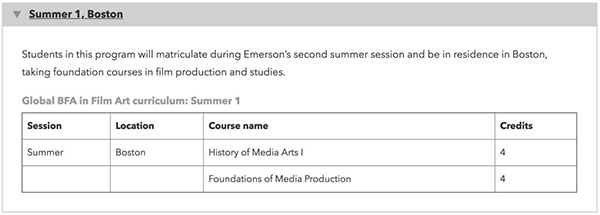
In addition to this part of basic extracurricular, Emerson's "Humanities Foundation", I would also like to specifically mention their Liberal Arts/Humanities courses:

Screenshot from Emerson's official website
Although each college will have its own basic courses, as an Emerson student, no matter what your major, you need to participate in such a unique part of the Library Arts courses.
This part of the course is divided into three stages, Foundations, Perspectives, and Minors.
The Foundations section is mainly to cultivate students' thinking patterns and habits. The course has only three key points: Original Communication/oral communication and Written Communication/writing communication, and Critical thinking/critical thinking. It mainly trains students' language writing ability.
For students majoring in film, the role is the same as SVA's writing&Literature. In addition to the paper in the future, it is also the creation ability of scripts.
Next, in the Perspective part, the course includes many aspects:
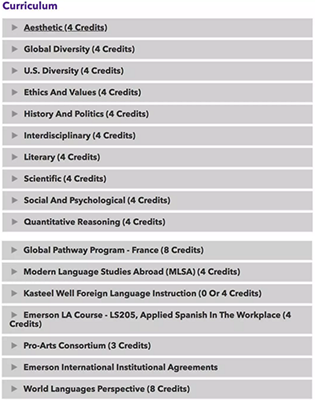
Screenshot from Emerson's official website - Perspective
We can take Aesthetics as an example to see the specific curriculum. This course examines works of art by thinking about some issues in the context of history, aesthetics, philosophy, culture and/or sociopolitics, and focuses on artistic interpretation in the contemporary context, thus promoting creativity, criticism and intellectual participation of works.
Aesthetics is not a single course, and students also need to make choices in specific research fields, such as music style research in different countries, contemporary drama research, photography research in different historical periods, visual art development, etc.
Finally, when it comes to Minors, that is, minor courses, the choice of courses in this part will be more free, but it is also divided into many small units, which is a link set up to help students obtain professional promotion in the "interdisciplinary" direction. Students can choose the following majors:
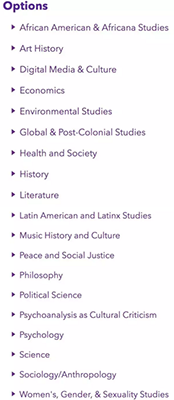
Screenshot from Emerson's official website - Minors
It seems that the minor courses in this part are of little use to the film major, but in my opinion, the film major itself is a diversified major. No matter what part of the film production you are responsible for, whether you are a screenwriter, director or setting, you need strong comprehensive ability and multi-dimensional understanding support.
For example, we take Latin American and Latinx Studies as an example. In this course, students mainly study the history of the entire Americas, and the theory and practice of Latin America and its politics and culture in the modern context.
And under the introduction of this professional direction, we will see that this course does not exist independently. In this direction, in addition to the compulsory The United States and Latin America, students can also take professional courses in 15 directions:
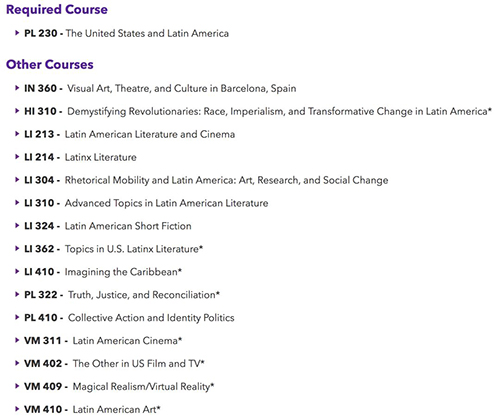
Screenshot from Emerson's official website - Minors
Such cultural background and historical learning are a good support for film production. The Rome we mentioned at the beginning of today's article is the best proof. In addition to the director's own memories of the historical era at that time, the construction of the whole era background is the foundation for the establishment of the whole film.
The general environment in which this film story takes place is Mexico in 1968-1971. At that time, Mexico was in a special period of history. Only with a very deep understanding of the environment at that time can we use the artistic language of film to express the pictures in the film; Handling dialogue between actors; And inject multiple metaphorical elements into the film.
Finally, I have to say a few more words about the interdisciplinary mentioned by Emerson. Emerson encourages students to be interdisciplinary, not only in the school curriculum, but also worth recommending that Emerson has set up an IDIP project to help students develop in interdisciplinary fields, The full name is Individually Designed Interdisciplinary Program.
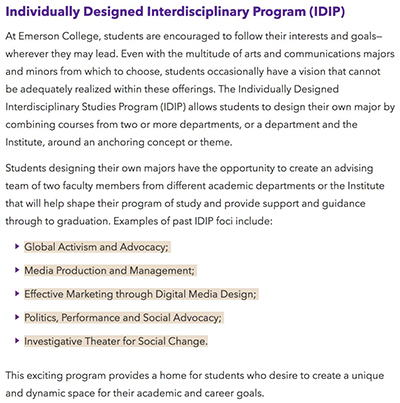
Screenshot from Emerson's official website - IDIP
NYU Tisch Tisch College of New York University
Finally, let's take a look at NYU Tisch, one of the shrines of film majors, NYU Tisch's film major I don't need to say more about reputation. When I mention film major, most students' first reaction should include Tisch.
In Tisch's undergraduate study, the name of the whole major is Film&Television, and film and television majors have not been completely separated. It is different from SVA's independence and Emerson's interdisciplinarity, Dixie College of Art, New York University The keyword of "Unique" is "the UNIQUE story they have to tell".
Under this interpretation, NYU Tisch also made limited requirements for students' basic professional quality. The whole course is divided into four stages. The first stage is very direct Freshman. During Freshman, students will not be exposed to very core opportunities, and they need to combine business practice to create specific creation opportunities, because the first year is mainly to create a film learning atmosphere for students, so that students can get the correct understanding and direction of the film.
The focus of this part of the course is: A foundation in image and sound production, The primary storytelling elements of the dramatic form, performance studies, film in a historical and critical context.
Courses include Frame and Sequence, Sound Image,Introduction to Animation,Performance Studies,Storytelling Strategies,Language of Film,Art and Practice。
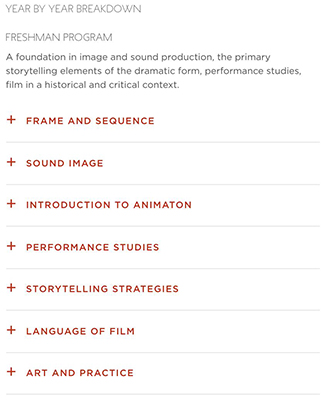
Screenshot from NYU Tisch official website - Film&Televison
Take specific courses for example. For example, Performance Studies is a compulsory course for all freshmen. As long as you enter Sound Image as a freshman, you must learn this course.
This course actually exists as a supplementary course of Storytell Strategies, aiming to introduce the language and culture of performance, as well as the essential relationship between director and performance.
In this course, it is necessary for students to understand the history and culture of performance and how to understand the basic meaning of performance. Students should master all the basic creative knowledge, including script analysis and performance arrangement. As students, they should be able to create unforgettable creative works after this course.
In addition to the performance studies mentioned above, which are compulsory for all students, Sound Image and Storytelling Strategies are also semi compulsory compulsory courses.
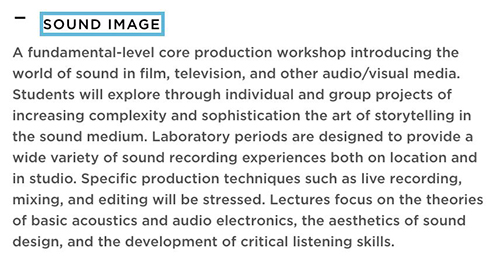
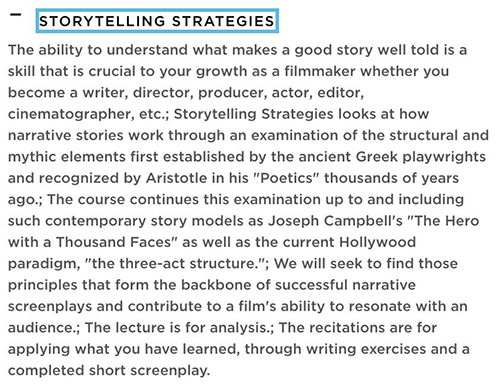
Screenshot from NYU Tisch official website - Film&Televison
I won't say much about Sound Image in these two courses, but mainly about Storytelling Strategies. When it comes to story telling, many students may think that how simple story telling is in movies. Just design several plots, link them together, and make people feel interesting?
In the process of film creation, "story telling" is often a headache. What kind of movie plot is a good story script; How to deal with the rhythm of the film plot; Does the story need to be reversed? How to add unexpected reversals to the story is very challenging.
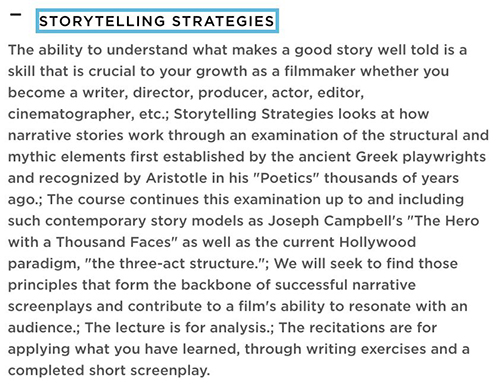
Screenshot from NYU Tisch official website - Film&Televison
For example, in NYU's course, students need to study the story structure in ancient Greek dramas and some mythical elements in the dramas at that time; And through understanding the narrative nature of stories recognized by Aristotle in "Poetics" thousands of years ago, we can explore the operation mode of story telling. Students will learn from ancient times to the story creation method in modern and contemporary film art.
Today's summary
Today I shared with you SVA, Emerson, NYU Tisch Basic study of film major in three schools. No matter how the school defines the film major itself, whether independence, interdisciplinarity or Unique, although they have their own interpretations of films, they are all trying to create a solid basic atmosphere for students in the course part. These courses are generally based on library studies.
These basic courses are full of humanities and aesthetics. Whether they are based on the film major or based on the library art, most of them provide students with a profound accumulation. They help students establish a perfect aesthetic awareness and a comprehensive art cognitive system. At the same time, it also teaches students how to view film as a unique form of artistic creation with critical thinking.
With these awareness and cognitive foundations, students can obtain more possible development and improvement in subsequent professional skills learning. As a film creator, his own accumulation of humanistic qualities, combined with a high degree of aesthetic design, can bring audiences a more profound experience of watching movies than "blockbuster popcorn movies".
The audience's psychology is always unpredictable, but it is not nowhere to be found, nor is it unguided, which actually requires the support of aesthetics and humanities. Aesthetics and deep understanding of art theory will become your basic aesthetic foundation; On the other hand, the accumulation of humanistic quality on the psychological level can enable you to guide the audience's emotions and movie watching experience more accurately.
Just like the natural light, it has always provided help to students who need to improve or consolidate the humanities curriculum. For example, before the formal commencement of the portfolio curriculum, the teachers of natural light will fully communicate with students, understand their strengths and weaknesses, and provide targeted curriculum help according to the needs of each student.
For students with certain professional skills, we will also focus on cultivating their ability in thinking awareness and design innovation. Combining design thinking and creative diffusion, we will provide students with some objective help in humanities, and guide students to build interdisciplinary portfolio projects from multiple dimensions.
For example, there was once a Wang student who applied for film major in Natural Light. His collection of works discussed a social topic, the emotional choice of marginalized people. He himself has a rich amount of film reading. Even if he is an obscure film, he often dabbles in it. As an advantage, the teacher guides the teaching and inspires him to show his creative expression deeply. The final collection of short films also helped him win offers from SVA, CalArts, Emerson, UBC and other colleges and universities.
On the basis of solid professional and aesthetic quality, deep thinking on the theme of topical creation can not only help students to better start the creation of the direction of the collection of works, but also bring more dimensions of comprehensive improvement when they really enter colleges and universities in the future. Of course, besides SVA, Emerson and NYU, there are film majors in American film schools, as well as New York Film Academy New York Film Academy ranking , please consult the teacher of natural light.
Natural light shares more topics for you:
Study in the United States as a film major and conquer SVA/CalArts in three months
This article belongs to the original article of Natural Light International Art Education Team. Without permission, it cannot be reproduced commercially in any form. If it is found, it must be investigated for legal responsibility.