The impact of the epidemic on studying abroad in the United States. At present, the epidemic has spread to 34 states of the United States and the capital, Washington, D.C., and 10 states have declared a state of emergency. Several famous universities on the west coast, including Washington University, Stanford University, and the University of Southern California, have announced that they will stop face-to-face teaching and change to remote teaching. Today, natural light will take you to see the latest epidemic countermeasures in American colleges and universities.
Impact of the epidemic on studying abroad in the United States
On March 9, a student of Columbia University was quarantined due to exposure to the new coronavirus, and Columbia University also officially announced the adoption of distance learning. Then, various art colleges and universities successively released new measures to prevent the spread of COVID-19, including adopting distance teaching and reducing campus gatherings.
Parsons

At present, New York State has entered into a state of emergency. In order to comply with the instructions of the Center for Disease Control and Prevention (CDC), Parsons is also taking more active preventive measures:
1. Suspend all travel programs related to academic studies of colleges and universities in other countries;
2. Assist in isolating teachers and students returning to colleges and universities from China, Iran, Italy, South Korea, Japan and other countries;
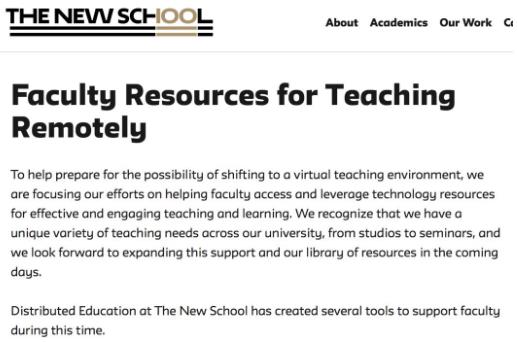
Secondly, according to Natural light art study abroad The students who are studying at Parsons have reported that the school has basically stopped offline teaching and put more emphasis on online distance learning. Parsons official website also said that it would further break through the technical barriers and help more teachers transfer various forms of courses online.
RISD Rhode Island School of Design
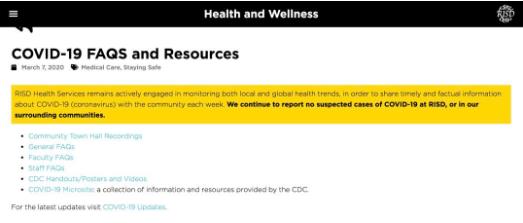
RISD also made a detailed explanation of the COVID-19 event, which was divided into three sections: students, teachers and employees, and gave specific answers to the most concerned questions, including:
1. Require that students returning from areas greatly affected by the epidemic (including China, Italy, Iran, Japan and South Korea) must be quarantined;
2. Cancel all international travel and academic exchange programs in spring;
3. Provide psychological guidance for students suffering from anxiety and emotional distress caused by the epidemic;
4. It is not allowed to drop out early. If students choose to leave RISD for objective reasons, they must comply with the regular drop out policy of RISD.
Secondly, although RISD is continuing the next courses according to the plan, most of the research and academic courses have been transferred to online, and students who are isolated at home are encouraged to actively contact their teachers and use online platforms such as ZOOM to complete their daily studies.
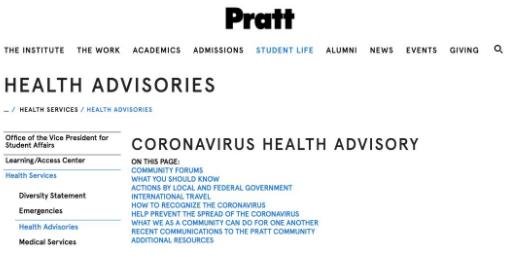
As one of the few institutions in New York that still insists on offline teaching, Pratt has not taken many updated measures against the epidemic:
1. Has been to China or Iran in the past 14 days, and will be prohibited from entering the country in the short term; Students who have returned from other areas or left the epidemic area for more than 14 days need to be self isolated in their homes for another 14 days after returning to school. During the isolation period, students will try their best to provide food and other services;
2. It is not recommended that all teachers and students carry out any international exchange and study abroad programs in the near future;
However, Pratt also said that he would pay close attention to the development of the epidemic at any time, and the planning of summer and autumn courses and summer programs was also under discussion. It was not ruled out that some academic arrangements would be suspended, but there were no relevant measures at present, and students were encouraged to actively feedback their opinions through email and the school.
NYU New York University
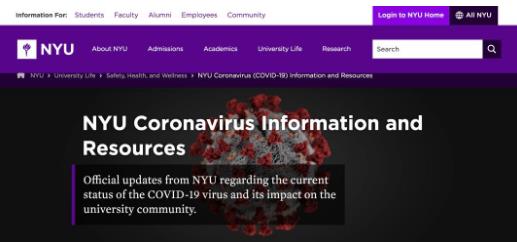
NYU announced that from Wednesday, March 11, all courses in the New York, Shanghai and Florence campuses will turn to remote or online guidance, and the course time will remain unchanged. However, this week, March 11-13 will also be the transition period from schools to distance learning, and some courses will be affected.
By the end of the spring semester on March 23, the school will also discuss whether to continue the form of long-distance teaching and specific implementation measures, but the school guarantees that in any case, the courses will be carried out in a planned way to ensure the continuity of students' teaching.
In addition, NYU strongly recommends that all colleges, departments and individual organizations not hold unnecessary large-scale gatherings, and some core academic activities will also be canceled, postponed or conducted in an "online" manner.
MICA Maryland College of Arts
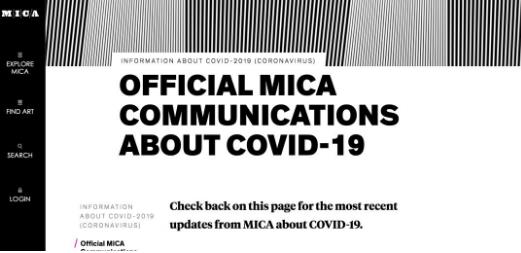
MICA said that in view of the seriousness of the epidemic, it has also set up an emergency management team of colleges and universities to convene regularly and carry out active discussions, some of which include:
1. Travel difficulties of teachers and students during isolation
2. The needs of students who may not be able to go home in summer
3. Education continuity and distance learning mode of affected students
4. Upcoming activities and parties
According to the discussion results, the College has formulated a series of policies, including:
1. Since there are no suspected cases in Maryland and MICA campus, the college will continue to carry out courses and activities as planned, and will not suspend large gatherings or courses in places such as Falvey Hall.
2. Teachers and students are advised to avoid going to China, Hong Kong, Italy, Iran, Japan, South Korea and other countries and regions, and students returning from these places must be quarantined;
3. Suspend the current study abroad program in Italy, and are working with the students and faculty of the program to arrange their return to the United States;
4. International students or students returning from other countries are required to self isolate for two weeks. If necessary, MICA will also provide appropriate housing for students;
5. Suspend all enrollment or academic travel programs to China;
SAIC Chicago Academy of Arts

SAIC has not taken many updated measures against the epidemic in the near future, and mostly follows the measures of the Center for Disease Control and Prevention (CDC) and the Chicago Department of Public Health (CDPH):
1. It is recommended that teachers and students cancel all trips to countries with epidemic risk ratings of 2 and 3;
2. Suspend various international academic exchange projects organized by the university;
3. It is recommended that international students stay at home after returning to the United States, and conduct isolation and health monitoring for 14 days before returning to campus.
4. All the study tours planned to be held in the middle of the summer of 2020 will be carried out as planned, and the registration will start on March 11.
CALARTS
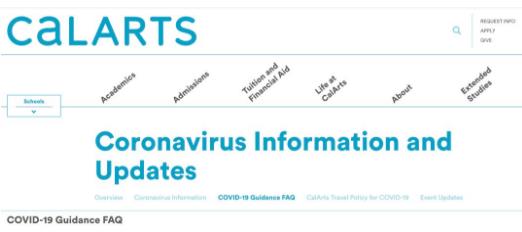
In addition to complying with the requirements of Calarts of the Center for Disease Control and Prevention (CDC) and advising teachers and students not to travel to the epidemic countries, Calarts also said that from February 3, 2020, teachers and students arriving in the United States from mainland China should be isolated for no less than 14 days before returning to school.
For the curriculum plan, Calarts also said that it is expected that campus activities will not be interrupted. However, if the epidemic is serious, the campus must be closed, and the school will also take various options, including remote courses, the use of online and virtual classroom technology, to ensure that the interference of the epidemic on students' education is minimized.
In the case of cancelling some collective classroom activities, the academic work of specific courses will not be suspended. It is also suggested that teachers can use online or other appropriate distance learning as far as possible to communicate and teach with students.
In addition, colleges and universities also said that it was expected that the epidemic would not affect the planned graduation time of any student.
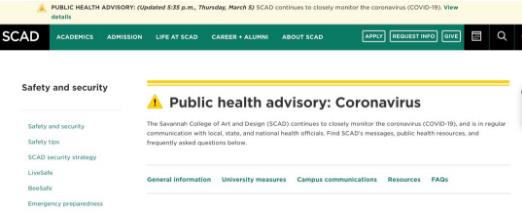
At the beginning of the outbreak of the epidemic in China, SCAD made it clear that offline interviews in all cities in China this year would be cancelled, and that the results would be notified by phone instead.
For the latest measures on campus, it is also clear that according to the regulations of the U.S. State Department and the Centers for Disease Control and Prevention (CDC), students returning to Savannah or Atlanta from CDC Level 1, Level 2 or Level 3 countries will be quarantined for 14 days, and other preventive measures will be taken for other countries where outbreaks are found.
In addition, the university also recommends that students avoid traveling abroad during the rest of the academic year (including the spring break).
SCAD also provides some online courses for students to choose in the spring semester, and the language courses in the summer semester are temporarily closed.
In view of the changing epidemic situation in Asia, SCAD Hong Kong Campus will provide all online courses for students in the spring semester, and cancel the opening ceremony in June this year.
The impact of the epidemic on studying abroad in the United States. Today, we introduced the latest epidemic countermeasures of American colleges and universities. If there are other majors and colleges that you want to know, please come to natural light for free consultation.
More articles about the influence of studying in the United States:
Measures for the impact of epidemic situation in foreign universities, summary of announcements of overseas universities
Does the epidemic of pneumonia affect overseas students? How can parents help their children overcome the crisis of studying abroad in art
This article belongs to the original article of Natural Light International Art Education Team. Without permission, it cannot be reproduced commercially in any form. If it is found, it must be investigated for legal responsibility.