On May 29, Chuan Jianguo's operation suddenly turned the half way application season into a "joke". Before that, most netizens were still joking about Trump's series of confused behaviors about the epidemic, standing by China and helping China establish its international reputation (hence the nickname of "Chuan Jianguo"). But this time, the policy for international students seems to have driven them to a dead end. What is the impact of entry restrictions on art students studying abroad? Can I study in the United States?
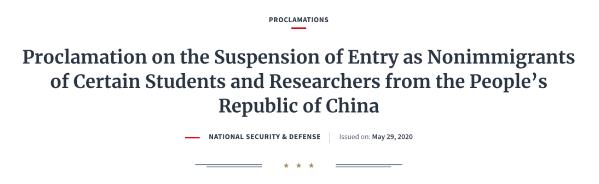
Source: Official website of the White House
In addition, the restrictions on Huawei and the strong interference in Hong Kong issues that followed made people deeply feel that Trump is throwing away the blame for its irresponsible behavior and playing politics by taking advantage of the epidemic. Such behaviors and actions have really made many foreign students panic completely while they are angry.
Since yesterday, students and parents have been asking our application team whether this measure will affect the application of art students and the planning of this year.
Since the beginning of the epidemic, the news that the policy for foreign students has been constantly tightened has continued. Australia was the first country to "refuse" Chinese students to enter the country, and other countries have restricted their entry, and overseas countries have reached epidemic deadlock. As a result, a series of college policy adjustments have been made. This year's application has not yet started, and a large number of foreign students have been persuaded to leave.
With the passage of time, this kind of information has become more and more, and the constantly introduced new policies have made art students at a loss. As the application season approaches, they are still considering whether to use gap. There are many people who cannot prepare applications and collections with ease. Even, many children who major in studying abroad are unable to concentrate.
The impact of entry restrictions on art students abroad:
So today, we will "focus" on the ban itself and talk about how to deal with this measure in detail?
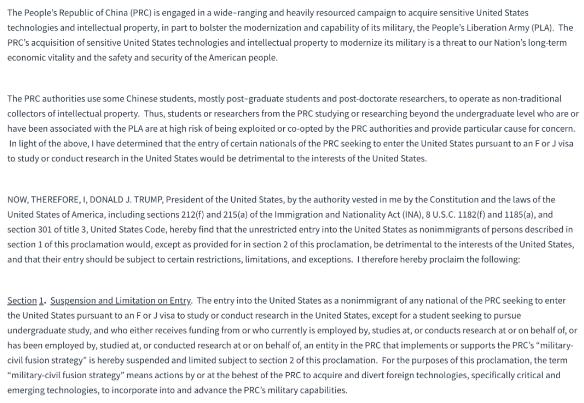
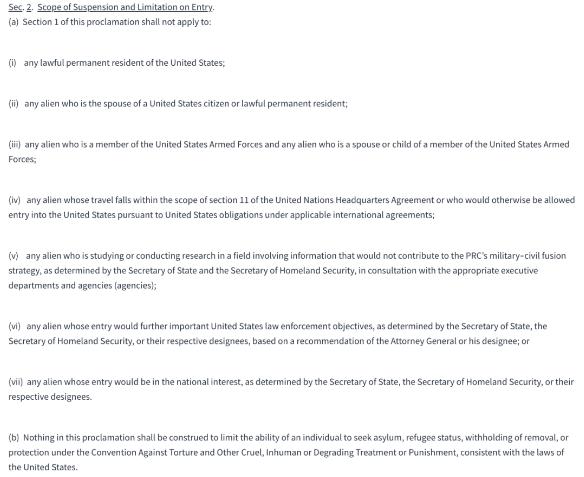
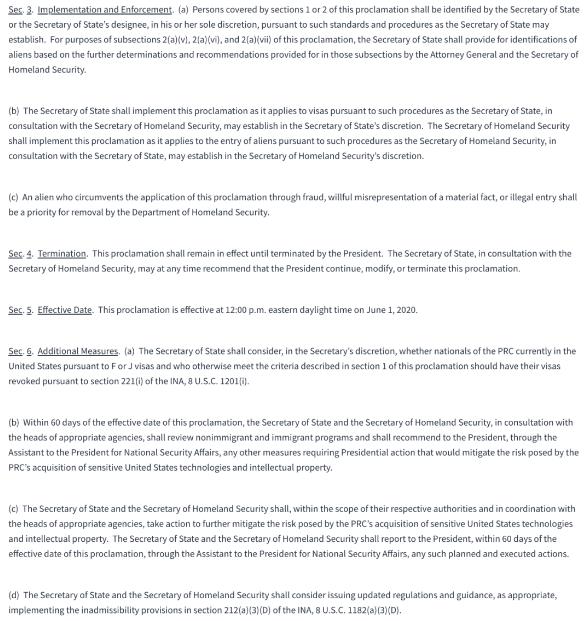
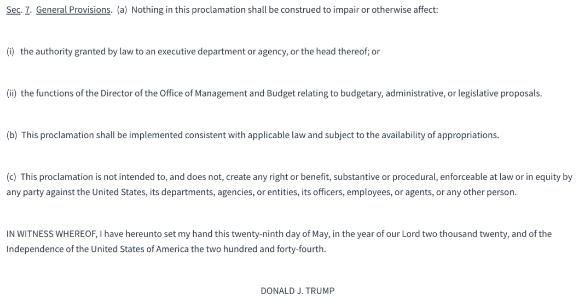
First, let's take a look at all the contents of this prohibition:
Source: Official website of the White House
01. The restriction order is not "official" and is "temporary"
Both Sec. 1 and Sec. 4 made it clear that this restriction was temporary, not permanent. This is really gratifying. But "This declaration shall remain in effect until terminated by the President. Combined with Trump's recent series of Chinese exclusion operations, it is worrying.
On this point, the interpretation of natural light is: first of all, China, as the largest importer of foreign students from the United States, goes to American art study About 30% of the students in the United States are international students. It is found that in 2017 alone, international students brought US $40 billion in economic income to the United States, and the additional industrial chain brought by Chinese students has also become the most important part of the US economic chain.
Therefore, for the moment, although Trump intends to suppress Chinese students, social forces, including universities and the media, must still oppose it. Because once Chinese students are restricted, the United States will face huge economic losses, which will not only affect the choice of Chinese students for the United States, but also have a huge impact on the local education industry in the United States. It is under such pressure that this measure will be "temporary" at present.
For example, Frank Wu, the 11th president and law professor of Queens College, said: This is selective discrimination against China and some countries and regions.
At the same time, Wendy Wolford, the vice provost of international affairs of Cornell University, also issued a statement on behalf of the university to protest.
Wendy Wolford said, "Cornell University is stronger because of its outstanding Chinese students, outstanding Chinese researchers and enthusiastic Chinese alumni. The outstanding international student group is the education (environment) for cultivating future leaders and world citizens Cross cultural understanding is becoming increasingly important for solving the major challenges facing mankind in the world today. We strongly advocate continuing to issue student (F) and scholar (J) visas to Cornell students and researchers from all countries and regions, including mainland China, in all disciplines, and continuing to issue temporary work permits (for graduates). "
In addition, a series of favorable policies provided by American colleges and universities during the anxious stage of the domestic epidemic in China indicate that the attitude of American colleges and universities is actually very friendly on the whole.
Secondly, the natural light would like to emphasize that this restriction order is only an Executive Order from the White House and Trump, rather than a real "legislation" for this matter. We can also simply understand it as the external statements or announcements issued by colleges and universities in different periods.
“Like both legislative statutes and regulations promulgated by government agencies, executive orders are subject to judicial review and may be overturned if the orders lack support by statute or the Constitution.”
"Like the legislation, regulations and rules issued by government agencies, administrative orders are subject to judicial review. If the administrative order lacks the support of laws and regulations or the Constitution, it may be overturned." - That is to say, such a statement can be "overturned" under certain circumstances.
02. The restriction is targeted at specific people, and "science students" are greatly affected
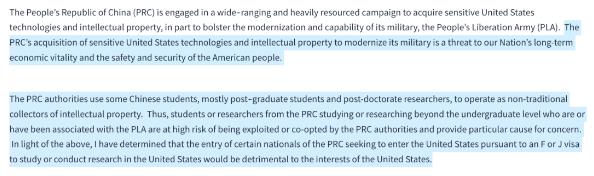
In addition to the above timeliness, the restrictions are mainly targeted at groups, not all groups of foreign students. The PRC's acquisition of sensitive United States technologies and intellectual property to modernize its military is a threat to our Nation's long term economic vitality and the safety and security of the American people
Source: Official website of the White House
The United States believes that China has modernized its military by acquiring sensitive American technology and intellectual property rights, which threatens the great economic vitality of the United States and the safety and security of American citizens. Among these threats, many are from Chinese students who are "used by the Chinese government" (most of whom are graduate students, doctors and above). And many of them have close research cooperation with the military.
Therefore, the target of this restriction order is "F (student visa)" and "J (visiting scholar visa)", which are some Chinese citizens. It does not include Chinese citizens who apply for undergraduate education. In addition, the entry of Chinese citizens who are studying at non mainland universities such as the United States, the United Kingdom, Hong Kong, Singapore, etc. will not be affected.
In addition, it should be noted that if the visa holder has studied or engaged in research in universities or research institutions that implement or support China's Military Civil Fusion Strategy (MCF), he or she is likely to be prohibited from entering the country.
Affected people include those employed by these universities; Study or engage in relevant research in these universities; Identity can represent these universities; A series of related personnel funded by these universities.
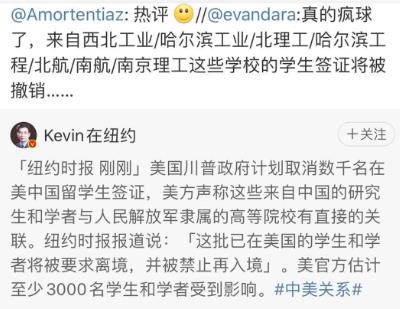
However, it has been reported on the microblog that many schools, including Northwestern Polytechnical University, Harbin Institute of Technology, Beijing Institute of Technology, Harbin Institute of Engineering, Beijing University of Aeronautics and Astronautics, Nanjing University of Aeronautics and Astronautics, and Nanjing University of Science and Technology, have cancelled their visas.
Tuyuan Weibo
In fact, the above points are also the most infuriating part of this restriction. But this is not the first time that the United States has opened up to these "sensitive" professions. For example, many American science and engineering majors are not open to international students (this is not only for Chinese students). These majors involve aviation, man-machine, advanced manufacturing, medicine, military and other fields. Even some majors, even friendly friends, are not open to the outside world. If Chinese want to apply for relevant majors, they must also be Chinese.
Since 2018, the United States has imposed strict restrictions on students applying for these sensitive majors, such as reducing the visa time to one year. Another example is the strict background investigation and visa restrictions for Chinese students. If we want to talk more about the recent events, then at about the same time last year, there was a trade war that caused quite a panic.
It can be seen that this restriction is undoubtedly a disaster for students who are preparing to apply for science and engineering majors in the United States. In particular, students who apply for graduate education or above are facing considerable difficulties.
Therefore, for these students, it is not so realistic to apply for changing majors at present. First of all, it is less than 100 days before this year's application season. Choosing to change majors will have an impact regardless of the size of the professional span. First, compared with art students, GPA, language standardization and documents are the core competition for general students; The document part contains almost all the highlights of your previous academic and social experience. It is not impossible to rebuild a set of documents at this time, but it is relatively difficult.
The second point is to turn to a major with a large span at this time. Take the art study abroad as an example, the focus of the investigation of art majors at the graduate stage is mainly the comprehensive professional quality reflected through the collection of works. It is very different from the undergraduate stage, which pays more attention to creativity. Therefore, it is extremely difficult to completely reverse within three months.
Thirdly, I believe that all international students have roughly thought about their future development direction when they decide to go abroad, and will only choose the current major to apply. At this time, I rashly transferred to a relatively "good application" school. Although the method is feasible, I think it is unacceptable to most international students.
Finally, this restriction is combined with a series of previous restrictions on foreign students and sensitive majors. It is easy to see that after the issuance of this restriction, the background review of international students will only be more strict. Students with limited academic background will face difficulties in a short time.
Then, for general international students, the best way at present may be to try to apply for the same major in other countries. Compared with Britain, Canada, Australia, etc., which are English speaking countries, it is a safer choice.
03. What is the impact on art students abroad?
Based on the previous analysis, we can see that this restriction was issued mainly for "science and engineering students" and academic groups with a certain background of "military" cooperation. It has little impact on art students abroad.
However, here, we also want to give you a preventive shot, because this does not mean that the future will not affect art students. Taking Trump's use of the epidemic to play a series of political games as an example, it is not impossible for Trump to take up "science and engineering" this time and increase efforts to all international student groups in the future.
Although the restriction order was issued this time, Zhao Lijian, spokesman of the diplomatic corps, immediately resented him and shouted for the group of overseas students: "The words are still in our ears. Is the US going to eat them?" "If the U.S. government publicly takes measures that harm the legitimate rights and interests of Chinese students studying in the United States, it will be naked political persecution and racial discrimination, and seriously violate the human rights of Chinese students studying in the United States."
But at this time, we also need to keep extra sober, not blindly follow, not at will. Plan B alternatives are reserved for you. At the same time, it is at this critical moment that we need to have a sense of advance, reject procrastination, and sort out the application planning. If you have any questions, please communicate with the application teacher or professional teacher at the first time to ensure that it is absolutely necessary to adapt to the circumstances.
This year, the application policies and college application plans of various countries will inevitably change a lot, although this restriction does not affect art students. However, this year's application situation is not stable. Just like the previous two days, we encountered the sudden cancellation of 60+majors in Edinburgh, about half of which are related to art and design. At that time, we had speculated that such a policy would not be followed by any colleges and universities.
Therefore, whether art students or major foreign students, they should first ensure that they do not delay, and improve the efficiency of preparing various materials, as well as the quality of application materials. Secondly, reserve at least one month for yourself as the retention period of Plan B. From now on, we can also consider whether there are other countries with similar application conditions as alternatives if we face such uncertainties. Or, when the specialty is restricted, whether it is possible to change the specialty.
The Natural Light team will also follow up the follow-up development of this restriction, as well as the possible future policies for foreign students, and provide escort programs for students at the first time.
There is no way out when mountains and rivers are heavy. As the back strength of foreign art students and the innovator of art education, natural light is willing to provide practical support and care for every decision and idea you make from this moment on. Because we believe that despite the difficulties this year, as the chicken soup said, opportunities and difficulties coexist. Natural light also goes with you.
Recommended articles for more art students studying in the United States:
Summary of the latest announcements of American colleges and universities on the epidemic situation policy of American foreign students
What should American students do during the epidemic? American Edition Guide for International Students of Art
This article belongs to the original article of Natural Light International Art Education Team. Without permission, it cannot be reproduced commercially in any form. If it is found, it must be investigated for legal responsibility.