Will the current Sino US trade war affect the application for art study abroad? In fact, it has been a long time since the policy for international students has been tightened. Since the beginning of last year, it has been constantly emerging. In such a tense atmosphere of overseas application, many parents and students have expressed their concerns and questions: will art students be excessively affected? Is it necessary to persist in applying to American art schools? If we persist now, what will we do if there are any changes in the future? Is it still possible to change your school selection goals? If you need to adjust your portfolio and application documents according to the school, is it still too late? Of course, it is not only the application of colleges and universities, but also the visa issue that worries everyone. Today, Mr. Yu Bochen will talk about these issues respectively.
How will the application for art study be affected by the Sino US trade war?
Academic situation
In the past, when we introduced art design majors in art colleges or comprehensive art universities, We can always see such a description: "Our students come from more than xxx countries in the world, and we welcome students from different cultures, education and professional backgrounds to learn in a cooperative and interdisciplinary manner, so as to better develop self innovation awareness and creativity."
But the recent tense atmosphere, I believe that most people have doubts about this sentence. Can students from different countries and cultural backgrounds really be open and inclusive and have equal learning opportunities in foreign countries? Especially yesterday, Huawei was once again promoted to "hot search", and the reason for this hot search is also related to academia: the world's largest academic organization IEEE (Institute of Electrical and Electronic Engineers) published the following microblog article on its official microblog, It directly mentioned: "Huawei and its employees cannot participate in IEEE activities that are not usually open to the public, including peer review and editing of some publications."
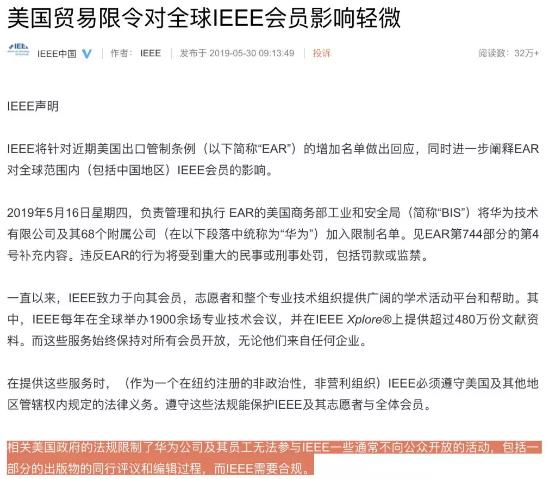
Once the news was revealed, the academic circle caused a big stir for the second time this year, and soon, the Chinese Computer Society also stopped the communication and cooperation with the Communication Society under the IEEE, and it took effect immediately.
Faced with the seemingly increasingly anxious academic changes, I believe many students have become extremely worried. However, a number of high-quality colleges and universities in the United States have been constantly expressing their positions recently - insisting on open, equal and highly respectful education. For example, Yale University, as a comprehensive university with the same outstanding art and design specialty, Yale officially released an open letter on its official website seven days ago to explain its position:
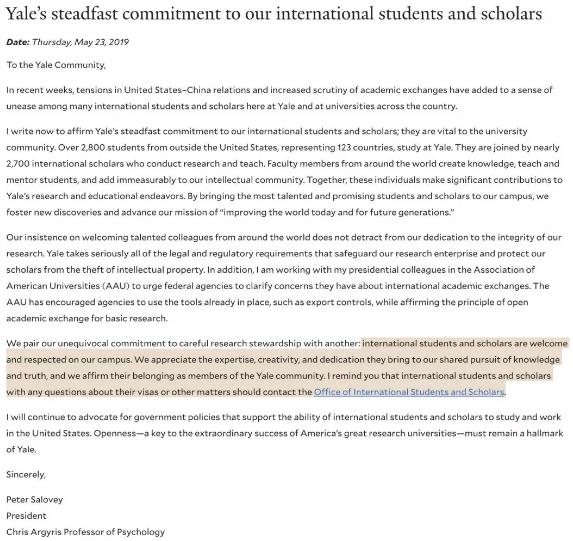
Screenshot from Yale official website
In this open letter, we will see such a "commitment": international students and scholars are welcome and inspected on our camp We appreciate the expertise,creativity,and dedication they bring to our shared pursuit of knowledge and truth,and we affirm their belonging as members of the Yale community. International students and scholars will be respected and welcomed in Yale's campus, because we thank every scholar and student. We study all kinds of majors together, and pursue knowledge and truth through creativity and dedication. We hope to give them a sense of belonging.
Except for Yale Yale University In March this year, Stanford (Stanford University) issued an open letter, which mentioned the issues of intellectual property rights and economic security. At the same time, Stanford also fully expressed its position. They hope to ensure that every student can be treated by the platform, no matter where they come from, with an open attitude and in an academic environment that respects equality.
These most outstanding universities in the United States have stood up to express their firm academic position, which has actually given us some reassurance. At least from the perspective of colleges and universities, they are still very receptive to overseas students. Especially at the moment when Chinese students account for a large proportion of overseas students, Chinese students have occupied a very high proportion in the "international student market" for the United States, even the United Kingdom and several other "hot" countries studying abroad. So in this direction, we can actually not be so panic.
In fact, it is not just the policy change of studying abroad application that affects everyone's mood. Sometimes, we ourselves will become overly frightened and concerned, which leads us to reduce our ability of rational thinking and analysis in front of all kinds of news. So, for the moment, answer the questions I mentioned earlier that everyone is concerned about, and now choose to go American art study Is it a wrong decision? Is it impossible to go? In fact, it is not always true that the United States is still a worthy country for art learning. But before applying, we all need to think clearly about our choices, adjust our mentality, and face with a positive attitude. You can pay attention at any time, but do not over analyze.
Study visa
When it comes to visa, it is also the most important part of studying abroad in the arts. Two days ago, a teacher in our department shared his student's visa question: students went to face to face, and when they were asked about their attitude towards the recent Sino US relations, the students immediately made a more serious answer, saying to the visa officer: Academic has no borders, and should be unrelated to politics, The choice of the United States is to study. In the face of knowledge, economy and politics are not disruptive. The students have maintained a basic rigorous attitude, but the final result is still rejected. In the face of this situation, more than one case has happened recently. Even on the Internet, we can see that many students have shared their similar experiences.
In general, the visa problem does exist and cannot be ignored. After all, visas are directly controlled by government agencies. And for international students, once they encounter visa officers with very, very extreme political positions, visas will indeed become an irresistible factor. As for the visa issue, I recently talked in detail with the teachers of the Natural Light application team, who also gave suggestions:
The first is a very wrong answer:
a. I am going to travel/study. I don't care about political and economic issues. They have nothing to do with me. After I travel/study, I will return home immediately;
b. I have not carefully understood the information in this regard. I do not pay attention to it at ordinary times, so I cannot make specific comments;
This kind of answer seems to be neutral, and it separates itself from the matter. In fact, in the opinion of the visa officer, this kind of answer may be a negative one, and the respondents are not open enough and have no independent thinking consciousness when facing such questions. In front of visa officers, it is actually a negative and sunless practice to "forget" the relationship between themselves and "international issues".
Referential answer forms:
"As for the conflict between the two countries this time, I believe it is only temporary. In the long run, our two countries actually need each other and encourage each other, so we grow up. In fact, we often see American products in our living environment. I believe that there should be many products from China in American life. In fact, the development of free trade is like a topic of discussion, which will inevitably lead to conflicts and frictions. But when we exchange ideas and understand each other, I believe that for the United States and China, we will develop in a better direction. "
Learning costs
Even if it is not art study abroad, we talk about the living expenses and study expenses of the major types of study abroad Art study fees Both are "small and huge sums" that cannot be ignored. However, stimulated by the trade war, the exchange rate has changed greatly.
For example, we can take a look at the recent exchange rate. As of the publishing of the Bochen column, the exchange rate has reached 6.91. What is the concept? That is to say, even if the tuition fees were unchanged last year, the tuition fees for applying to American art schools were also facing an increase of 1.8-3.2w.
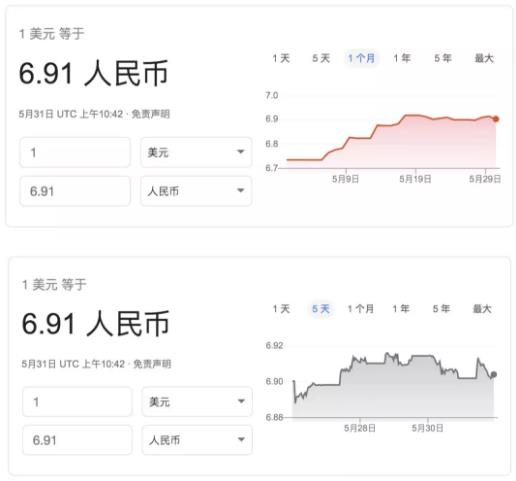
For art students who spend a lot on studying abroad, tuition will become a factor that cannot be ignored when choosing colleges and countries. Secondly, correspondingly, the cost of living will also increase. For some students, the increase in the cost of studying abroad may also become one of the influencing factors.
In general, the Sino US trade war has definitely had an impact on the application of art students, mainly reflected in visas and costs, but so far, the impact is not very huge. If the students still have some questions, they can also come to talk with me about their views.
Natural light shares more topics for you:
Compared with the application for art study in Britain and the United States, it is better to study in the United Kingdom or the United States
The words you must know when applying for art study abroad make you feel comfortable on the official website of foreign art colleges
This article belongs to the original article of Natural Light International Art Education Team. Without permission, it cannot be reproduced commercially in any form. If it is found, it must be investigated for legal responsibility.