Parsons, also known as New York Fashion Art Design School, is what many undergraduate and graduate students want Fashion Fashion Design for Studying Abroad The Department's Dream School, Parsons' innovative concept runs through all aspects of art students, not just freshmen's guide. Parsons hopes to guide undergraduate and master students to view the world in the most creative way. So what did Parsons learn in his first year of college? What's new with Parsons this year? Let's take a look.
Do you remember the preview in early September? Parsons Admissions Officer is going to meet the students in Shanghai, Shenzhen and Beijing. If you want to meet with the Admissions Officer, please come and gather! Amanda, the admissions officer of Parsons, who has 12 years of experience in recruiting students, has gone to three cities in China. Do you have any students who know later? Don't tell me that you only know this news now! It doesn't matter if you don't seize this opportunity. Today's homepage will summarize Amanda's exclusive advice to students!

Amanda
Parsons Admissions Officer with 12 years of admissions experience
12 years of enrollment experience in art design. She received an undergraduate degree in musicals and a minor in film from Columbia College Chicago, and an MBA degree from Argosy University.
Amanda is the most authoritative "expert" in Parsons' school situation, school characteristics, as well as the tendency and detailed requirements of the collection of works. If you want to go to Parson, she will give you the most comprehensive suggestions and tips. Amanda also has a keen sense of smell in the industry for the whole collection of art study abroad in North America 。
What will Parsons do this year?
Amanda: I think Parsons is always expanding and improving to develop new courses; We have just reopened the production center on 12th Street, and we are very excited to provide all these new equipment for students.
Parsons, as the No. 1 art school in the United States and the No. 2 art school in the world, has become the first choice of Dream School for many people because of its strong fashion specialty and resource background. But like the fashion circle that is constantly updating, Parsons seems to be constantly refreshing people's understanding of it. This is just like the definition of it - colleges and universities that exist with "and" as the highlight.
These concepts about innovation do not only exist in the official documents or freshmen guides of the colleges and universities, but are reflected in all aspects of Parsons. Parsons hopes to guide students to view the world in the most creative way, so whether it is teaching content, curriculum, student creation, living arrangements or teaching facilities, Parsons is making efforts to inspire students from all aspects.
What learning content will students encounter in their first year of undergraduate study?
Amanda: In the first year at Parsons, undergraduate students will learn how to expand their ideas. They will learn the basics of design, but they will also learn how to become a real artist. Undergraduate students have a lot of free time to explore different design fields, and they also have a lot of free space to create new things 。
Parsons The first year of undergraduate study is very interesting. Maybe the names of the courses are not interesting, because they are all called similar art studio courses, but the contents of the courses are very interesting, because students have many opportunities to cooperate with different instructors across media. Undergraduate students can choose whether to work with architecture teachers, interior design teachers, or fashion design teachers in the course, So as to determine which professional project is the direction they will choose.
First of all, Parsons pays attention to students' ability of thinking and divergence, but also to the cultivation of students' professional foundation. Therefore, in terms of curriculum, undergraduate students will still learn a lot of basic professional knowledge when they enter the first year. We can clearly see this from Parsons' curriculum:
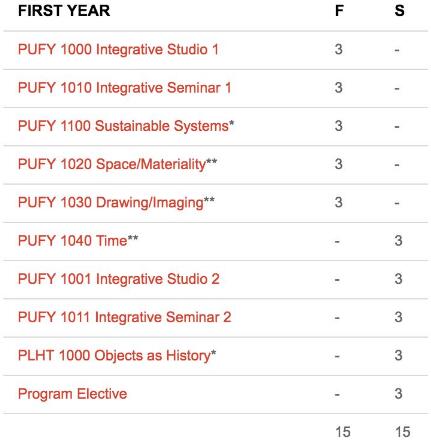
The above four courses are exactly the same. They are from Communication Design/Visual Design, Fashion Design/Fashion Design, Photography/Photography, and Product Design/Product Design. They look almost completely different fields.
In addition to these four majors, the curriculum of Parsons' other majors in the first year of undergraduate stage is the same as the screenshot above, all of which are basic courses. No matter what major you choose to apply for, in the real sense, the study detailed as "major" starts from the second year. And even in the second year, the school will still arrange certain basic courses for students.
These courses are generally carried out by the unit. Undergraduates will follow their tutors to explore the project system during the class, from which they can gain more comprehensive aesthetic and design gains.
For example, the course of Objects as History:
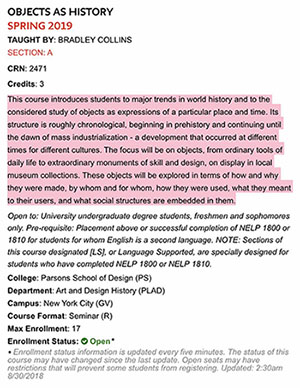
This course seems to be art history, but it is different from the art history we know before. It mainly explains the general trend of world history to students, and studies the development of art and design by limiting the research object to a particular era or place environment, rather than simply explaining the history of art works.
The course covers prehistoric civilization, large-scale industrial manufacturing, etc. The research object is not only limited to artworks, but also includes daily necessities, ordinary tools, modern large machines, and design works with extraordinary manufacturing skills or milestones.

To study the production methods, causes, who makes them, how to use them, and what they mean to users, we will conduct a comprehensive discussion, so as to guide students to have a global awareness and concept of art and history.
Works of Parsons (BFA) undergraduate students
In these courses, undergraduate students will personally explore the history and development of art and design, and get inspiration from them, so as to better understand their future development direction and how to become a designer or artist.
Parsons' cultivation of undergraduate students' innovation awareness is actually, as Amanda said, also reflected in what it is for students. Parsons encourages students to work together with classmates or mentors in other majors to carry out cross professional and cross media cooperation, so that students can also inspire their own professional thinking from other perspectives.
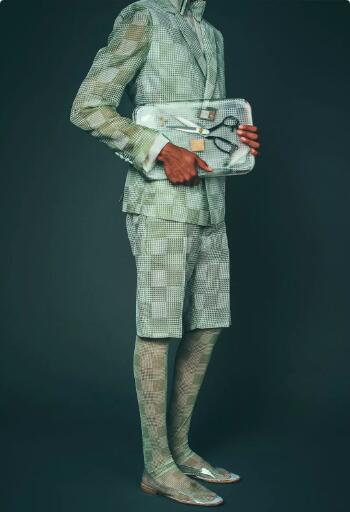
Parsons Undergraduate Works
Parsons Do you have any notes for applying for a portfolio?
Amanda: We are looking for students who are closely connected with their own works. What they think about is not only skills and abilities, but also not just simple concepts, but also how concepts are connected with students. We hope that students can not only have strong skills and strong concepts, but also put forward "why" behind their works
It is never required that a specific content should appear in the work collection, so students actually have a lot of freedom, but this may also be the reason why many students feel nervous. We hope that students can tell us, as an artist, who are they? We hope to see students tell us stories. Therefore, the collection of works does not need to be technical paintings, fashion illustrations, or similar things at all, but it must be those works that are most closely connected with them personally, and tell us who they are through the works.
Focus! Focus! Focus! Suggestions from Parsons Admissions Officer!
In fact, it is not just Parsons. Most art schools do not put forward mandatory requirements on the theme and content of the student works collection project, except that some schools will request to submit some observational paintings in order to investigate the basic ability of students, Most art colleges do not require undergraduate students to create in some form around a certain topic or theme.
For art colleges, students' applications sample reels In particular, for the works of undergraduate students, the inspection points tend to focus more on the students' creative thinking ability and design expression. Many students may have seen some collections of works, which seem to be only about 90% complete, or the performance of the collection project is not very cool, but they have received an offer from a very high-quality art school.
This is actually a Application for art study abroad In particular, many students in China have a biased understanding on this point. Most of the "collections of works" produced by many domestic students during their schooling are based on "dazzle" finished products, but this is not the case in foreign art schools, which tend to pay more attention to students' creative expression and design thinking.
Creative expression and design thinking display, which is what Amanda said, students can play freely in the content and form of works, but students must show their relationship with the works through the works collection, and how they think as an artist/designer.
If these are Amanda's oral content, Parsons' official website publishes official information as follows:
“We encourage you to show experimentation and breadth, and the portfolio does not need to specifically address the major to which you are applying.”
Parsons School doesn't even restrict undergraduate majors. What does that mean? That is to say, for example, if you are applying for a major in fashion design, you can submit architectural works, film and television works in addition to fashion design projects in the works collection. This is what Parsons learned in his first year of undergraduate study. If you want to apply for Parsons, please come to the natural light training portfolio.
Topics with many foreign art schools:
Style of collections of fashion design institutes [Britain_U.S.a.Italia] Analysis of fashion styles of global institutes
Finland Academy of Fine Arts [application_majority_piece] _ What language does Finland Academy of Fine Arts use for undergraduate and master study
European and American art works collection, how to create European and American art works collection? What are the requirements?
This article belongs to the original article of Natural Light International Art Education Team. Without permission, it cannot be reproduced commercially in any form. If it is found, it must be investigated for legal responsibility.