In this special application season this year, affected by the epidemic, many students in Britain and the United States, a traditional art education power, were caught in the dilemma of choosing a country of interest. At the same time, Japan, with its more friendly geographical advantages and enrollment policies, showed its head in the field of art study. Recently, more and more students and parents have asked us about studying in Japan. Indeed, the diversified enrollment system and unique professional settings corresponding to the high-quality teaching level have also cast a mysterious veil on a number of Japanese art colleges. Now, let's recommend some famous Japanese art schools. Which majors are more creative?
Which majors are more creative in famous Japanese art colleges?
Comprehensive design, representative school - Tama University of Fine Arts
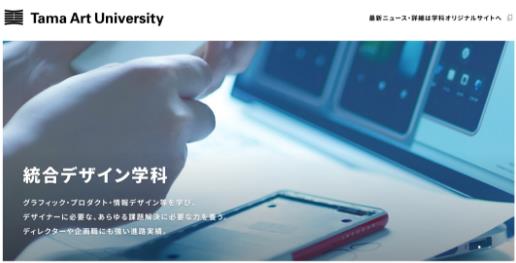
This design major, founded in 2014, is an art major developed by Tama University of Fine Arts in response to the requirements of the times, integrating knowledge in services, manufacturing, advertising, IT, software and other fields, and cultivating comprehensive talents. Its purpose is to "solve problems in a comprehensive way".
In general, the training mode of this major focuses on the business field. Japanese art students will learn graphics, products, information design, etc., and need to master the skills required by designers to solve all the above problems. From the perspective of the employment rate of graduates of this major in Tama University of Fine Arts, its strong ability to adapt to the commercial market has also been better proved.
In the first two semesters of the basic courses of Integrated Design, students will learn the basic knowledge around three design fields: graphics, products and interfaces. By creating various works, students will understand the principles of modeling, as well as the thinking ability to find and solve problems and the professional skills of system design.
In the last two professional courses, all fields are regarded as a whole. The professor guides students to learn and practice integrated design through comprehensive projects, and proposes topics and solutions suitable for society in the form of seminars in the project. In addition, the school will also allow students to freely combine various design disciplines through various elective courses to deepen the different skills required by everyone.
During the course training, in addition to receiving direct guidance from outstanding designers from all over the world or representatives in a certain field, the school will also hold special lectures and workshops for celebrities or entrepreneurs to help students maintain positive contact with the business community.
Information Design, Representative College - Musashino University of Fine Arts

Information design is also what we often call information design. It is one of the most representative innovative disciplines in the field of art education in Japan as well as Musashino University of Fine Arts. Its principle is to break the convention with creativity and realize new ideas with a new theoretical and practical framework.
Musashino University of Fine Arts discusses the design field and its surrounding environment from two aspects: "design behavior" and "information transmission". The discipline believes that the environment and life we live in are based on the aggregation of information, and each part needs to seek appropriate forms to separate and expand.
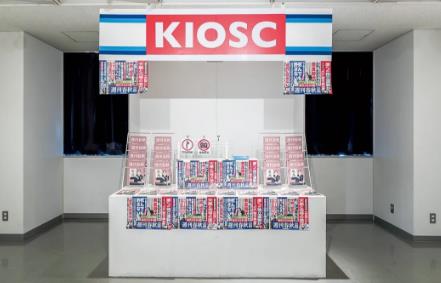
Works of students majoring in information design by: Naho Tanaka Noe
Source: Official website of Musashino University of Fine Arts
Informatization first means liquidation. When designing new combinations, we should pay attention to the possibilities created by existing frameworks such as industry, politics and disciplines, and use creativity to promote the whole process of task setting, research and analysis, design and planning. From this point of view, colleges and universities find new ways to reorganize our life and social environment through new expressions.
In this discipline, considering the tradition of art education, Musashino will train students to freely use "knowledge in the field of design as a general technology", combine comprehensive modeling ability with the academic fields of technology, media and social science, with the goal of developing innovative and capable new talents.
The School of Information Design hopes to train students to reconsider the behavior of "design" and establish a method for designers living in the new era. In the first two years, it will study the essence of design work through a large number of basic lectures and theoretical exercises.

Works of students majoring in information design by: Miyazaki Ayumi
Source: School official website
From the second year, the course will be carried out in the form of seminars, and the corresponding course tasks will be arranged around each topic. In addition, this year, students will carry out project practice together with professors from overseas and students of other majors in international projects. In the last year, the focus of the discipline was the creation and practice of graduation works.
Art therapy, representative college - Women's University of Fine Arts
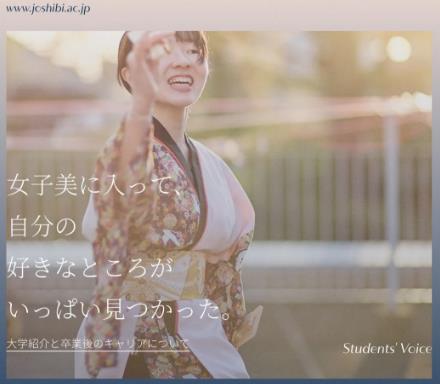
First of all, the Women's University of Fine Arts is Japan's first art education institution of higher learning for women. Founded in 1900, it has trained many outstanding female art talents for Japan and opened up many innovative disciplines. It is worth mentioning that the visual design specialty of Women's University of Fine Arts is at the top level of Japanese universities, so the official website design is also very artistic.
The field of art therapy is currently a popular new discipline. In addition to the Japanese national environment's emphasis on mental health, the Women's University of Fine Arts has developed a systematic training program for art therapy in response to the psychological problems arising in the current society. The purpose of this postgraduate discipline is to create a relaxed environment with art and design skills, So that people's spirit can rest and pressure can be relieved.
In the college curriculum, the relationship between space and society will be explored by studying the theme of psychological rehabilitation in modern society from the field of art design. Heal people's psychology through thinking and using creation and theory, and guide the patients to discover new things through social interaction.
In addition, the school uses the experiential learning environment covered in various social fields to help students strengthen the communication between individuals and groups, and explore ways to improve various problems in society from practice.
Through a series of learning courses, students will design various public spaces and daily living environments, including medical space, welfare facilities, psychological comfort room, etc., and provide a series of visual communication design Product design study abroad Multiple knowledge in the field.
At the same time, the teaching team of the school will also focus on the research theme of students, and will use medical research as an auxiliary tool to help students promote theoretical research based on color psychology and other aspects of research. Let the functionality of art be maximized in today's society, and also train students to build a dual comprehensive ability of psychology and art skills, and become indispensable talents.
Today, we recommend some innovative and promising majors from well-known Japanese art schools, which are also intended to help you broaden your thinking and find the direction that best matches your ideal. In response to your call, Natural Light will also launch services related to studying Japanese art. If you want to know more, please come to Natural Light for free consultation.
More articles recommended by famous Japanese art schools:
What are some good universities for Japanese students to choose from?
How much is the tuition for the friars of Tama University of Fine Arts in Japan?
This article belongs to the original article of Natural Light International Art Education Team. Without permission, it cannot be reproduced commercially in any form. If it is found, it must be investigated for legal responsibility.