Today, Natural Light is going to introduce to you the student pool of Natural Light 2020, who applied for studying in the United States for zero foundation illustration design. In four months, he won eight Grand Slam offers, and all the eight schools he applied for got offers: SVA, MICA, ACCD, Pratt, SCAD, FIT, MCAD, CCA. Ms. Chi gave up her "iron rice bowl" of clinical medicine and faced her hobbies and talents with a more sincere attitude. When she made such a decision, she was destined to start a highly "autonomous" life. Now, Natural Light will share with you her illustrations collection creation, zero foundation study abroad application experience, and SVA learning and life experience from an exclusive perspective.
"You have a future!" Until now, when I was very depressed and helpless at school, I would always remember the words of Yu and cheer up. This sentence is very simple, but it took me through every period of time or tangled, or sad, or painful--- Natural light Student of 2020 Chi
Experience sharing of zero basis illustration design application for studying abroad:
Put aside clinical medicine and face your hobbies and talents with a more sincere attitude
I have always liked painting since I was a child. I have always been a propaganda member in my class from primary school to high school. Because there is prejudice against art candidates in China, I didn't follow the path of art students. I am a science student. I was admitted to a 211 university in Guangzhou to study clinical medicine.
This major may be the "iron rice bowl" in the eyes of many people, but after studying for a year and a half, I thought carefully that I could not be a doctor all my life. I want to face my hobbies and talents more sincerely and decide to choose the profession of my life. After a long time of consideration, I chose the profession of illustration that is most relevant to painting.
So I chose to come to natural light in July of 19 years to officially start my art career. I am basically studying abroad for zero foundation illustration design, but the preparation of the collection of works is only about three or four months. I first prepared for the TOEFL for two months, and after passing the exam in September, I began to concentrate on preparing my portfolio. A little reminder: It is recommended that when you apply for school, you must take the language test early, otherwise you will be very anxious in the later stage of the collection preparation.
I think when I prepare my portfolio in China, I must mention my portfolio teacher, Yu. Although I haven't systematically studied painting before, Yu hasn't "taught" much about the basics and techniques. Because I don't need to be framed by the stereotype of basic techniques, I will create more freely and more relaxed.
Teacher Yu will give me a lot of targeted help, such as enlightenment, software learning, and even psychological guidance. I remember that at that time, I was very anxious and self-confident because I couldn't draw well and I was in a hurry. I often cried. Teacher Yu once firmly said to me, "You have a future!" Until now, when I am very depressed and helpless at school, I will remember this sentence from my teacher and cheer up. This sentence is very simple, but it took me through every period of time or tangled, or sad, or painful. He is like a "big brother" who can talk about everything, and a mature and reliable "old father".
I think it is the teaching of natural light and the encouragement and support of Yu that give me more "choices" in my application. I got offers from eight schools I applied for at that time: SVA, MICA, ACCD, Pratt, SCAD, FIT, MCAD, CCA. Later, I chose SVA after many communications with Yu, the educational administration teacher, and the applicant teacher, as well as my own consideration. There are two main reasons: First, the geographical location and atmosphere of New York are very suitable for learning art. The most top and avant-garde artists are basically concentrated in New York, where you can have the self-confidence of "becoming anyone". There are many big exhibitions in New York, and the New York Art Book Fair and MoCCA Art Book Fair are the events I look forward to most. Second, SVA has a very diverse and inclusive style. No matter what direction you want to develop, you can use SVA New York Institute of Visual Arts Find the professor who matches you.
I have always missed the days in natural light, so every year when I go back to China, I have to visit natural light first. This place is really full of my memories. I like to stay in the studio with my classmates, draw together, take away at the beginning, and sometimes get together to watch interesting movies and cartoons.
I still remember that in the late stage of the collection preparation, everyone would sleep in the studio. I bought a bean bag sofa, and students would take turns to sleep on my sofa, waiting for the cleaning aunt to clean up at four in the morning. At that time, the students led by Yu, who we called "old father", could "harass" him at any time and anywhere. He would always respond to any questions about his work collection and profession, and would often stay overnight with us. At Christmas, the studio held a Christmas party. The teacher bought colored paper and decorated the Christmas tree. We ate, drank, listened to the teacher's gossip, wrote greeting cards, played games and decorated the Christmas tree. This experience is wonderful for me.
I still have a deep memory of my experience in natural light at that time, and I am grateful for the reason that it really helped me. Yu has helped me a lot in learning methods, thinking patterns and creative logic. My foundation was not very good at that time. Teacher Yu told me: Don't get so tangled with the foundation. I can draw things that are not realistic. As long as I express them sincerely, I can make my creation "self consistent". When I was wavering in style, Yu told me to stick to one style and one backbone, add and subtract things constantly, and do experiments and trial and error on the basis of the backbone.
Because I am basically a zero basis illustration design student. I have been painting since I was young, but I haven't taken any painting classes. The preparation time was tight, so the basic courses were not arranged. Teacher Yu first took me to a style exploration class. During this period, we did a lot of exercises in different styles and media. After finding a direction for further development, we started the creation of the first project. During this period, I also practiced the depiction of materials, light and shadow in basic sketches.
In the second project, I made a self portrait in the form of oil painting. During this period, I practiced and explored comprehensive materials (oil painting, toner, color lead, watercolor, collage); The third project has done ceramic sculpture and new media materials (electronics, light); The fourth project is the combination of art books and screen printing prints. In this process, I learned software typesetting, manual binding and screen printing.
The curriculum is very multifaceted and diversified, not only in illustration, but also beyond illustration, involving graphic design, book making, sculpture and pure art. Therefore, my collection of works is also "diversified" and "interdisciplinary". I have done a total of six projects - including basic sketch, oil painting, illustration projects, sculpture, art books, and so on. The collection of works starts from illustration, but goes beyond illustration.
Later, when I entered SVA, I found that the teaching style and teaching here were very similar to the natural light. SVA is also a school that emphasizes "expressing yourself" rather than foundation, so our style is very unrestricted. We will pay more attention to exploring our own inspiration sources and expression methods.
Self taught typesetting and binding, SVA bears the first independent book in my life
In SVA, I think the most special thing is that it is located in New York.
It is very important to learn art, watch and experience. And New York can really satisfy the viewing of art to a large extent. For example, the professor will arrange you to go to The Met or MoMA after class to see the original works of art mentioned in the art history class that day. The size and details of the original works will be different from the pictures you see in the book from every angle, and you will have a unique and deeper experience.
In addition, SVA does not have a campus. Every day after class, you will have the illusion of going to work and leaving work. Looking at busy New Yorkers, you dare not be lazy. We often have humanities classes in the west campus in the morning and go to the studio across Manhattan in the afternoon.
Moreover, I like the SVA library very much. It has only one floor, but although Sparrow is small and dirty, we have not only all kinds of art books and reference materials, but also DVDs and games that can be borrowed. The latest magazines will also be updated in the magazine shelf area.
The most interesting thing is that Milton Glaser, the founder of our school and also a very powerful designer, has set up a studio and collection area, where there are original posters created by Push Pin Studio since 1950s.
The curriculum of SVA is as attractive as this school. In my freshman year, I took a course of Mini Comic and Risograph in the School of Continuing Education (i.e., people outside the school can also sign up for classes).
I would like to introduce the teacher of this course. He is Patrick Crotty, the boss of the Swiss publishing house PEOW, which I liked very much before I went to college. He is first a cartonian and illustrator, at the same time, a very experienced publisher, and also a very mature lithograph artist.
In class, he will share with us how to draw cartoons, how to tell stories, how to let more people see your works, and also taught risgraph printing. The students in the class are basically already working designers, illustrators, or other industries.
Finally, everyone made a comic book of more than 20 pages and printed it with riso. Finally, it was sold or exchanged at a small fair held by risolab at school. I loved and enjoyed the atmosphere very much.
Since that class, I have started to do my own independent publishing. I will treat each assignment as a real publication project and improve every detail, from the overall completion of the work to the signature on the back cover of the book and the marking of the number of copies printed. I will also participate in the coming fair organized by the school to sell my works. This summer, I also participated in the abc Beijing Art Book Fair as an exhibitor, and I am also applying for the New York Art Book Fair for 19 years.
It makes me feel very happy, happy and worthwhile to exchange my works with the people I met at the book fair and to be understood and appreciated by the audience. I think this course has brought me a lot of new knowledge, and also brought me a lot of inspiration for my later creation.
Here I want to add another thing that I think SVA is very attractive to me. That is, there are many "opportunities" for you to "expose" yourself and your ideas in various ways, and you can always get a lot of sincere feedback and suggestions.
SVA will provide many opportunities for illustration students to "expose" their works, and will organize students to participate in various competitions at the beginning of sophomore year; In the junior year, industry professionals will be invited to visit the exhibition for exchange. If it goes well, you can get many opportunities to invite contributions; In senior year, there is also a portfolio review. I think these competitions and exhibition opportunities provided by SVA are very helpful for becoming a mature commercial illustrator.
Because I like books very much, I have also made a lot of books in SVA, and I can share three of them with you:
The first one is a comic book about Margaret that I made at SVA. According to his letters and diary, I constructed four short cartoons of surreal stream of consciousness and printed them with the school's risgraph machine.
The second one is my sophomore cartoon class project. The professor will give a very interesting topic in each class, and this book is also completed in these topics, including five comics in total. Today, I would like to share with you two of the most interesting ones: the first one is that the whole class writes words together, extracts words from each other, and creates a cartoon without logic; The second is to build a game and create a cartoon. Finally, the process of reading the cartoon is like playing a game.
The third book is the creation of Pac man Confusion, the first comic book I made in the principle of illustration class after my sophomore year. My Professor Principle is Henrik Drescher. He is more like a pure artist than an illustrator. In my opinion, he is a very good example of combining commercial illustration with pure art. His paintings are often incomprehensible, but he is very purposely accurate in conveying information.
In his class, he will pay great attention to the cultivation of our experimental creation. The first homework takes "shut up" as the theme, requiring more than 16 pages of books, without any text, and the content of the book should be related to shut up, similar to the form of creating silent films, to accurately convey the meaning you want to express through the screen.
I made a book about a little boy who was bullied on campus and hid in a Pac Man game in order to escape from reality. The bullied people are "shut up", and the situation of the dot you control in the Pac Man game is the same as that of the little boy: you can fight back against the imps by eating the energy beans, but you can never eliminate them, just like the isolated and bullied children.
The creation time of this project is only three weeks. In three weeks, all the ideas, creations, typesetting, printing and binding are completed by themselves. I had never learned InDesign before. I learned typesetting and printing Booklet by myself and stayed in the Print Lab of the school all day until 11:00 p.m.
The Assistant in the Lab has also helped me a lot, which is actually one of the reasons why I particularly like SVA, the atmosphere of students helping each other in SVA. Returning to this book, I finally bound it myself with needle and thread. This experience has opened the way for me to "learn by myself". In fact, professors in universities really can't teach you everything. They are more interested in learning how to do their own research and self-study. In the process of self-study, they learn more and more deeply than those who passively accept teachers' professors.
One thing I want to share with you is that SVA will invite artists to the school every now and then to set up a newsletter, and will release information through email and the daily school newspaper. If you are ready to enter SVA now, you can pay more attention to your email.
Sometimes professors will take us to their studio visiting and home. In some classes, professors will also invite guests to share. For example, Sara, one of my teachers who took Photocopy Zines as an elective course this year, will make editions with her husband and participate in various book fairs. In the class, she invited an artist (also a Chinese overseas student) who met at MoCCA Art Book Fair to introduce a lot of Riso printing and work experience in New York, which helped us a lot.
Every class is a "surprise", and there will always be endless gains and growth
What we can share with you next should be something that everyone will care about - SVA specific courses, as well as some learning experiences. Let me introduce the structure of the course:
• Foundation Year
Courses include Painting, Drawing, Sculpture, Visual Computing, and Writing and Literature. The time spent in each class of freshmen is basically the same and can be divided equally.
The courses at this stage will be divided into dozens of packed schedules according to the "BLOCK" according to different majors. Each BLOCK includes the same courses (Painting, Drawing, Sculpture, Visual Computing and Writing), but the teaching of each class will be different.
Students of four majors, namely, Illumination, Design, Fine Art and Cartooning, will be in the General Foundation Block. If you feel dissatisfied with the teacher of a certain class after the class starts, you can go to Academic Advisor to get an application form to change classes within two weeks of the class. For example, I changed four classes at that time.
• As a sophomore, I started to study in the major of illustration, supplemented by two elective courses of Technique: Principle of Illustration (the main course of illustration, I can do various illustration projects, which will be different according to different directions of professors), Western Civilisation (humanities, western history), Drawing (sketch/sketch), History of Illustrations( Illustrator takes a Technique course in one semester.
I think the courses of this year will be more "fun" because they start to be professional. I think the best class to play is Storytelling. The professor is Gary Panter, a very famous American cartoonist and artist.
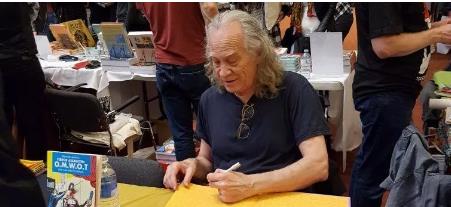
Cartoonist and artist Gary Panter, from Google
His homework is basically a week of black and white cartoons, which require drawing with G pen and ink. The two black and white works I shared with you earlier were completed in his class. Each homework topic is very indie and experimental, guiding us how to "play comic".
One assignment was in the form of a word drawing game. Each student wrote six words in turn according to the sentence pattern of "(noun) - (verb) - to the (noun) - and found a (noun) - which - (verb) - the (noun.)", and then the whole class randomly selected them in order to form a sentence.
The sentence I got is "Moon jumped to the Hollywood and found a glove which act as an act". There is no logic in the meaning, but in fact, the syntax of the sentence is logical, not just picking out a few words, but building a picture in its own logic. It is this unusual combination that allows you to think outside of your normal way and make Wulitou a narrative cartoon.
Another impressive assignment was that Gary asked us to eavesdrop on other people's conversations anywhere in New York, and then re create a cartoon based on each other. It is better not to simply record, but to create your own characters, your own world, and then put the dialogue on the characters.
I went to MoMA to listen to the audience talking about Rene Magritte. Some students went to Starbucks, Union Square and the station. In fact, it is difficult for you to fully capture the complete dialogue, which on the contrary widens the space of imagination. I still remember that there was a Chinese student whose English was not very good at that time. Her homework drew a very abstract cartoon called "Unacceptable". The teacher also liked it because it was an honest creation.
Second, sophomore students spend the most time in Principle class, because unlike freshmen who can draw some basic paintings, they don't need to think too much about oil paintings and sketches. The creation of illustration requires a lot of thinking, and it takes about a week to conceive and draft. My professor is also a very pushy person, and usually needs to do a project in three weeks, Often make a ten page picture book or comic book for jumping.
• There are only two compulsory courses for junior students: Oriental Problems and Culture Survey.
The Oriental Illustrations, also known as Thesis, is a Thesis project initiated by Thomas Woodruff, the dean of the department. People of all grades will spend their junior year in college to create a series of illustrations based on the book lists and films he provides. The dean of all works will conduct a critique, and finally there will be a Thesis show. The dean of the department will decide whether they can participate in the exhibition.
Because there is no graduation exhibition in the SVA Department of Illustration, the junior's thesis show is actually the only opportunity to carry out, so it is also the most important course. Culture Survey is a research course for Thesis. The rest of each semester can choose three elective courses.
• Senior Porfolio is the only required course of senior year, that is, making a collection of works. The remaining credits can be taken in any course. From the perspective of course selection, SVA really has a high degree of freedom.
I know many students have heard that SVA is the art school with the highest employment rate in the United States, so many students have chosen SVA. But in fact, it is difficult to talk about "employment rate" in illustration homework, and the more successful ones are freelancers. But SVA does provide many opportunities for students to increase their exposure.
For example, our junior Thesis Show will have Art Directors and publishers in the industry, who can get the opportunity to invite contributions through communication with them. For another example, at the beginning of sophomore year, the school will organize everyone to participate in the Student Competition held by the Society of Illustrators, which was founded in 1900 and is the largest and most authoritative illustrator association.
If the works are selected, there will be prizes and exhibition opportunities in SOI Museum, as well as many Art Directors, professional illustrators and artists. SVA does not have a complete set of facilities, but there will be a Portfolio Review in senior year. The venue is in a hotel, and the student union has its own booth to display the collection of works like a stall. The school will invite various professionals to evaluate your work. If they appreciate your work, they will directly provide an opportunity to invite contributions. The artistic atmosphere of New York welcomes young artists, who have no sense of class.
I have some "immature" suggestions for your application and future
First, in the application Portfolio training Stage, we must learn English well! There will be a language exam after enrollment, which will affect the future course selection. If you have not passed the exam, you may not be able to choose some very interesting humanities courses, or you may delay graduation.
After school, almost every class should be presented in front of professors and classmates to explain what your works want to express and convey your thoughts to the audience. In addition, in terms of communication with professors, if you want to get more targeted advice, be able to speak clearly what you want to express, and the difficulties encountered in creation, you need to have a good English ability.
Secondly, we must be independent and able to take care of ourselves in life. After going abroad, I have to rent a house, cook and study by myself. No parents will help me again. When I first arrived in New York, I really didn't adapt to it. First of all, renting a house was very complicated. I had to contact the building and set up a water and electricity network myself. If I didn't pay for the house, the water and electricity would be cut off. If I didn't clean up the house, the whole house would be messy and smelly.
In addition, I recommend that you must live in a house near the school. When I was a sophomore, I moved to Brooklyn, where I had to go to school by subway. It was a very painful year. Unlike China, the subway in New York is very old and backward. It often stops at weekends, or changes its route. When catching Final, it is busy and has to go to school all the time. It takes time and money to take a taxi. Another thing is that if you can learn more dishes, it is very expensive to eat in New York. Cooking by yourself will be very happy, and it is also a way to relax.
Finally, I would like to say to the students of zero basis illustration design studying in SVA's illustration major in the United States that when preparing the collection of works, you should not be limited to illustration, but also make sculptures and art books, so that the admissions officers can see that your development direction is rich and diversified, so that they will consider you more. Finally, I wish all the students who study in natural light can get their ideal offers!
Natural light shares more topics for you:
Illustration design recommended by top 3 universities in the United States
British illustration design study abroad, recommended by British illustration art colleges
This article belongs to the original article of Natural Light International Art Education Team. Without permission, it cannot be reproduced commercially in any form. If it is found, it must be investigated for legal responsibility.