Interactive design overseas works collection training, art overseas interactive design is a kind of technology that makes products easy to use, effective and pleasant, and makes users feel comfortable using it. Therefore, from the perspective of interaction design art itself, it is a very applied practical discipline, which includes both "design" (art), technology, psychology, cognitive science and social science. As a major or a subdivisional discipline, "interaction design" originated in the United States. As far as its application is concerned, it is also a pioneer in the United States. The simplest example is Apple's interaction system. Different from the traditional design discipline, the interaction design overseas work collection pays more attention to the connotation. The art overseas interaction design focuses on the behavior and way of planning and describing things, and then describes and conveys the most effective form of expression of this behavior.
Interaction design perfectly combines the theory, technology and traditional technology of engineering discipline. It is not a simple superposition of parts, but a unique combination of methods and practice. When consumers use various software, websites, and consumer products, they are interacting. The feeling in the use process is called interactive experience. The development of the network and various new technologies has led to more and more new products and more interactive ways. People's experience of interaction is becoming more and more important. Where is the best place to study interactive design? Which institution is good for British and American graduate students to apply for interactive design?
Product interaction has also gone through several stages of development. Up to now, product interaction has been promoted to a high level, and many time tested laws have been formed in the field. Alan Cooper, the father of interaction design, has a famous saying "Unless there is a better choice, standards will be followed." Before there is a better solution, Why don't you come with Natural Light Art to see what are the recognized standards in the field of interaction design?
No.1 Fitts' Law

Law content :
The time required to move from a starting position to a final target is determined by two parameters. The distance to the target (D) and the size of the target (W) can be expressed by a mathematical formula: T=a+b log2 (1+D/W).
T: Average time of action;
a: Represents the start/end time of the device; b: Speed (slope) of the device itself; D: Distance from the starting position to the target center; W: The width of the target area in the motion dimension. The inspiration of Fitz's law in design is that the time required for user operation can be controlled by the size and position of the operation button. The content that needs to be highlighted can be highlighted by setting large buttons.
In addition, the iOS human-computer interaction guide also stipulates that the minimum click hot zone is 44 * 44, which is to ensure that every click can get effective feedback and prevent the operation hot zone from being too small, which makes it difficult to click.
In the design specifications of iOS, some operations are deliberately placed in the dead corner of operations to extend the time of user operations and prevent users from making mistakes. For example, on the mobile terminal, the control to be operated is placed on the right side of the navigation bar, and the cancel and delete buttons in the pop-up window are located on the left side of the pop-up window, increasing the moving distance of user operations, so as to extend the user's operating time, Reduce the possibility of user misoperation.
No.2 Hick's Law
Law content: The more choices a person faces (n), the longer it takes to make a decision (T). It can be expressed as reaction time T=a+b log2 (n) by mathematical formula.
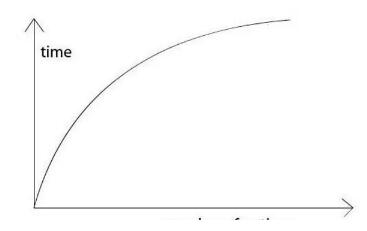
T: Time required to make a decision;
a: Total time unrelated to decision making (pre cognition and observation time); b: Processing time based on the cognition of options (the constant derived from experience is about 0.155s for people);
n: The number of choices faced. The content of Hick's Law shows that when the options are increased, the time we spend making decisions is increasing. For example, when there is only one button, the user can operate directly. When there are two buttons, the user will have a certain amount of thinking time.
Hick's Law enlightens us that when designing, we need to reduce the number of options to reduce the time spent by users in making decisions, but at the same time, we should reasonably control the breadth and depth of the product structure, because every additional option means that the cost of users' choices will increase, If the breadth is too wide, users will spend more time browsing and comparing options. For example, there are two menus. Each menu has one menu with five items and one menu with ten items. When the user makes a choice from them, which one needs shorter decision time? While reasonably reducing options, options can also be grouped in the same category and distributed at multiple levels to improve the efficiency of user decisions.
No.3 7 ± 2 rule

In 1956, George Miller conducted a quantitative study on short-term memory ability. He found that in short-term memory, the width of human memory is about 7 ± 2 units. When it exceeds this unit, human brain will start to make mistakes, which is the so-called 7 ± 2 rule.
In daily life, we will remember the mobile phone number and ID card number by dividing the numbers, and then organize them together. When the fragmentary information is in the range of 7 ± 2, human memory is in the best state.
For example, in the design of mobile terminals, the number of tag columns is generally up to 5. When filling in forms and organizing some information, the information is divided into blocks or steps, so that users can clearly remember the contents of each module, and then combine the information together.
No.4 Approach Law
The law of proximity is one of the Gestalt principles. There are other principles in the Gestalt principle, such as similarity principle, continuity principle, closure principle, symmetry principle, subject/background principle, common destiny principle, etc.
Proximity rule representation When objects are too close, consciousness will think they are related. In interaction design, a submit button will be next to a text box, so when the function blocks close to each other are irrelevant, it indicates that there may be a problem in interaction design.
No.5 Tesler's Law
Law of conservation of complexity was proposed by Larry Tesler in 1984, also known as Tesler's Law. The law of conservation of complexity points out that every application has its inherent complexity that cannot be simplified. Whether in product development or in the interaction between users and products, this inherent complexity cannot be removed according to our wishes, and we can only try to adjust and balance it.

There is a similar point of view in Pareto Optimality, that is, when a critical point is exceeded, the system will not be able to continue to optimize, and continuing to optimize a certain aspect will inevitably lead to other problems of the whole system. If there are no other problems, either the whole system is not optimized, or the boundary of the system has not been clearly defined. According to Tessler's Law, every process has its inherent complexity. When optimization reaches a critical point, it can no longer be optimized or simplified. Instead, it can only transfer the inherent complexity from one place to another. Take WeChat Shake Shake as an example. Shake Shake has been very simple. Can you continue to optimize the user's use process? Maybe, but will it bring new problems to technology or other aspects? If there is a new problem, or if the cost of solving the problem increases exponentially, it is necessary to make a reasonable trade-off between the user experience and the cost performance of solving the problem.
As Study abroad in art Of course, in addition to good professional and academic background, the interaction design portfolio is an important competitive condition for the interaction design students who are one of the design majors to study abroad. How to provide a work that impresses the admissions committee is the most difficult problem for art applicants to study abroad. At the same time, the interactive design works focus on the design of some websites, program design and selection of some art forms, and pay attention to the mutual cooperation of key points and aspects, which will add luster to your works.
Ranking of American Interaction Design Universities
This article belongs to the original article of Natural Light International Art Education Team. Without permission, it cannot be reproduced commercially in any form. If it is found, it must be investigated for legal responsibility.