University College London's application rate for art therapy in China under the newly established UCL School of Creative and Cultural Industries last year reached 30%. UCL Art Healing also has very loose restrictions on the subject background. From psychology, medicine/biomedicine, nursing to social science and art, medical, science and engineering, arts and art students can apply!
It is the Creative Health major that has just enrolled for two years! In the newly established UCL College of Creative and Cultural Industries last year, there is such a major: in 2022, only 85 people will apply, with a total admission rate of 61%, of which the success rate of Chinese students' applications is 30%, which can be called a "leak detection major" with a small but hard core.
How can Health be creative? In fact, University College London UCL is also catching up with the emerging trend of art healing for several years. There are more treasure colleges and universities, which are far ahead of UCL!
Project Introduction
Creative Health MASc will train a new generation of scholars and practitioners involved in society to meet the changing needs of the health, social care and voluntary third sector, where personalized care, attention to health inequality and patient experience will become the mainstream of public health. This program is the first of its kind in the world in terms of qualification (Master of Arts and Sciences) and academic research (Creative Health).
The plan aims to meet the growing national and international interest in the growing field of creative health. It does this by examining different aspects of the field, including the arts, culture and nature of health, health equity, life experience and community assets. Provide the first master's degree in "Arts and Sciences", focusing on arts and health sciences.
Application requirements
-Personal Statement
-2 letters of recommendation
-IELTS 7.5, single item 7/TOEFL 109, reading 27, speaking 23, dictation 30
-The minimum weighted average score of all bachelor's degrees outside the list recognized by the Ministry of Education of China is 90%
-Candidates with experience in art/culture/nature and health, social prescription or other aspects of health and social care are particularly encouraged to apply
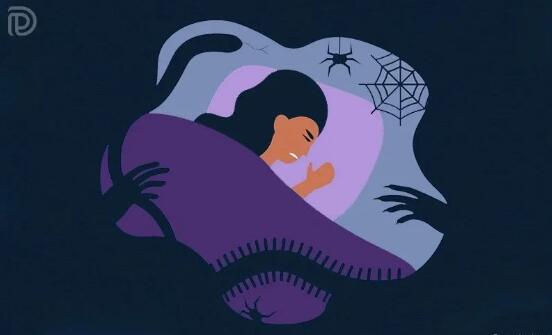
Why learn art healing?
Artistic healing may sound a little new, but at the moment when life and death are involved, the word "healing" should be familiar to everyone. Some time ago, online celebrity bully cats committed fraud under the banner of psychological healing, and countless believers with considerable educational background and social status lost their money in pursuit of inner peace.
This also shows from the side that there is a huge void of demand for psychological therapy in society, and there is a lack of corresponding high-quality talents to fill it.
In 2019, the World Health Organization released a 146 page report, which combines a large number of research results in Europe and other regions of the world in the past two decades, and believes that art has an all-round positive role in people's physical and mental health, and this role applies to all ages.
Artistic healing is different from divination, spirituality and so on in the market. Its essence is a humanized therapy with companionship and help as the main doctor-patient relationship, which has a profound scientific foundation. Art healing is not pure art, its purpose is not to create a masterpiece, but more about the creative process and the ideas and feelings generated when creating art.
If you only understand art therapy as an aid to traditional therapy, you are totally wrong. Research has found that traumatic events can affect key areas of the brain, especially speech and language control centers. It is often difficult for patients to find words to describe the vivid images that flash back in their minds.
These invasive thinking, flashbacks, nightmares, and cognitive and emotional changes cause patients to remain highly alert, angry, and afraid. Taking art as a metaphor and self-expression mode, patients can use colors, textures, patterns and shapes to symbolize their internalized specific feelings and create an emotional vocabulary that does not rely on language.
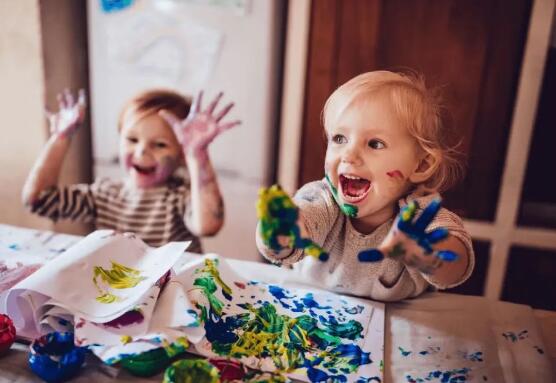
It is in this sense that art healing helps people express their pain that is difficult to convey with words. Art healing activities may be directed specifically, such as "please draw a safe space in your heart"; It may also be very relaxed and gentle, such as directly picking up materials to create, and then discussing ideas with the therapist. Painting, sculpture, ceramics and clay molding are common forms of art healing activities abroad.
By transforming invisible wounds into tangible objects, patients with post-traumatic stress disorder, addiction, dementia, cancer, Parkinson's disease and other nervous system diseases, as well as those with anxiety disorder, can get some catharsis and empowerment.
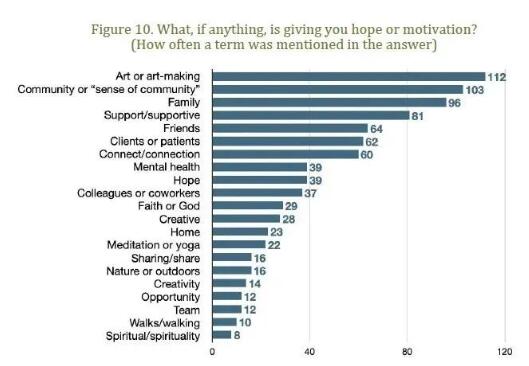
The American Art Therapy Association released a report: "What gives you hope or motivation (during the epidemic)?", in which "art or artistic creation" is the answer with the highest frequency.
Art healing is applicable to those patients who cannot express themselves, and also to those patients who think too much. It is not easy to talk about or write about the pain even if you have sound expression ability. Susan Sontag published the Metaphor of Disease after her diagnosis of cancer, pointing out that various narratives about disease strongly shaped individual cognition, but made the disease itself difficult to see.
Susan Sontag's Metaphor of Disease: Art therapy is to guide patients to bypass language and express their feelings with art, so as to inspire them to obtain release and enlightenment.
Study abroad in dance design: what do you study in stage art?
This article belongs to the original article of Natural Light International Art Education Team. Without permission, it cannot be reproduced commercially in any form. If it is found, it must be investigated for legal responsibility.